Opinion
CALL TO SERVE
Security isn’t someone else’s job


 Add EJP on Google
In Short
This Veterans Day, many of the Americans we thank for their service are still standing watch. The rest of us should join them.
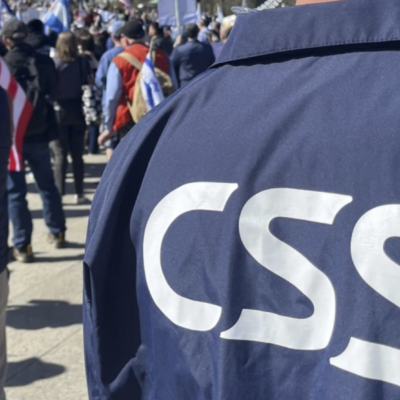
On any given night in New York, Ross, a former U.S. Marine, might stand at the door of a Jewish community event, watching the street and safeguarding his friends and relatives inside. Every Saturday, many more members of the Jewish War Veterans of the USA, the oldest active veterans service organization in the country, stand guard at their own synagogues as volunteers with the Community Security Service.
Since the U.S. draft ended in 1973, fewer and fewer Americans have come to know what service is like. In 1980, about 18% of U.S. adults had served. By 2022, that number had fallen to just 6%, and today less than 1% of Americans are on active duty. As military service became concentrated in fewer hands, too many Americans began treating safety as a commodity to be consumed rather than a responsibility to be shared.
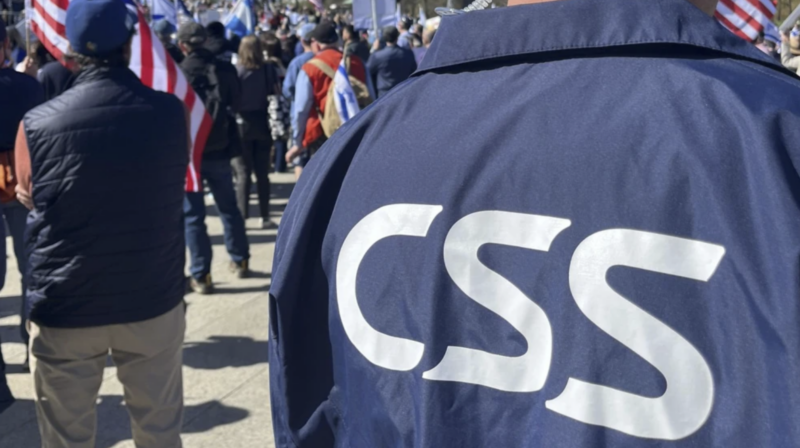
Courtesy
A member of the Community Security Service standing watch at a public event in an undated photo.
With antisemitic threats rising, however, Jewish veterans are leading the charge to bring that ethos back to our neighborhoods. They are reminding the rest of us that protecting our community is a duty that belongs to everyone.
One of us, Richard, grew up in Amsterdam before moving to the U.S. At 17, he joined the official Dutch Jewish security organization, volunteering to guard his own synagogue against a wave of antisemitism that only grew worse. Centuries of persecution in Europe are a stark reminder of why the small Jewish communities that remain insist on having a say in their safety.
Selina represents a very different experience: that of the American Jewish community. Earlier this year, she was elected the first woman to serve as national commander of JWV. Unlike Europe, the U.S. has a long history of Jewish civic acceptance and service in uniform, predating even the nation’s founding. But it hasn’t always come easily.
The first Jews to serve in America did so before its independence. In 1655, the rulers of New Amsterdam, now Manhattan, prohibited Jews from serving in the Dutch colony’s militia and required them to pay a tax instead. One Jewish settler, Asser Levy, refused to accept it. Together with his contemporary Jacob Barsimson, he petitioned to stand watch like everyone else. Colonial officials answered that the two men were free to leave. Levy stayed, and he kept pushing until he won the right for Jews to stand watch alongside their neighbors.
In the centuries that followed, hundreds of thousands of Jewish men and women served and fought to protect America’s promise.
Gen. George Washington commanded several notable Jewish officers during the Revolutionary War, some of whom earned his personal commendation. JWV was founded in 1896 by Jewish veterans of the Civil War, in response to claims that Jews had not fought in it — an old trope antisemites are unfortunately popularizing again today. Jews also served in World War I and World War II in numbers well beyond their share of the population. Few communities understood better what America’s promise means for their civil rights.
That’s why, in 1933, while other Jewish organizations were still debating how to respond to Hitler and his sympathizers in the United States, JWV led hundreds of thousands of veterans in marches and stepped up to protect neighborhoods against antisemites and thugs. When the 550,000 Jewish men and women who served in World War II came home, JWV campaigned for religious and racial protections in the GI Bill, so that Jewish, Black and other minority veterans could use the benefits they had earned.
Today, as antisemitism reaches unprecedented levels and terrorist attacks become more frequent, Jewish veterans are once again standing in defense of their community. On Veterans Day last year, JWV formalized a partnership with CSS, whose more than 7,400 volunteers now help protect over 500 synagogues and Jewish organizations every week. They are neurosurgeons and teachers, college students and retirees, and veterans like Chuck Berkowitz, a former U.S. Army Ranger and retired New York City Police Department detective who has since joined the CSS staff and heads its operations.
At the NYPD, Berkowitz stopped terrorist attacks, yet he calls volunteering the most rewarding work of his life. “I served my country, I served my city, and now I serve my community,” he says. Last Memorial Day, he helped coordinate CSS volunteers to walk the parade route alongside Jewish World War II veterans as they rode down Constitution Avenue in Washington.
America today faces threats abroad and at home. The men and women who put on a uniform in the armed forces and in police departments play a pivotal role in protecting us. So do volunteers. When neighbors stand watch, they rebuild civic ties that have frayed across American life and safeguard the freedoms our soldiers have fought to protect for centuries.
Veterans swore to defend the Constitution, and they’ve never stopped keeping that oath. For generations, American service members have deployed worldwide to defend America and its democratic values. Today, on American soil, citizens and veterans like Ross and Berkowitz stand watch to safeguard the fundamental freedom to gather and worship without fear.
The front line of defending the Constitution shouldn’t have to be the doorway of a synagogue or community center. But so long as threats remain, we should all step into that tradition of service and security.
Whoever you are, we need you on the home front.
Richard Priem is the CEO of the Community Security Service, the largest community-based Jewish security organization in the U.S.
Selina Kanowitz is the national commander of the Jewish War Veterans of the USA, the nation’s oldest active veterans service organization.