THE LONG ROAD
In uncharted waters, Israeli nonprofit SafeHeart melds PTSD research, care for Nova survivors
The group shared its findings at its second annual conference in Jaffa, highlighting the harm and help that psychedelic drugs can offer to trauma victims
SafeHeart
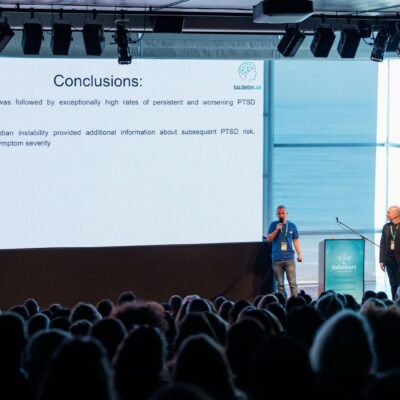
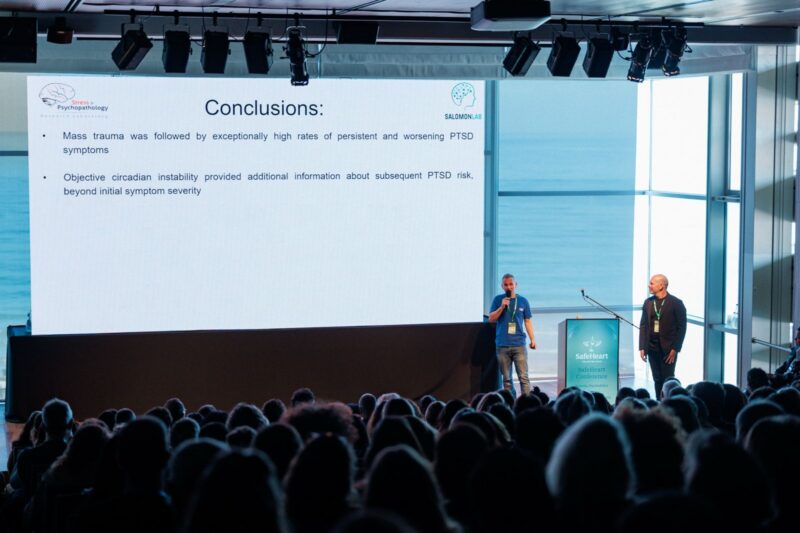
Professor Roee Admon and professor Roy Salomon present their findings at the SafeHeart conference in Jaffa, Israel, on Nov. 11, 2026.


 Add EJP on Google
JAFFA, Israel — The Oct. 7, 2023, massacre at the Nova music festival, in which 378 people were killed, was unique among mass-casualty attacks: Many of the young partygoers were under the influence of mind-altering substances — from alcohol and marijuana to psychedelic mushrooms, MDMA and LSD — when Hamas terrorists struck at sunrise.
Three years later, the Israeli nonprofit SafeHeart is tracking more than 1,200 of those survivors in a long-term study while treating them with open-ended care, and asking unprecedented questions: What role did those drugs play in their trauma, and what role can those same compounds play in their healing?
Nearly two-thirds of the Nova survivors that the organization tracks have been diagnosed with post-traumatic stress disorder, more than three times the rate typically seen after serious trauma, according to the nonprofit. Researchers and clinicians gathered in Jaffa for SafeHeart’s second annual conference to compare what they have learned, even as SafeHeart’s leaders worry that funders have moved on and lack the bandwidth to keep supporting Israel’s PTSD generation.
“There has never been a trauma under such drugs like this. A mass-casualty event with drugs at the center of it,” said Efrat Atun, SafeHeart’s CEO.
Did being under the influence of a powerful psychedelic like LSD during the attacks make it more or less likely that the survivor will develop PTSD? What about MDMA? What about alcohol? Can psychedelics be used to treat PTSD, as a growing body of research indicates that they can?
Founded immediately after the Oct. 7 attacks, SafeHeart treats survivors and studies them at the same time, melding research and clinical practice as Israeli society confronts trauma on a scale it has never known. Its clinicians bring expertise in psychedelic-informed treatment and the nonprofit runs retreats, support groups and programs for families. About 400 therapists work with SafeHeart, treating some 1,000 survivors one-on-one, and another 1,200 families belong to its families circle network.
“Something has changed,” said Avital Diment Litvin, who supervises therapists at SafeHeart and treats patients there. “In Israel, post-[trauma] is not underneath the surface. That changed after Oct. 7.”
The trauma now spans very large civilian populations, she said, and the therapists treating survivors are sometimes traumatized themselves, all during what she called the longest war Israel has known.
“Many children in Israel, more than ever before, suffer from anxiety,” she said. “On a day-to-day basis, people are much more anxious, edgy, sometimes aggressive.”
To understand that population, SafeHeart partnered with University of Haifa researchers, who are tracking 1,268 festival survivors through surveys, physical measurements and cognitive testing, with new findings at SafeHeart’s second annual conference yesterday.
The team laid out its approach in “The Nova Protocol,” a study design posted to the preprint server medRxiv in August and not yet peer-reviewed. The project is led by Roee Admon, who heads the university’s Stress and Psychopathology Research Lab, and Roy Salomon, a Haifa professor who is also SafeHeart’s head of research and a member of its board. Beginning in the first weeks after the attack and running for about two years, it tracks survivors through wearable sensors, saliva samples, brain scans and interviews, alongside a comparison group.
The conference, “Trauma, Psychedelics and Therapy: The Power of Community,” held at the Peres Center for Peace and Innovation in Jaffa, put that kind of cutting-edge research in front of the clinicians who treat survivors every day. Sessions ranged from psilocybin-assisted PTSD treatment to support groups for parents and mothers of survivors. A high-tech company, which asked not to be identified publicly, held its own conference at the center the day before and donated to SafeHeart.
The cohort lets researchers ask questions earlier studies could not, Admon said.
“Think about such a large cohort of survivors that all of them experienced the same event on the same day, and you follow them over time,” he said. “That enables us to ask many questions about dynamics over time.”
Some answers have arrived; others have not. Of 453 survivors questioned eight to 12 months later, roughly 70% said they had used several psychoactive substances, alcohol among them, according to preliminary findings the Haifa team presented at the conference. A separate analysis tied high levels of an inflammatory marker in survivors’ saliva, measured soon after the attack, to worse post-traumatic stress disorder symptoms down the line.
About 20% of people who live through serious trauma develop PTSD, Atun said. She attributed the far higher rate among Nova survivors to the day itself and what followed.
“We know it from the research,” she said. “It’s because of the traumatic event that they went through all day and all the drugs, and also because it was three years of war.”
Those findings feed directly into care. “The therapy is based on the research,” Atun said. “If there are findings on how certain drugs work, the therapy will be drawn from that.”
That question is moving from the clinic to policy as the Israeli Health Ministry is weighing whether to approve psychedelic drugs for treatment. Psychological support should be a condition of that approval, before drugmakers move ahead, Rachel Yehuda, a PTSD researcher at the Icahn School of Medicine at Mount Sinai in New York, told the conference, according to SafeHeart.
The research also points to a long road, with many survivors getting worse over time, Diment Litvin said.
“We have a much higher percentage of people with PTSD that are not actually getting better,” she said. “We have a higher percentage of people that have later onset. … That’s why in SafeHeart, what we’re directing at is long-term therapy.”
“Our role is for long-term therapy and support. It’s not a sprint; it’s a marathon,” Atun said. “We are here for the long term for anyone that needs us.”
Persistence made the difference for Ron Segev, 41, who went to the Nova festival with his brother, Dan, and a few friends. During a four-hour escape, the brothers came under fire three times; none of the group was physically hurt, and they helped save others along the way. About a week after the attack, SafeHeart called to offer him therapy. He clicked poorly with his first psychologist and stopped going.
“I’m lucky that they kept calling. They didn’t give up on me,” he told eJP. “They called me again, and they found me someone else, and this guy is my therapist until this day.”
The care later extended to his family when he attended a SafeHeart retreat with his parents. “The best example is that me and my dad never had good communication, and since that retreat, we talk all the time,” he said.
Families carry their own trauma, Atun said. Many spent Oct. 7 on the phone with survivors as the attack unfolded. “It’s not a full secondary trauma; it’s a 1.5 group.”
For some families, the warning signs never showed. Ronen Shalev’s son Roi, a Nova survivor, killed himself on Oct. 10, 2025.
“The ones who seem strongest are the ones I worry about most,” Ronen Shalev said in remarks on the conference stage. “They can look fine on the outside.”
Since Oct. 7, PTSD-focused Israeli organizations have seen a massive influx of funding from global Jewish philanthropists as donors flocked with funding to support Israel’s reservists, Nova survivors and hostage families, and eventually the hostages themselves.
More than three years later, the field still draws funders. But donor fatigue is seeping into conversations about Israel in foundation boardrooms, raising questions about what role philanthropy will play in trauma care over the long term. For SafeHeart, the fact that its work and its clients are so deeply connected to drugs can also
Between sessions, attendees spilled outside to sea views, a light breeze and upbeat music, lending a communal, uplifting air to a heavy subject that has taken on new urgency in Israel. For the clinicians who carry thousands of patients between them, the day offered a rare chance to come together.
Scott Davidson, a donor from Maine, flew in for the conference. “This is an important conference,” he told eJP. Its focus on supporting healers, he said, lets them keep doing the work and helping those who need it.
“The therapists and the healers are exhausted as well,” Davidson said. “So I understand the fatigue, but we are all digging deeper to help.”
SafeHeart’s 16 million NIS ($5 million) budget is split evenly between government funding and philanthropy.
“Because we were founded on Oct. 7, we have a wide range of connections with different funders,” Atun said. “At the beginning, the philanthropists reached out to us, which is rare and was a real sign of trust in the newly born organization.”
Those early backers have grown into a wide network. SafeHeart’s donors, fundraising partners and other institutional supporters now include UJA-Federation of New York, Jewish Federations of North America and the Jewish Federation of Greater Washington, as well as Charles and Lynn Schusterman Family Philanthropies, the Russell Berrie Foundation, the Rothschild Foundation, the Diane and Guilford Glazer Foundation, the Alan B. Slifka Foundation, the Gimprich Family Foundation, the Sharna and Irvin Frank Foundation and the Marlene and Samuel Halperin Family Foundation.
The government has kept up its share. On Nov. 11, it approved funding to keep survivor support services running in the coming years, according to SafeHeart. Yet state support also generally means more bureaucracy — for the survivors and their therapists — and people falling through the cracks, so there will always be a need for private funding, according to Atun.
Still, SafeHeart’s leaders worry about donor fatigue alongside donors prioritizing other philanthropic focus areas that have sprung up since Oct 7. “There is more of a focus on the North and South and less on survivors, and it’s worrying and difficult,” Atun said. “The need for support for survivors goes up with time; some of them have worsening situations.”
“As an organization founded without a budget, we don’t know if there will be money,” she said, adding: “I’m worried for the future. The needs are growing, and people think the survivors are in the past, but actually their needs continue to grow.”
For some potential funders, there is also a hesitancy to get involved with an organization whose work and clients are so deeply connected to something illegal: drugs.
In a conversation last year, Atun told eJP that while she understands this hesitancy, the Nova survivors didn’t choose to be attacked by murderous terrorists, and they desperately need help, including guidance on safe — or at least safer — drug use. Marijuana, for instance, is a common drug of choice for the music festival crowd, but recent studies have shown that it not only doesn’t help treat PTSD, but it can also make treatment even more difficult, numbing the patient and making it harder for them to process their traumatic experiences.
“We compare it to sex education — whether we like it or not, it happens; better to guide it safely,” Atun said in a conversation last year.
For donors weighing where to give, Admon called Israel a natural home for trauma research and urged them to back the strongest work.
“We live in a stress lab. So it could be a very good place to invest in,” he said. “… I would go to places where there is really high-quality research, because you really need high-quality research to eventually translate this to improved treatment, which is what we really want.”
Diment Litvin framed the stakes in national terms. Treating trauma, she said, is crucial to Israel’s continuity as trauma passes from one generation to the next.
“Israel is [at] a very critical junction, and we see the trauma in politics. We see the trauma in social processes,” she said.
“If we do not treat trauma, it will slowly … deteriorate our infrastructure, our social matrix.”
Related News
ADVANCING A VISION
N.Y. federation donates $1M toward building shared-society center named for peace activist killed on 10/7

MAJOR GIFTS
Center for Jewish History celebrates 25 years with a $25M matching grant
HIGHER EDUCATION
As Jewish donors reconsider academia, Jan Koum doubles down, endowing Israel studies at Stanford
EXIT INTERVIEW
Elizabeth Sokolsky, longtime EVP of Birthright Israel, to retire next year
CLOSING WORDS
In AZM address, Cosgrove links communal ‘orthodoxy’ on Israel to rising anti-Zionism among young Jews