Q&A
‘The reservist and his family’: How soldiers’ wives are reshaping how Israel thinks about its army
Miriam Amedi, CEO of the IDF Reservists' Wives Forum, talks to eJP about her organization's push for better rights for the families left behind when (mainly) men go off to fight
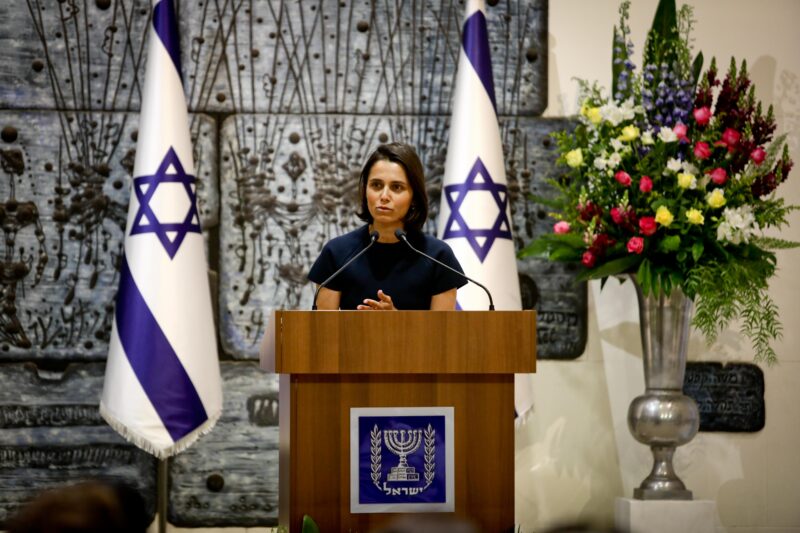
Yonit Schiller
Miriam Amedi, CEO of the IDF Reservists' Wives Forum, speaks in the Israeli President's Residence in Jerusalem, in an undated photograph.




 Add EJP on Google
Miriam Amedi walks into a neighborhood coffee shop in Tel Aviv — an hour and a half from her home on the outskirts of Jerusalem — and is instantly recognized. One person is a former university classmate. Another is a fellow reservist’s wife. She greets both warmly — one even thanks her for her activism — before sitting down. She doesn’t enjoy the spotlight. But as she told eJewishPhilanthropy, she no longer has the privilege of being a private person.
Amedi is the CEO of the IDF Reservists’ Wives Forum (the Forum) and a reservist’s wife herself. Her husband, Idan Amedi — her high school sweetheart — is primarily known to foreign audiences for his role in Netflix’s “Fauda” and to Israelis as one of the country’s most beloved singers. When Idan was severely injured during his reserve service in Gaza in January 2024, he became a symbol of war’s widespread impact across most parts of Israeli society.
The Forum was born from a single Facebook post in November 2023. A woman who couldn’t find anyone fighting for her rights asked if others wanted to join her. Thirteen women responded. All 14 became founders of the Forum and registered it as an Israeli nonprofit in April 2024. Amedi, a veteran nonprofit leader who previously led Link20, a nonprofit focused on disability inclusion, and was the head of social action and partnerships at the Edmond de Rothschild Ambassadors Program, joined as CEO in January 2025. Under her leadership, Amedi said, the Forum has grown to represent more than 20,000 reservist wives and helped secure NIS 27 billion ($9.1 billion) in government support.
Amedi sat down with eJP this week to discuss the cost of war on the families behind the soldiers, the policy victories that followed, what comes next for the Forum, and what comes next for the 100,000 reservists — and their wives — who answer the call to serve.
This interview has been edited for length and clarity.
Justin Hayet: How did you find yourself in this role — and what did it take to step into it?
Miriam Amedi: On Oct. 7, like so many others, Idan was called up. I remember that morning clearly. We keep Shabbat, so it took us a few hours to understand the magnitude of what was happening. He turned on his phone, packed his bag and said goodbye. I felt two things at once: I was so proud of him for leaving his home, his family, everything stable, to go fight for our country. And I was terrified — I think we all understood that this war was different from anything before.
He served 93 days in a row in reserve in Lebanon and in Gaza until he was severely injured in January 2024 in Gaza. Several soldiers were killed. More than 10 were injured. He was among the most severely injured. When he arrived at the hospital, he was so badly burned that no one recognized him. They admitted him under an unknown name, and it took hours, using dental records, to identify him. Then they called us. He had injuries across his whole body. Miraculously, he was able to rehabilitate.
When he was discharged from the hospital, he held a press conference. I was standing in the background. Afterward, I got hundreds of messages from women across Israel from wives of injured soldiers asking how I was managing, asking for tips on how to cope, how to move my husband and my family forward. Idan is a well-known public figure, and I had always tried to keep our personal and professional lives separate. But at that moment I understood: I no longer have the privilege of being a private person.
A few months later, I saw the job posting for CEO of the Forum. It seemed like the perfect match — professionally, this is what I do: I manage NGOs. And personally, this is where I needed to be. I applied and interviewed, and then, they chose me. It felt right.
JH: What was the Forum’s biggest accomplishment during the war?
MA: The first thing is that we changed the conversation — not just among government and policy stakeholders, but among ordinary Israelis. At the beginning of the war, everyone talked only about “the soldier.” Today, everywhere you look, people talk about “the reservist and his family.” We changed the understanding: When a soldier is called up, his whole family is called up with him.
In our first month, these women — who were once completely anonymous to Israeli society — went everywhere and spoke out. We did 100 media articles and interviews in one month. This visibility is what brought the minister of finance [Bezalel Smotrich] to meet with us. We came with a paper: Here are our ideas for what needs to be done to help reservist families.
The Finance Ministry took our ideas, doubled what we’d asked for, and that became the first-ever governmental resolution for reservist families in Israel NIS 9 billion ($3.03 billion) in support for the reservists, their wives and their families. Since then, we’ve been part of four additional resolutions, totaling NIS 27 billion [$9.1 billion].
We work as an advocacy and policy organization in a very unique model. We collect data from our community of more than 20,000 reservist wives through surveys, group meetings, and conversations. We identify the systemic problems that connect all reservist families, write policy papers, go to the government, lobby, and then go back to the community and explain what we were able to accomplish.
JH: Beyond securing funding from the government, what else has the Forum accomplished?
MA: We passed historic legislation protecting reservist wives from being fired during their husband’s service and for 14 days after. We passed a law allowing wives to leave work one hour early, with pay, when their husband is in reserve. We passed eight days of additional annual leave.
We also fought for two groups the army and government didn’t want to address at first. Self-employed women — they had no protection, no income, nothing. We got them a special government grant. And divorced women who share children with a reservist. The army saw them as invisible — you’re not married to him. But if he’s in reserve for 100 days, she’s the one taking care of the kids alone. We got those women’s support too.
JH: What comes next for the Forum — and what does a long-term vision look like?
MA: Oct. 7 changed everything, including the nature of reserve duty in Israel. We need to become the permanent representative organization for reservist families — not just in wartime. This voice needs to be heard in Israel forever, because we will always do reserve. The army says, in the most optimistic scenario, 60 to 80 reserve days per year for the next five years minimum. That is still more than two months a year per family.
We have four main goals. First: Everything we’ve accomplished needs to move from governmental decisions — which must be renewed every year — into permanent law and incorporated into the state budget. Second: We want the government to establish a national agency responsible for reservists and their families, both during service and after. There is no ministry solely responsible for the well-being of reservists and their families during and after their service. Third: we want to change the Reserve Duty Law itself. The current law talks about 45 days over three years, which is completely irrelevant to today’s security reality. It needs to be updated, but it also needs to include real limits. You cannot call someone up for 100 days with no notice. That is not a way to build a sustainable country. Fourth: We want to build a resilience center specifically for reservist families. Today, if I go to a resilience center in Israel and say I have anxiety because my husband has done 300 combat days and I didn’t sleep for two and a half years — I am not prioritized. I don’t qualify. The system is not built for us, yet we hold the system together. We need a center that understands our specific situation.
JH: Have most of your grants from funders been emergency-based, or are funders offering longer-term commitments?
MA: This was a new focus area for many funders. Before Oct. 7, reservist families simply weren’t on the philanthropic map. Most of what we’ve received has been one-year emergency grants. However, the problems we are facing are not problems that can be solved in a few months or a one-year grant cycle. We need to build infrastructure for 100,000 families, families that are carrying the responsibility of protecting this country and will continue to do so.
Multiyear grants allow us to plan and build long-term, so we can tell the reservist families of Israel that we will be here with them for two or three years. It also allows us to tackle the complex legislative work that genuinely takes years. Due to the fundraising in dollars, we’ve also had situations where grants we thought were committed came in much smaller installments than expected. This makes long-term planning very difficult.
JH: What’s one of the biggest misconceptions about reservist wives?
MA: That we are a strong population that doesn’t need help. Reservist families remain the backbone of this country: employed, taxpaying and proud to serve. The past 2 1/2 years have changed our situation dramatically.
More than 30% of reservist wives are no longer working, laid off or unable to find work because employers don’t want someone whose spouse disappears for three months every year. Divorce rates in reservist families are significantly higher than the general population. Our children have emotional difficulties. As couples, we have been through almost three years of war together — or apart. It is hard for us to even understand that we have become a population that needs philanthropy and government support. Until now, we were the strong ones.
JH: What gives you hope?
MA: Reservist families who have decided to expand their families. They understand what they’re sacrificing as a family, and they still choose it, over and over again. And it drives our work. I wake up every morning knowing I’m doing the most important thing in Israel today — helping reservist families. This country owes them everything.
Related News
HIGHER EDUCATION
As Jewish donors reconsider academia, Jan Koum doubles down, endowing Israel studies at Stanford
EXIT INTERVIEW
Elizabeth Sokolsky, longtime EVP of Birthright Israel, to retire next year

MAGICAL EXPERIENCE
Shefa launches psychedelics retreat for Jewish professionals suffering burnout
CLOSING WORDS
In AZM address, Cosgrove links communal ‘orthodoxy’ on Israel to rising anti-Zionism among young Jews
ADVANCING A VISION
N.Y. federation donates $1M toward building shared-society center named for peace activist killed on 10/7