AMERICA 250
Shalom Hartman Institute’s Beit Midrash for America offers a ‘more complex form of patriotism’
With events, podcasts, guides, educational materials and a special journal, the U.S.-Israeli Jewish think tank explores how Jews changed America and vice versa
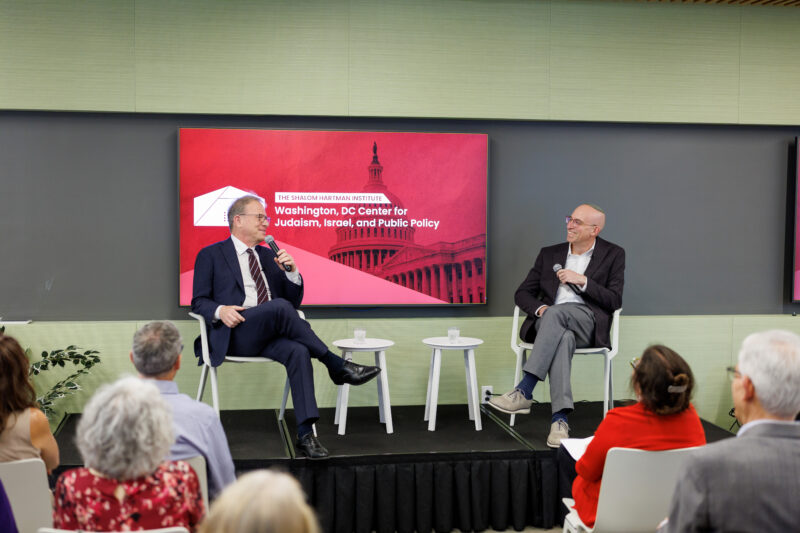
Courtesy/Shalom Hartman Institute
Shalom Hartman Institute President Yehuda Kurtzer (right) speaks with 'The Atlantic' Editor-in-Chief Jeffrey Goldberg at the Capital Jewish Museum in Washington on April 16, 2026, as part of its Hartman Beit Midrash for America at 250 initiative.




 Add EJP on Google
The Shalom Hartman Institute’s celebration of the 250th anniversary of America will last an entire year, seeking to answer a single question: How does the story of American Jewish success intersect with thousands of years of Jewish wisdom to inform how American Jews tackle today’s challenges and imagine the years to come?
“The way that we are encouraging people to answer that question is to recognize the uniqueness of the American situation, to recommit to American ideals, democratic ideals in particular,” Claire Sufrin, director of research and publication at the Shalom Hartman Institute of North America, told eJewishPhilanthropy. “[Democratic ideals] made our success possible. They’re goods in and of themselves, and they’re necessary for the future. We’re really drawing on the idea that these are attitudes and investments that have to be cultivated and renewed. We can’t take them for granted.”
The yearlong program, titled Hartman Beit Midrash for America at 250, launched earlier this month and will include in-person events, podcast episodes, holiday guides, educational resources and a special issue of Shalom Hartman’s Sources: A Journal of Jewish Ideas, to coincide with July’s semiquincentennial.
“The 250th is a moment for reflection on American Jewish life, American Jewish thriving, and also on America itself and what Jews owe America,” Sufrin said.
The program is aimed at Jewish leaders, community members, educators and “anyone who wants to use Jewish wisdom, Jewish text, Jewish history in this moment for thinking about what it means to be an American Jew,” Sufrin said.
Programming has three interconnected subthemes: the contract between American Jews and America, in which both sides have obligations and promises; the ways Judaism and American values shape one another; and the importance of Jews showing up in public spaces — outwardly as Jews — to advocate for the Jewish community, for other minorities and for democratic ideals.
Even with antisemitism skyrocketing and many claiming that the golden age of American Jewry has ended, echoing journalist Franklin Foer, “We’re asking people to take a step back, take in a bigger picture of the American Jewish experience, to recognize, on the more negative side, that antisemitism has ebbed and flowed throughout American Jewish history, and also to recognize the many ways in which we are thriving in this post-golden age situation, compared to other moments in Jewish history, other places around the world right now,” Sufrin said.
As part of the program, Shalom Hartman partnered with A More Perfect Union: The Jewish Partnership for Democracy to create a 30-page book titled American Jewish Civics, offering ways to strengthen democracy through Jewish teachings.
The book takes on an air of “gratitude,” Sufrin said, pointing to a 1984 letter written by Rabbi Moshe Feinstein, who had served as the rabbi of Luban in Belarus before fleeing to America due to antisemitism. Feinstein implored the American Jewish community to vote as a way of fulfilling the Jewish principle of hakaras hatov, recognizing the good, and showing appreciation to America for the opportunities it provided the Jewish people.
When some people think of being a patriot, they envision cheerleaders for the country and all its actions, good and bad, Sufrin said, but “part of what Hartman is trying to put forward with this Beit Mitdrash… is a more complex form of patriotism. I keep using the word commitment, and that’s really at the heart of what we’re teaching. It’s not a love without criticism. It’s not a refusal to see the bad parts. It’s actually a call to really look most at the bad parts and see what you can do to make a difference and make a change.”
The special issue of Sources includes contributions from historian Jonathan Sarna; Michael Koplow, the chief policy officer of Israel Policy Forum; and Deborah Barer, a Hartman Institute senior faculty member.
Sarna’s piece, “Does the Torah Really Articulate Democracy’s Fundamental Principles?” ponders if the Torah is the source of all democracy.
“Many of us grew up basically being told that everything that’s wonderful about America is actually Jewish or it came from us,” Sufrin said, but Sarna argues that the influence goes both ways. America, he says, also shaped Judaism.
Sarna explains that Jewish leaders began emphasizing American ideals, such as equality and democracy, around the American Revolution. Jewish institutions created constitutions because America did. Tikkun olam, although the phrase has medieval roots, became distinctly American Jewish, evolving into a way of life for many American Jews.
Koplow’s piece, “Judaism, Zionism and the Promises of America,” makes the case “for Jews not to retreat, not to pull out of mainstream American society and go back into little Jewish enclaves, but instead to remain invested and also to do a better job of explaining ourselves, of explaining our sense of connection to the State of Israel, of explaining what it means to be Jewish, what it means to us,” Sufrin said. To do that, American Jews need to clarify these answers to themselves first.
Barer’s piece, “Towards a Covenantal Citizenship,” asks the question: How do you love the country that disappoints you?
Amy Spitalnick, CEO of the Jewish Council for Public Affairs, said that initiatives like this are the reason her organization often partners with Shalom Hartman. “This initiative reminds us that questions of democracy and pluralism are central to both our tradition and our history. At a time when extreme voices are telling us to choose between Jewish safety and democracy, it’s vital to remember that’s a false choice — and that we must fight for the democratic norms and institutions that have been inherent to Jewish advancement and security.”
The initiative needs a full year, Sufrin said, because “The things we’re asking people to do take a long time… We’re asking them to really be reflective about the ideas that we’re putting forward, to talk about them in community, maybe to build community around them. We want [American Jews] to test our ideas in their local situations, see how they play out, and to build and strengthen relationships, to really think deeply about their own American Jewishness. That’s a big project.”
Hartman Beit Midrash for America at 250 grows out of the work the institute does every day, she said. “On July 4, 2027, we’re not going to drop it all and say the year is over, we’re done. This is a serious interest and serious commitment.”
Related News
EXIT INTERVIEW
Elizabeth Sokolsky, longtime EVP of Birthright Israel, to retire next year
PRESIDENTIAL REBUKE
Israel’s Herzog: Mamdani ‘makes no effort’ to hide disdain for Israel, Jews must fight back

MAGICAL EXPERIENCE
Shefa launches psychedelics retreat for Jewish professionals suffering burnout
ADVANCING A VISION
N.Y. federation donates $1M toward building shared-society center named for peace activist killed on 10/7
CLOSING WORDS
In AZM address, Cosgrove links communal ‘orthodoxy’ on Israel to rising anti-Zionism among young Jews