Opinion
PEOPLEHOOD PAPERS
What camp teaches us about accountability and belonging




 Add EJP on Google
The following essay, published here as part of a collaboration between eJewishPhilanthropy and the Center for Jewish Peoplehood Education, is from the latest edition of CJPE’s Peoplehood Papers series, “Cultivating Jewish Peoplehood at Camp,” produced in partnership with the Foundation for Jewish Camp and coming out this week.
Courtesy/Foundation for Jewish Camp
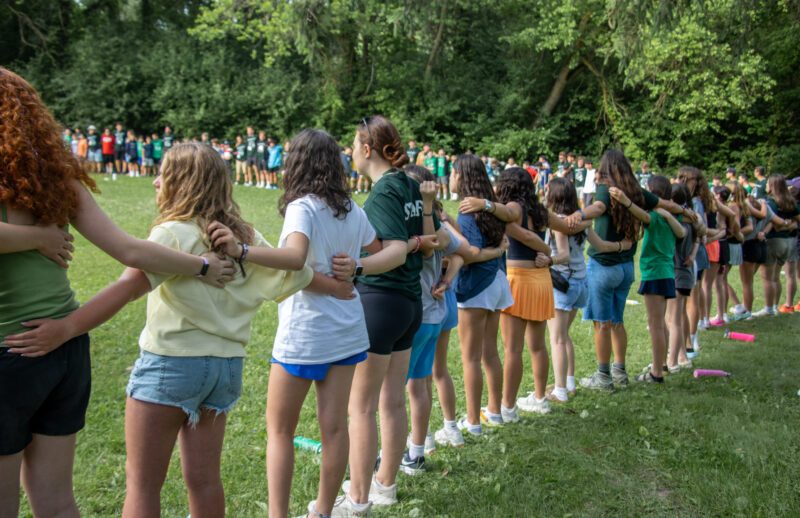
A photo from Summer 2025 at Beber Camp in Mukwonago, Wis.
Accountability is often misunderstood as oversight or enforcement. In many settings, it appears only when something goes wrong. At camp, it means something else entirely. It is not about control. It is about care. By accountability, I mean doing what you said you would do, the way you said you would do it, when you said you would do it, in service of the people who are relying on you.
Jewish camp is one of the few environments where responsibility, relationship and Jewish identity are fully intertwined. At its core is the lived experience of Kol Yisrael Areivim Zeh Bazeh, the understanding that we are responsible for one another in practice, not only in theory. In my experience supervising and training both seasonal and year-round camp staff, I have seen what happens when a culture of follow-through is intentionally supported and what happens when it is avoided. When roles are clear and systems reinforce shared ownership, people rise to the occasion. When expectations are vague or sidestepped in the name of being nice, confusion and frustration follow. Camps cultivate reliability as a pathway to Jewish Peoplehood, the lived sense of shared belonging.
At camp, accountability lives in culture, not checklists. It is not about rigidity or compliance. It is about honoring the trust placed in us and our obligations to one another. It shows up in shared norms, clear expectations and common language. When accountability is framed as care rather than punishment, it becomes a way to help people succeed rather than a mechanism for assigning blame.
Much of this learning happens without formal systems. Camp teaches accountability through modeling, proximity and the visible impact of people’s actions. You cannot disengage quietly, because people see you and rely on you. A counselor who forgets to remind their campers to bring a bathing suit to the lake quickly sees the impact. A Unit Head who does not clarify expectations before an activity feels the ripple immediately. The effects are tangible.
One of the less visible lessons is helping staff understand that when they say they will do something, someone else is planning around it, relying on it or being shaped by it. Camp is a fast-moving environment where responsibilities overlap and interruptions are constant. Rather than relying on individuals to simply remember everything, camps reinforce shared habits that support one another’s reliability. Staff internalize the idea that consistency depends on systems and habit. They create structures that support their commitments and develop practices that make follow-through more reliable and shared.
Camps give young people real responsibility early, not as a reward, but as an expectation. Staff are responsible for safety, for moments that shape a child’s experience and for the morale of those around them. These responsibilities are not hypothetical. They show up every day.
For camp, what matters most is not perfection. It is staying accountable when things do not go as planned. When accountability is avoided, strong performers notice. Avoiding difficult feedback may feel compassionate in the moment; it weakens standards and demotivates those who are meeting expectations, signaling that responsibility is optional.
Growth happens when people are trusted and then held to clear standards with dignity. Camp creates this environment intentionally. Responsibility is given before people feel fully ready, with support provided along the way. Over time, this shapes a deeper understanding of Jewish Peoplehood: belonging carries obligation.
Camp staff learn accountability by watching how leaders respond when situations break down. Written policies matter far less than lived behavior. When leaders own their mistakes, others learn to do the same.
At camp, a culture of accountability begins with leadership, and leadership is not limited to senior roles. When challenges arise, effective camp leaders start with self-reflection. Everyone has the opportunity to lead by setting clear expectations and taking responsibility when things do not work as planned. Jim Collins describes this leadership discipline as choosing to look in the mirror rather than out the window when things fall short. In a camp setting, this means examining whether expectations were clear, support was sufficient and systems were designed to help staff and campers succeed before assigning blame. It also means asking: What could I have done more of, less of, or differently to set this up for success?
Modeling accountability also requires resisting the urge to be everything to everyone. Leaders who prioritize being liked over being effective erode trust. When the work of building a safe and trusting community matters more than approval, consistency becomes stabilizing.
Camp teaches that belonging comes with responsibility. At camp, a counselor shows up early because campers are waiting. A staff member steps into a difficult conversation because a teammate needs support. You act, not because you fear consequences, but because others depend on you. In this environment, leadership is practiced at every level, through the expectations people set and the ownership they take for how things unfold.
This lesson extends directly to Jewish Peoplehood. Staff do not stay engaged or take initiative because they are worried about discipline. They do so because they care deeply about the mission, about their campers and about the community they are helping to build. Caring for community means showing up consistently, staying when things are hard and taking responsibility even when not formally assigned. Peoplehood is not theoretical. It is behavioral.
Camp staff often describe the need to think one step ahead. At camp, accountability is practiced as a way of setting yourself and the people around you up for success. A programmer checks the weather before an outdoor activity and adjusts the plan. A division head confirms staffing before a large program begins. A staff member leaves dinner early to prepare materials for the evening program, so no one is scrambling while campers wait. People learn to confirm expectations, clarify timelines, and plan their day with others in mind.
Learned in an environment where people rely on one another constantly, this way of working extends beyond camp. Those who carry it into communal spaces describe asking for clarity, following through reliably, and building systems that create cognitive ease and reduce overwhelm. Camp teaches that accountability is rooted in habits and structures that allow people to stay focused on the mission and vision of their organizations. What camp uniquely offers is a proactive approach to responsibility that builds trust and makes reliability the norm, because they care deeply about the work and about one another.
Accountability is an act of care. Camps teach accountability as a lived value and as an enabler of joy, not a threat to it. Jewish camps are training grounds for people who understand that belonging carries responsibility.
If the Jewish people want engaged, reliable adults, we need to pay close attention to how camps teach accountability so early, so effectively, and so humanely. Camp does not teach responsibility through lectures. It teaches it through lived experience. Through daily reliance, shared purpose, and real consequences, young people learn that their actions affect others and that belonging carries obligation. We need people who know how to be accountable to one another, who follow through not because they are monitored but because they understand that others are depending on them. We need leaders who clarify expectations, who take ownership when things fall short, and who build systems that make reliability easier rather than harder. These habits do not emerge automatically in adulthood. They are practiced and reinforced in formative environments.
Camp is where many first learn that accountability is an expression of care. It is where responsibility becomes relational, where trust is built through consistency, and where Jewish Peoplehood is experienced not as an idea but as a shared practice. In this way, the principle of Kol Yisrael Areivim Zeh Bazeh, that we are responsible for one another, becomes not just something we say, but it is something we live. If we value communities rooted in mutual responsibility, we need to recognize camp not only as a place of joy and identity, but as a training ground for the kind of adults our communal future depends on.
Diana Bloom is an accountability consultant who works with Jewish community professionals and lay leaders to strengthen leadership, communication, and organizational effectiveness, with particular experience in residential camp settings. Bloom teaches in the Jewish professional studies master’s program at the Spertus Institute and serves on the faculty of the Foundation for Jewish Camp’s Cornerstone Fellowship.