Healing Hands
IsraAid’s Yasmeen Abu Fraiha aims to build bridges in the Middle East through medicine
After treating the victims of the Oct. 7 massacres, Abu Fraiha dedicated herself to strengthening the healthcare systems of Israel’s neighboring countries
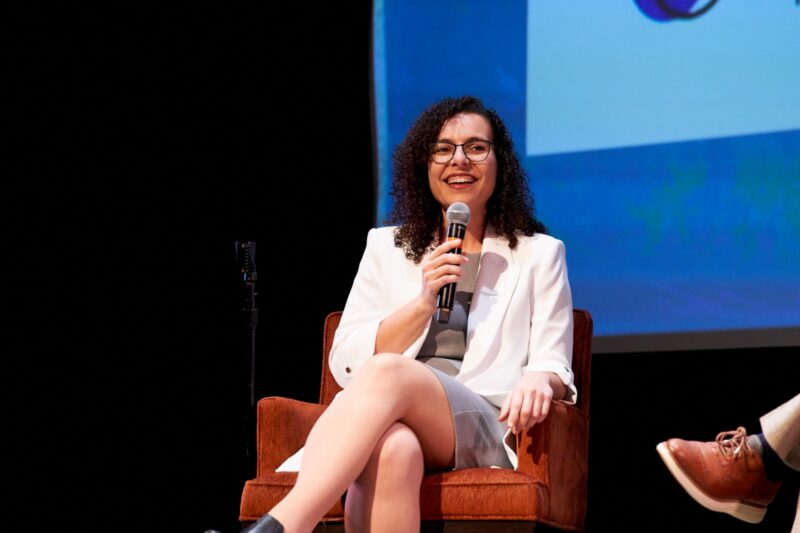
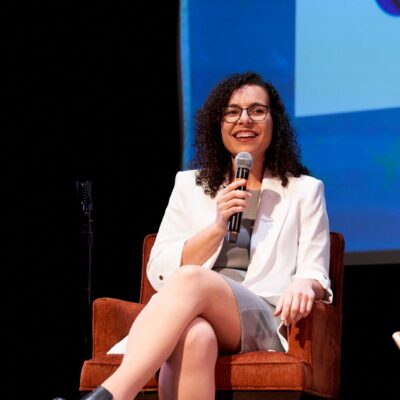
Courtesy/Yasmeen Abu Fraiha
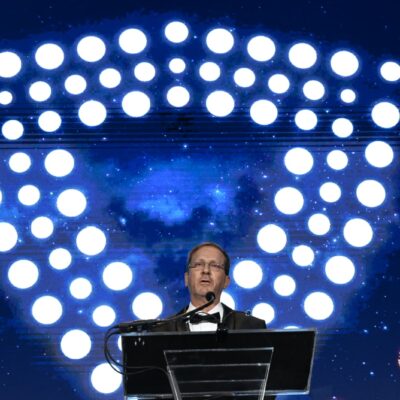
Yasmeen Abu Fraiha speaking at New Israel Fund's Guardian of Democracy event in April 2024




 Add EJP on Google
Dr. Yasmeen Abu Fraiha awoke at the crack of dawn on Oct. 7 to sirens wailing and knew she needed to rush to the Soroka University Medical Center, where she worked in internal medicine.
She expected to treat traumatic injuries caused by rockets fired from Gaza, similar to previous attacks. When she arrived at the hospital, the largest in Israel’s southern Negev region, she saw a bloodbath instead: There was a flood of young Israelis who had been mowed down by terrorist gunfire at the Nova music festival. There were foreign farm workers with extreme burns from running through flaming fields to escape murder. There were also Bedouin parents who lived in unrecognized villages — their communities were neither protected by the Iron Dome missile defense system nor equipped with bomb shelters — cradling their slain children. In a different life, that could have been her.
Abu Fraiha knew about the hostages kidnapped by Hamas before the Israeli government and the news stations did — she had heard their names cried out by family members. By 12 p.m., the hospital had run out of antibiotics. Amid the chaos, Abu Fraiha glanced around and witnessed religious Jews treating Christian Arabs. Muslim doctors caring for settlers. Everyone was helping one another, no matter their background: secular, religious, left-wing, right-wing, Jews, Christians, Bedouins.
“The lessons that I learned that day, I still believe in today, maybe even more,” Abu Fraiha told eJewishPhilanthropy. “The one thing that I feel sorry about is that we didn’t take advantage of the opportunity to tell a new story of Israel/Palestine. We fell into the trap of revenge and anger and hate and dehumanization, and sadly, it’s getting worse.”
Three years later, Abu Fraiha serves as the head of strategic partnerships in the Middle East at IsraAid, the largest Israeli nongovernmental humanitarian aid organization. Soon after the massacres, IsraAid partnered with international aid organizations to provide aid in the Gaza Strip. Now, under Abu Fraiha’s guidance, the agency is expanding into other countries in the Middle East, some that don’t have diplomatic relations with Israel. Before Oct. 7, IsraAid didn’t have a presence in the Middle East; today, providing aid in the Middle East is a pillar of its work, and Abu Fraiha believes that healthcare workers like her and her partners in the region can build trust across borders.
Born in Tel Sheva, the first Bedouin town in Israel, Abu Fraiha’s life took a dramatic turn in 1996 when she was 5, and her parents — her mother a Palestinian schoolteacher; her father a Bedouin engineer — moved the family to the nearby affluent Jewish suburb of Omer, yearning to give their four children a better education.
“The difference between Omer and Tel Sheva is a five-minute drive but 100 years away,” her father would tell her. According to a ranking of Israeli cities released by Israel’s Central Bureau of Statistics in 2016, Tel Sheva ranked lowest in socioeconomic status; Omer ranked highest.
While Abu Fraiha was afforded a quality education, she never fully fit in. She knew she spoke a different language at home than her friends did and practiced a different faith. When her mother died of breast cancer when she was a teen, Abu Fraiha said that she felt that viscerally when her family tried to bury her mother in Omer, and they were told the sole cemetery in the community was a Jewish one.
Abu Fraiha also had another realization at that time. She watched as her mom received chemotherapy. The doctors, she felt, had a magical ability to soothe others. She knew her destiny, and she never let up, receiving a medical degree from the Hebrew University of Jerusalem and a Master of Public Administration from Harvard Kennedy School.
In the years since, she has started two nonprofits supporting Bedouin communities in Israel and served as the health policy director at the Task Force for Health Promotion and Equity in the Arab Society at the Israeli Ministry of Health. She was chosen as one of Forbes’ “30 under 30” in 2017 and one of Israel’s 50 most influential women by the Israeli business publication Globes in 2023.
After leaving Israel in 2024 for a two-year stint as clinical fellow at the Beth Israel Deaconess Medical Center in Boston, Abu Fraiha returned home in February.
“I knew that the world has changed,” she said. “I can’t go back to the hospital, to my nine-to-five, as if nothing has happened,” so she turned to IsraAid after seeing the agency supporting both Israelis post-Oct. 7 and Palestinians in Gaza after it was devastated by the war with Israel, its infrastructure in ruins, with much of the population displaced and the civilian death toll climbing, something she said hasn’t entirely ended, with limited fighting persisting even as the larger war has halted. The organization had “the ability to see the humanity in both sides and say, ‘We are a humanitarian organization that will help everyone who is in need.’ That’s quite significant and quite moving.”
That view, Abu Fraiha said, “embodied exactly the way I see medicine and the way I see my job.” In 2025, as part of the Middle East Initiative at Harvard Kennedy School, she co-authored a study, published in The New England Journal of Medicine, titled “Health Care Bridges — Pathways toward Trust in Gaza and Beyond.”
“Our findings suggest that cross-national healthcare programs can overcome formal and informal segregation, establish connections and help build trust between groups in conflict,” the study said. “Moreover, our interviews and surveys revealed that many Palestinians and Israelis are receptive to working with one another in programs related to health, even in wartime.”
The reason healthcare workers can build trust between communities, Abu Fraiha said, is because that skill — trust building — is intrinsic to the profession. “I keep saying that my superpower is to go into a room and make you, after two minutes, trust me enough to tell me about your bowel movements and your sexual life and all the things that you won’t tell anyone else,” she said.
Additionally, healthcare workers “flip the power imbalance,” she said. “Suddenly, the Palestinian is your doctor or the Palestinian is your nurse, and they hold the information and the solutions and what needs to be done. Then you look up to them, which is different than the usual experience in Israel/Palestine, so that breaks some prejudice sometimes.”
When healthcare workers from different backgrounds come together, Abu Fraiha said, they also have a common goal: saving lives. Still, the Israeli healthcare system is not the utopia that some people would have others believe, as evidenced by recent attacks on Arabic-speaking staff at Rambam Health Care Campus in Haifa who were accused of mistreating Israel Defense Force soldiers, even after the hospital found that the claims against them baseless.
“When you say coexistence, it’s like, ‘OK, we exist one next to each other.’ That’s basically what you would see in the hospitals. ‘OK, yeah, Arabs and Jews work at the same building. Cool,’” she said. “That does not mean that the place is not racist. That does not mean that people there feel that like they’re equal or they have equal rights of free speech or to assemble.”
These systems need to move beyond mere coexistence to create a shared society built on partnership, she said. “If you and I are partners, then we’re equal. We talk about things. We don’t ignore the issues, and we see each other for who we are.”
Through IsraAid, Abu Fraiha strengthens the healthcare systems of Israel’s neighboring countries that have been hit by brain drain caused by doctors fleeing due to constant wars. IsraAid trains junior doctors, nurses and midwives in Jordan to fill those roles in the countries they serve.
All the training is done in Arabic and includes mental health support, which is essential since so many in the region suffer from trauma, which Abu Fraiha described as being like a toothache, in a November interview with Rabbi Sharon Brous, who leads the Ikar congregation in Los Angeles.
“Imagine you have a toothache, and it’s so terrible [that] the entire universe is your tooth,” Abu Fraiha said at the synagogue event. “Nothing else matters. You can’t really think of someone else’s pain. That’s natural. That’s human. That’s just how we are. But at some point, you need to understand that the way you deal with trauma [isn’t working]. There’s a healthy way to deal with traumas, and then there’s an unhealthy way to deal with trauma.”
Winter is coming in Gaza, and while more food is coming in, they still lack clean water and medicine, Abu Fraiha said; large swaths of the population are displaced and living in tents. Still, she is inspired by the people she works with: “Jewish Israelis, Jewish Americans, Palestinians, both in Gaza and the West Bank, and people who see eye to eye and are on the same page,” she said. “They’re like, “We just turn off all the bull**** from outside, and let’s just do the work. That’s what keeps me going. There’s a lot of people like this. They wake up, and they’re like, ‘OK, let’s work. Let’s make people happy and help other people.”
Yotam Polizer, the CEO of IsraAid, told eJP, that he “can’t think of a better person” to lead the organization’s work in the Middle East. Abu Fraiha is a humanitarian and a doctor who understands diplomacy and politics. “She knows a lot of the world we’re dealing with: the Palestinian, the Israeli, the American, the Jewish diaspora, the medical, and then she has an incredible network.”
Abu Fraiha also serves on many boards, including at the New Israel Fund for the past four years, where she is a passionate and insightful advocate for humanitarian work in Gaza, as well as for anti-occupation and Palestinian equality initiatives, Shira Ben Sasson Furstenberg, the director of New Israel Fund in Israel, told eJP. Abu Fraiha’s work with IsraAid gives her inside expertise on what partners NIF should work with and how to allocate funds related to Gaza humanitarian work.
In Abu Fraiha’s work and personal life, she doesn’t see herself as representing Israel, IsraAid, NIF or anyone other than herself, she said.
“That’s a major message to bring out there to the world,” she said. “To understand that not every person that you meet represents a government or a country or a history. Let’s see the person that is inside the person that we’re talking to. And also it also helps me not feel [like I have to be superhuman]. I don’t want the responsibility.”
She tries to remind people: “I’m just a curly girl who does things.”
Related News
EXIT INTERVIEW
Elizabeth Sokolsky, longtime EVP of Birthright Israel, to retire next year
EXCLUSIVE
Detroit-based philanthropists Nancy, James Grosfeld donate $8M to renovate JDC’s Israel campus
ADVANCING A VISION
N.Y. federation donates $1M toward building shared-society center named for peace activist killed on 10/7

MAGICAL EXPERIENCE
Shefa launches psychedelics retreat for Jewish professionals suffering burnout
CLOSING WORDS
In AZM address, Cosgrove links communal ‘orthodoxy’ on Israel to rising anti-Zionism among young Jews