SUNSET CLAUSE
This Israeli NGO gave itself 5 years — no more — to improve the Gaza border area’s education system
'If we say we'll be here forever, the government has no incentive to step in,' its founder, venture capitalist Izhar Armony, tells eJP

courtesy/habaita
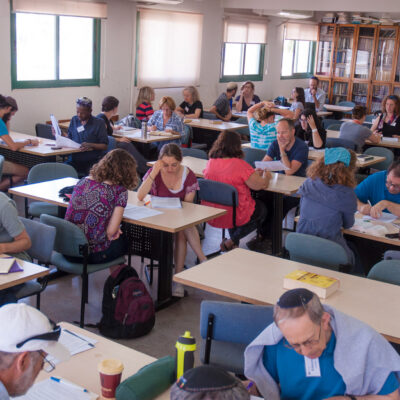
A classroom operated by the Israeli education nonprofit Habaita, with support from the defense firm Elbit.


 Add EJP on Google
Some nonprofits merge. Some close. Others rebrand and relaunch. Habaita was built to close its doors.
Boston-based venture capitalist Izhar Armony founded Habaita in 2024, betting that better schools could bring families back to the Gaza border communities that were evacuated following the Oct. 7 attacks. The Israeli education nonprofit has since expanded to 14 municipalities in the Western Negev and the Galilee.
When the organization’s five-year clock runs out in 2029, its leadership plans to wind it down, regardless of whether the demographic crisis it was built to reverse is fully solved. “Even if the 2029 survey doesn’t show the full impact we want to see, I feel that Habaita’s job, and time to make a difference, is done,” Armony told eJewishPhilanthropy recently. “Five years feels like a long enough period of time to pilot programs, to grow those that are showing positive results, and to get to full scale.”
Habaita grew out of Armony’s earliest wartime work. In the weeks after Oct. 7, he supported five of the hardest-hit border kibbutzim: Kfar Aza, Nahal Oz, Kissufim, Re’im and Holit. Leaders there warned that families would stay away unless the region offered them a reason to return, and a February 2024 population survey pointed to schools as that reason.
Habaita launched that summer with a NIS 20 million ($6.5 million) pilot, serving 9,900 returning students, in partnership with the Tekuma Administration, the governmental body overseeing the reconstruction of the Gaza border region.
Habaita funds programs and leaves physical buildings to others. Its flagship effort operates out of assorted government facilities and school buildings, where students in the Western Negev and the Galilee can try technology, performing arts and competitive sports. One program, run with a major Israeli defense contractor, fills a converted hangar with robotics, drones and machining equipment and hosts weekly three-hour sessions for classes from across the region. By the 2025-26 school year, the organization says, it was serving 40,000 students.
Still, the notion of an organization with a sunset date — a date when the lease will not be renewed, when staff will no longer be employed and when the mission will only be mostly or somewhat complete — is rare across American and Israeli nonprofits alike.
Israel has 40,000 registered nonprofits, according to GuideStar. How many still operate is harder to say, according to Alon Bachar, co-founder of Community O and the former head of the Israeli Corporations Authority, which regulates Israel’s nonprofits.
Registering an Israeli nonprofit is relatively simple, with 1,500 to 2,000 new ones added each year, Bachar said. Dissolving one is slow and costly, in part because any remaining assets must go to similar public purposes. Most defunct groups simply stop filing reports and linger on the registry until the authority removes them.
“The gap between the cessation of operations and removal from the registry makes it difficult to determine with certainty how many nonprofits in Israel are active,” Bachar said. No official figures track voluntary dissolutions, he added, but they are rare. Habaita plans to be one of them.
Oct. 8 Israeli expats
While the emergence of so-called “Oct. 8 Jews” in America has been largely covered, less covered is the advent of a different type of Jew: a reawakened Israeli who spent much of his professional life living in America.
Armony’s own awakening was born of personal loss. His cousin Sharon Avigdori and her 12-year-old daughter, Noam, were kidnapped from Kibbutz Be’eri and taken into Gaza on Oct. 7.
Both were released in November 2023 during the first hostage-release deal. “I felt very, very frustrated, sad and I just went,” Armony said. He flew to Israel on one of the first flights, on Oct. 10, and spent weeks with a five-person team helping evacuated families find temporary housing. Early on, he said, that meant buying displaced families basics like underwear and toothpaste.
“I felt it was my responsibility because I can,” Armony said of why he got involved so immediately and so directly, rather than simply writing a check from Boston.

Before Oct. 7, Armony said, trips to Israel were a family vacation once or twice a year. Since then, he has spent 165 days in Israel one year and 155 the next. “My attention and time shifted to Israel,” he said, describing the change as a kind of personal reprioritization that went well beyond philanthropy — it now demanded his time and presence.
Habaita was also his first exposure to Israeli local and central government, he said. “I knew nothing about that.” Before Oct. 7, his Boustan Charitable Foundation mainly focused on shared-society work in Israel.
Armony’s family has committed $25 million to Habaita’s $120 million five-year budget. Philanthropic support is expected to cover half of the organization’s budget, with the Israeli government matching it.
Beyond Armony, various Jewish federations and foundations have committed $21 million in total, leaving $14 million more to raise. Donors include the Jewish federations of Boston, Washington, Cleveland, Detroit, Houston, San Diego and Toronto, as well as New York, including through its Day After Fund. Habaita also noted the generosity of the Jewish Federations of North America; Jewish Federations of Canada-UIA; Keren Hayesod-UIA; KKL-JNF; the Edmond de Rothschild, Frieze Family, J. Blair and Tina Frank, and the de Toledo family foundations.
The ultimate goal
Asked how he balances Habaita achieving its goal when it sunsets with the fact that the cause it serves will likely never be fully solved, Armony acknowledged that it poses a serious challenge, in part because his focus — education — is not the only factor in addressing the larger aim.
“Our ultimate goal is to drive demographic growth in the Western Negev and the Galilee regions,” he said. “We recognize it will be impossible to isolate education [as] a single contributing factor. We might do a great job improving the education system, but the demographic growth won’t be where it should be because of other factors; and vice versa: even if the demographic growth is great, how can we tell it is mostly due to education?”
Armony said Habaita tracks how residents feel about their schools year over year and looks for a rising trend, since the group’s own research and other studies tie those attitudes closely to population growth. A final study at the end of the program will compare results against a February 2024 baseline and the data gathered along the way. Interim readings, he said, make him fairly confident that parents and students are already noticeably more satisfied with their schools.
Setting an end date
Armony said the choice to sunset in 2029 is deliberate and strategic. An open-ended Habaita would give the government no reason to take over, even though the need will persist. “If we say we’ll be here forever, the government has no incentive to step in,” he said.
Part of making that handoff work, Armony said, meant learning early on that the political leadership of a ministry is rarely where the actual work gets done. He said Habaita won the relevant minister’s blessing. The team went further down the hierarchy to career officials like a district head with 34 years in the job who, he joked, knows the details down to how many pencils a classroom needs. Those officials already had plans for the region but lacked the money and attention to carry them out, and most of their priorities overlapped with Habaita’s.
The partnerships started small and grew as Habaita shared results and gave officials the credit. In less than two years, Habaita’s annual philanthropic contribution quadrupled, from roughly NIS 10 million ($3.25 million) to NIS 40 million ($13 million).
“A lesson for nonprofits and philanthropists is to find the people who are there to do their job — usually nonpolitical, usually civil servants, many years in the office,” he said. The key, he added, is humility: treating the work as a shared effort.
With government funds roughly matching it, the full project runs about NIS 80 million ($26 million) a year through 2029. In the Western Negev, Habaita’s main government partner is the Tekuma Administration. In the Galilee, it works mostly with the Education Ministry and local municipalities as there is no single government body tasked with reconstruction efforts — a sore point for northern residents and the nonprofits that support them.
While much of the Oct. 7 emergency response focused on southern Israel, Armony said the Galilee’s needs were different and arrived on a different timeline. He said the average evacuation there lasted 15 to 18 months, far longer than in most Negev communities. “[In parts of] the Galilee, return rates are much lower — we have places… below 50% return rate,” he said. He added that the Galilee’s challenges predate the war: “Their problems with education did not start with the war — they were there before. They were just exposed, and [the war] made it worse.”
Armony, the venture capitalist turned Oct. 8 Israeli philanthropist, is betting that five years of results will persuade officials to take over what has been working. “And if the stakeholders — local municipalities in particular, but also the Ministry of Education — do not want to finance a program, it is their right,” he said. “[It’s] not for us to force them.”
Related News

EXCLUSIVE
Detroit-based philanthropists Nancy, James Grosfeld donate $8M to renovate JDC’s Israel campus

MAJOR GIFTS
Center for Jewish History celebrates 25 years with a $25M matching grant
ADVANCING A VISION
N.Y. federation donates $1M toward building shared-society center named for peace activist killed on 10/7

EXIT INTERVIEW
Elizabeth Sokolsky, longtime EVP of Birthright Israel, to retire next year
CLOSING WORDS
In AZM address, Cosgrove links communal ‘orthodoxy’ on Israel to rising anti-Zionism among young Jews