Opinion
SILVER LINING
Political homelessness is freeing




 Add EJP on Google
In Short
In times of political homelessness, Jews can always turn to Judaism for guidance.
Last week, a friend told me about teaching her high school students political philosopher Thomas Hobbes’ theory that without government, we can’t live moral lives. Moral precepts like seeking peace and keeping one’s word, which Hobbes calls eternal and discoverable through reason, exist even in the “state of nature”; the problem is that no one can safely act on them without a sovereign power to ensure that others do the same.
I am sure I must have learned these big ideas in high school, too, but I didn’t remember them. Hearing them in 2026, around the third anniversary of the Oct. 7 attacks, they landed with a thud. My view of politics and government has changed so much in recent years, and not for the better.

Getty Images
Illustrative.
Hobbes thinks we need to find morality through government, but I am turning to religion.
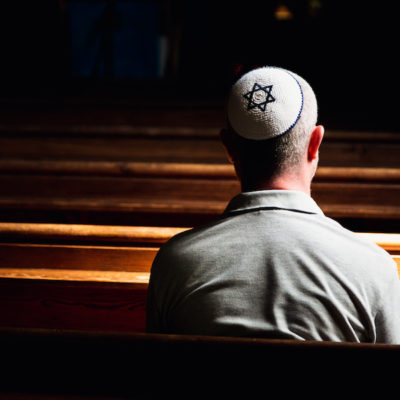
Many American Jews feel politically homeless these days. Not all of us, but a lot of us. Those who once felt comfortable on the left are facing the antisemitism that has been there for years but now become impossible to overlook or excuse. Those who found a home on the right, grateful for leaders willing to acknowledge and defend Israel and Israelis, have watched that support waffle and wane with the winds of the moment. The loudest role models on the right — talk show hosts and social media heroes — have become unabashedly and outspokenly critical of the Jewish People.
Around 2020, I spent enormous energy making sure I was saying just the right thing. The political and social movements I aligned myself with had many very specific demands on my language: Introduce yourself with your pronouns. Include a statement rejecting racism in every bio. Make a land acknowledgment, but not a performative one. These demands all correspond to real issues that I still care about deeply, but the language rules were nearly impossible to follow and I am embarrassed by how much of my mental and emotional energy I spent on trying to get them right.
After Oct. 7, 2023, like many politically liberal Jews, I found myself suddenly and painfully uncomfortable in the movements and organizations I had been a member of. I wandered over to the right, hoping to find a different political home, but the right carried its own language rules — up to and including a willingness to declare Christ as king. I couldn’t meet those either.
As American Jews, we are raised to be civic-minded and align ourselves with bigger fights, so it isn’t surprising that many of us are feeling abandoned and alone. But my experience has been different. I am not lonely — I am liberated.
I still read the news with sadness and anger, but with clearer eyes. I ask critical questions regardless of which journalist is speaking in which outlet. I don’t feel required to sign anyone’s petition or open letter. I get to choose my own language.
But total independence is, as Hobbes correctly noted, dangerous. I cannot, and should not, move through the world feeling accountable only to myself. That is a surefire recipe for immorality and greed. But in feeling less and less accountable to the ever-shifting demands of America’s political leaders and movements, I have come to see more clearly my accountability to Torah and mitzvot. In other words, to God.
Every day, I recite traditional Jewish prayers in which I call God king. In this world that is so obsessed with power and influence, I am choosing to be influenced by the Divine. By coronating God, I reject the human kings with their human demands, and instead commit to assess my merit by who God wants me to be. Do I seek justice and practice kindness? Am I loving my neighbors and the stranger? Do I take time to pray? To feel joy? To sit with the pain of the world and then work to make it better?
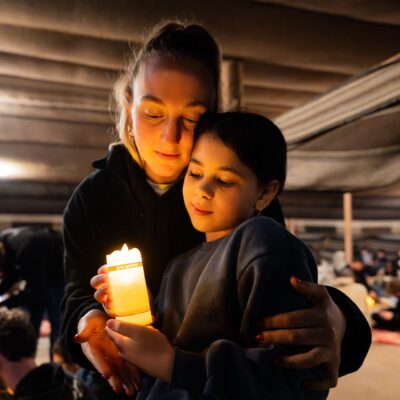
“A mitzvah is a candle, and Torah is light” (Proverbs 6:23). The Talmud explains that, like a candle, the commandments light the way to put one foot immediately in front of the other, while Torah offers the kind of deep wisdom that helps us see farther and feel existentially safe. The passage ends, “And the path of life is the rebuke that disciplines.” To navigate the world with morality, we need rebukes. We need guardrails. We need guidance.
For the moment, while we are still lost in these political woods, I am choosing to take this guidance from the Torah. You can, too. Instead of bemoaning our loneliness, let’s take this opportunity to remember that we are part of the Jewish People. Thankfully, this membership comes with an abundance of guidelines for how to speak and behave. We need these commandments desperately right now. Let’s study them and do our best to live by them. Perhaps they will change us — and the world — for the better.
Rabbi Avi Killip is the executive vice president of the Hadar Institute.