OCT. 7 ANNIVERSARY
3 years on, ICF aids 573 kids, young adults orphaned on Oct. 7 with the long, slow road to recovery
The Israeli Children's Fund, also known as Atufim Be'Ahava, was created to provide for the 'civilian orphans' who lost one or both parents in the Oct. 7 terror attack
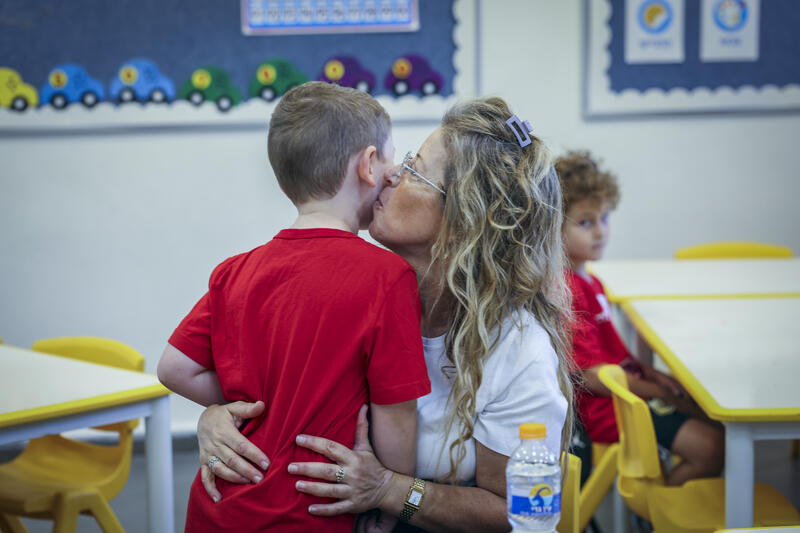
Yossi Zamir/Flash90
Illustrative. A teacher hugs a child at a school in Jerusalem on Sept. 1, 2026.




 Add EJP on Google
In a single bloody day, hundreds of Israeli children and young adults had their lives upended as their parents were butchered in the deadliest terror attack in Israel’s history and one of the deadliest ever. In some cases, they too were injured by the very terrorists who killed their parents or were forced to witness the brutality; in others, they learned of it from afar.
For the children with one living parent, they are being cared for by a person grappling with their own traumas from the Oct. 7 terror attacks. Those who lost both have mainly been fostered by aunts and uncles or grandparents, who also have just lost a sibling or child — in some cases, more than one.
Many of these orphans from the hardest-hit kibbutzim are still displaced; others have left the communities in which they were raised entirely, finding it too painful to remain in the same place and with the same people from before the attack.
Three years later, their needs — financial, psychological, social, educational — remain immense. They are also unique.
“Everything is much slower than you would believe,” Mody Kidon, the co-founder and chairman of the Israeli Children’s Fund, told eJewishPhilanthropy recently. “We have to be more patient. Each one of them is a different story.”
ICF, known in Hebrew as Atufim B’Ahava (“Wrapped in love”), supports 573 Oct. 7 orphans, from those that were still in utero when their fathers were killed up to those age 30. Roughly two-thirds of them are minors; 15% of them are from hostage families. Three-quarters lost their father, and 8% lost both parents. Most of them are from southern Israel, mainly the Gaza border communities, but also 17% from Bedouin communities.
“It’s a huge, huge number. It’s a number that’s unrealistic — you can’t imagine it,” Kidon said.
A former Israeli Air Force pilot, Kidon went into his family’s advertising firm, Gitam, helping build it into the country’s largest, and then broke into the field of real estate investing nearly 20 years ago.
When the Oct. 7 terror attacks began, his first thoughts were about the people he knew in the Gaza border area. And he realized: “Kibbutz Be’eri — it is one of my investors.” Be’eri was one of the hardest-hit communities in the Oct. 7 attacks, with hundreds of Palestinian terrorists infiltrating the kibbutz, killing more than 100 people, injuring scores more and taking 32 people hostage. It took days before the IDF had killed or captured all of the terrorists that had broken into the kibbutz.
In those initial hours, Kidon called Harel Yitzhaki, a former CEO of the kibbutz’s Be’eri Printing Press and member of the community’s investment committee, and promised to set up a fund to support the kibbutz’s orphans.
“[The idea] jumped to my head,” Kidon recalled. “When you are managing money for other people, you usually say that you have to respect it like this is the money of orphans and widows. This is how they educate you to be very, very careful of other people’s money. So immediately, I tell him, ‘This is my responsibility now. I’m taking care of your orphans.’”
At Yitzhaki’s urging, Kidon expanded this to include the orphans of the entire Gaza border region. Kidon said Yitzhaki also encouraged him to wait a few days before launching the fund, as others had expressed interest in supporting the victims of the attack.
“After three days, he gave me a few names… and I called them immediately,” he said. “I told them, ‘We’re going to do everything together. We don’t want there to be competition between the organizations. We want to help [the victims].’”
A few days later, that group merged with a similar venture founded by Chemi Peres, an entrepreneur and son of former Israeli President Shimon Peres, to create ICF. The founders set about hiring top professionals to lead the organization and began raising funds from the Israeli business community, private philanthropists, family foundations and Jewish communities abroad.
The organization also began to establish clear guidelines — what kind of assistance it would provide and to whom. For one, as to not overlap with the work of the IDF Widows and Orphans Organization, which supports the bereaved children of fallen soldiers, police and security personnel, ICF decided that it would only focus on the “civilian orphans,” who generally do not have the same level of support from the government and nonprofits as military orphans.
ICF also adopted more expansive criteria, providing support to orphans up to age 30, out of an understanding that most children continue receiving significant financial support from their parents through young adulthood.
This also gave the organization a clear end date: 2053, though its work will technically continue a few months beyond that. “We have 10 babies that were born after the attacks. We have a few that were born in May 2024,” CEO Miri Yaacobi Horowitz told eJP.
Its financial support is provided in “three kinds of packages,” Yaacobi Horowitz said. The first is focused on the immediate rehabilitation needs, providing funding for mental health care, resilience and recovery programs — paying for things beyond what is covered by government benefits and the National Insurance Institute.
The second is the “opportunity package,” paying for the formal and informal education programs that a parent would normally pay for: from after-school activities for elementary school children and summer camps to vocational training and scholarships for higher education.
And the third, Yaacobi Horowitz said, is for “lifecycle milestones”: birthday gifts, presents for Rosh Hashanah and Passover; bar and bat mitzvahs, weddings, graduations, first children, help buying a first car.
So far, the organization says that it has allocated some NIS 15 million ($4.88 million). Some of these grants are given to all beneficiaries; others are needs-based, with a retired judge serving as the head of the grants committee, which operates with recommendations from social workers, Yaacobi Horowitz said.
“We understood with time that giving money in this kind of situation of loss and trauma has to be combined with professional, tailor-made guidance, and this is how we we started to build our professional team of social workers who are guiding each family, each young adult to make sure that they are exercising their rights, that they get our [regular] grants, and then to feel what what is really needed,” she said.
The adoptive uncle of a teenager who lost both of his parents in the Oct. 7 attacks told eJP that when he and his wife took in their nephew, they realized that their home was physically not prepared for another person to live in. They reached out to ICF for help. “They gave a sizable grant for us to do a renovation so we could house him,” the uncle said, speaking anonymously to preserve his family’s privacy.
For the solidly middle-class family, it “felt like a luxury” to get a grant to redo their home, he said, but it was also not something that they would have done otherwise.
In addition to the grants, ICF also offers mentoring and support groups — for adoptive families, for teenagers getting ready to join the army or for widows with young children — as well as financial guidance, Yaacobi Horowitz said.
Sagit Kupperman, an ICF social worker who works with teenagers and their families, and Tom Regev, an ICF social worker who works with young adults over 18, stressed the importance of this customized approach.
“We are three years later, but people are still struggling — mentally, financially and in terms of employment,” Regev said.
“We have to adapt for everyone. There is no magic solution,” Kupperman told eJP. “We all try to see what each of them needs.”
Some beneficiaries need to be empowered to do things for themselves, to not rely too heavily on outside help. Others struggle to ask for help and need to learn that they can trust people again.
“Being in a position of having to ask for help is very awkward and uncomfortable,” the adoptive uncle told eJP.
On the other hand, he said, his nephew wryly jokes about the easy access to the myriad organizations and individuals who are willing to provide assistance and gifts as being his “orphan powers.” The uncle recalled his nephew being given three laptops by donors at one point. When one organization learned that his nephew used to play an instrument, it just bought one for him; it sat unused under his bed. This is while the family is trying to teach the teenage boy about personal finances and responsibility, the uncle noted.
Kupperman and Regev said that this is an area of consideration for them as they determine how best to support ICF’s beneficiaries and not only how to immediately give them everything that they ask for.
“It has to come from a place of connection, not just being an ATM,” Kupperman said.
Regev noted that many of her adult clients are also in a position of both receiving help and giving it to others.
“One person I work with is a preschool teacher; another is a doctor. There is a lot of giving [help] as well, of thinking, ‘How am I being supported and how do I provide support?’” she said. This is important, she added, to prevent a sense of “victimhood or pitifulness.”
In addition to navigating the needs of the beneficiaries, ICF and its social workers also help their beneficiaries navigate the often complex, intimidating maze of nonprofits and government offices that they must work with to receive the benefits that they are entitled to.
“We are working internally very, very hard to understand all the rights,” Yaacobi Horowitz said.
In addition to researching the government guidelines, ICF is also part of The War Orphans Forum, a network of organizations that support the orphans created in the Oct. 7 attacks and the wars that followed.
As an example, Yaacobi Horowitz said that ICF informs its beneficiaries of the various summer programs that are available to them. “We talk to all the [other] organizations,” she said. “And we have this mini-site for our beneficiaries [where] they can see all the programs of all the organizations — and that’s not us. We are not running any summer programs.”
The adoptive uncle, who in his professional capacity works at the intersection of government offices and the nonprofit sector, highlighted ICF’s cooperation with other groups, stressing that this is often not the case.
“They are part of this community of NGOs that are aware of the need, are willing to work together, and are working to make sure that the aid is being distributed based on need and equity,” he said.
The uncle — who was not referred to eJP by ICF — said that the organization stood out for its professionalism and sensitivity.
“We really like them. They have been thoughtful, kind, considerate and helpful. Our contact there [Kupperman] has been wonderful,” he said. “They have been very good, given how complicated our situation is in all sorts of ways, and I think that is generally true of other families.”
According to Kidon and Yaacobi Horowitz, the organization is roughly half-funded, with approximately 70% of its funds coming from donors abroad and 30% from Israeli supporters.
“We need to understand that recovery is not a linear process. They have ups and downs, ups and downs all the time, and it’s really so individual and so long-term, which is something that I’m not sure anyone knew or understood in the beginning,” Yaacobi Horowitz said. “This is complex, personal work that we need to build as we go. … We don’t know exactly how the trauma will be exposed, and what will be the needs. And our job is to stay here with them.”
On Saturday night, Kidon, Yaacobi Horowitz and ICF’s head of fundraising, Caroline Hagerty, along with two of the organization’s beneficiaries, traveled to the United States, where they will visit five communities — New York, Washington, Miami, Atlanta and Dallas — over the course of three weeks to raise money for the fund.
“There are so many organizations, and there are so many needs and so many causes,” Kidon said. “And we really respect other causes. But I think, as a Jew, this is the most important thing: to take care of widows and orphans.”
While ICF is bringing two of the young adult orphans that it supports on this fundraising trip, both ICF employees and the adoptive uncle of an orphan told eJP that the organization does not exploit the personal tragedies of its beneficiaries for fundraising purposes.
“We had NGOs come in that were unpleasant, in my view,” the uncle said. “They had a savior complex; it felt like they were in it for themselves, using us and our suffering to feel good about themselves, using our ‘sob story’ to raise money. I’ve had none of that with ICF.”
The social workers, Kupperman and Regev, noted that ICF’s website does not feature photographs of their beneficiaries, nor are they generally used in other promotional materials.
“If you ask me the names [of beneficiaries], I cannot tell you,” Kidon said. “I don’t want to know any name. I want everything to be just through the professionals.”
At the same time, Kupperman and Regev said, there are beneficiaries who want to be involved in supporting the organization, and that can also be respected.
The most important thing, Regev said, is to give them the power to choose. “They lost their sense of control [in the Oct. 7 attacks],” she said. “We need to return that. Everything we do has to be done openly, explicitly, transparently and with dialogue.”
This week, around the three-year anniversary, Kupperman said that the organization and its social workers are slowing down their activities, focusing on personal connection and offering warmth and strength to their beneficiaries, in recognition of the sensitivity of the period. “There’s less bureaucracy these days,” she said. “If we are speaking with them, it’s about our relationship.”
At the same time, Kupperman stressed, for the survivors and families of victims, Oct. 7 is only one of many painful days of the year. Birthdays, anniversaries, holidays can all serve as painful reminders of the ones that they have lost. For hostage families, there are also release dates or days when they learned that a loved one had been killed in captivity.
“There are many other dates during the year that can be triggers,” she said.
Asked how the needs of beneficiaries have changed after three years, from the initial months after the Oct. 7 attacks to today, Yaacobi Horowitz started to answer but then paused to reconsider.
“I was slow with my answer because the differences are not as big as you think,” she said, noting that the organization’s most recent grants included support for families moving back to Gaza-border kibbutzim and private mental health support — the types of funding that ICF has been providing for years at this point. “It’s still [support for] basic functioning,” she added.
At the same time, Yaacobi Horowitz noted, the organization has also given grants for joyful occasions, marking growth and progress.
“We have already helped with more than 30 weddings,” she said, noting that they have also given 11 grants to adult orphans who have had their first child and 33 grants for children celebrating a bar or bat mitzvah, as well as 79 scholarships for higher education.
“So life goes on, but it’s still slower than you’d think,” she said. “Recovery is a very slow process.”
Related News
ADVANCING A VISION
N.Y. federation donates $1M toward building shared-society center named for peace activist killed on 10/7
CLOSING WORDS
In AZM address, Cosgrove links communal ‘orthodoxy’ on Israel to rising anti-Zionism among young Jews
HIGHER EDUCATION
As Jewish donors reconsider academia, Jan Koum doubles down, endowing Israel studies at Stanford
EXCLUSIVE
Detroit-based philanthropists Nancy, James Grosfeld donate $8M to renovate JDC’s Israel campus

MAGICAL EXPERIENCE
Shefa launches psychedelics retreat for Jewish professionals suffering burnout