Opinion
READER RESPONDS
The next generation is already leading. Give us a vote.


 Add EJP on Google
I read Betsy Berns Korn and William Daroff’s piece in eJewishPhilanthropy (“The next generation is already leading. Let’s make room.” Sept. 18) and reacted the way I think a lot of teens would: I nodded along at every paragraph, then wondered what steps are being taken to turn it into reality.
When people picture the next generation stepping into communal leadership, most imagine college students like the campus leaders Korn and Daroff write about, the ones who stepped up after the Oct. 7 attacks and their aftermath. But this generation doesn’t start showing up in college.
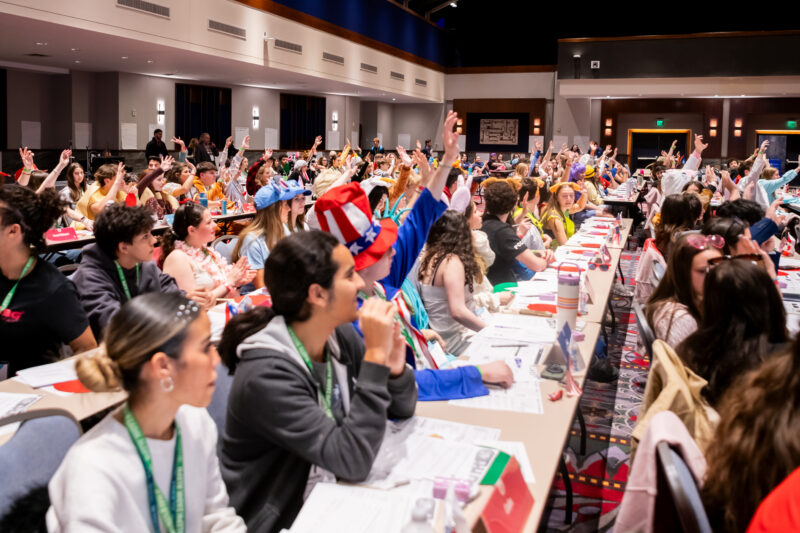
Courtesy/BBYO
Teen leaders meet and vote at BBYO’s February Executives Conference in 2026.
It starts much earlier.
My name is Adi Shankman, I’m 18, and I just graduated from high school. I serve as one of BBYO’s teen presidents, the 102nd International Grand Aleph Godol, alongside my counterpart, Kayla Hertzberg, the 82nd Anita M. Perlman International N’siah.
A few months ago, I was in Mexico meeting with teen leaders from across Latin America. On day three, during a session on building programs, I went around the room asking my peers how many teens came to their chapter events.
Forty. 60. 25.
Then a 17-year-old from El Salvador, said, “Four.”
My first thought was, “Okay, I can work with four.” I have a whole toolkit for small chapters, and we will reach 15 by December.
But then he explained to me that four was really good. He could count the number of Jewish teens in El Salvador on both hands; and yet, even with a small community, this teen had given up a week to fly to another country and learn how to run better programs for four people. Looking back, I felt kind of silly for jumping straight to growth numbers.
I think adults often do the same thing with teens: they see our age first. Korn and Daroff write that young leaders should be able to “assume responsibility before every credential has been accumulated.” The teen from El Salvador is doing exactly that, and he’s not alone. Stories like his are unfolding everywhere, from Toronto to Tokyo.
As a leader of the largest pluralistic Jewish teen movement, I agree with the article’s call for institutions to move beyond “encouragement, conferences, fellowships and invitations to observe,” but would take it a step further. How about inviting high school students to join Jewish institutional boards, with a voice and a vote?
That’s the idea behind Seat for the Future, a BBYO initiative launched this year encouraging local, national and global Jewish organizations to add a teen to their board of directors as a voting member. And the best part is, the impact doesn’t end when their term in office does — that’s when it begins. A teen who helps shape a strategic plan or votes on a budget goes to college knowing how the Jewish community actually works. Years later when they come home, they aren’t strangers to communal life. They’ve already helped lead it.
Since we began presenting this idea, we’ve heard the concerns, and they’re fair. Will a high school student take the responsibility seriously? Between school, extracurriculars, college applications and everything else, do they have the bandwidth for governance? Is this real commitment or a résumé line?
Here’s my answer: teens can absolutely do this. No one flies to another country to learn how to build programs for four people to “pad a résumé.”
In fact, teens in BBYO are already doing this kind of work. Local chapter and regional boards are run entirely by teens who manage budgets, plan programs, recruit new members and figure out how to keep people coming back. Many put in hours every week on top of school, and they don’t get graded for it. They do it because they care about whether their chapter or region succeeds.
Korn and Daroff’s piece closes with the Torah’s account of Moses and Joshua, and it’s worth remembering how that story begins. Rabbi Lord Jonathan Sacks, whom I’ve long looked up to, taught that Moses’s greatest act of leadership wasn’t the parting of the Red Sea or the Ten Plagues; it was preparing the generation that would come after him. That work started early. When the Torah first describes Joshua keeping watch at the Ohel Mo’ed, the Tent of Meeting, it calls him a na’ar, a young man (Exodus 33:11). Moses didn’t wait for Joshua to grow up before bringing him close, a reminder that leadership isn’t something you hand over at the end. It’s something you share from the start.
Korn and Daroff ask our community to trust young people with real responsibility. I’d take them at their word. Make real room with real votes for Jewish teens in the places where “yes” and “no” matter. Give us the platform and you’ll see that we’re already building our future, in rooms of four and rooms of 4,000, all over the world.
In the end, what we’ll be remembered for as a community isn’t only what we did for today. It’s what we build for the future of all Am Yisrael.
Adi Shankman serves as the 102nd Grand Aleph Godol (teen president) of BBYO.