PHILANTHROPY PIVOT
How Oct. 7 shaped and reshaped the Jewish nonprofit world and its leaders
The massacres in Israel fundamentally changed Jewish nonprofits’ purpose, scale and motivations

Judah Ari Gross/eJewishPhilanthropy
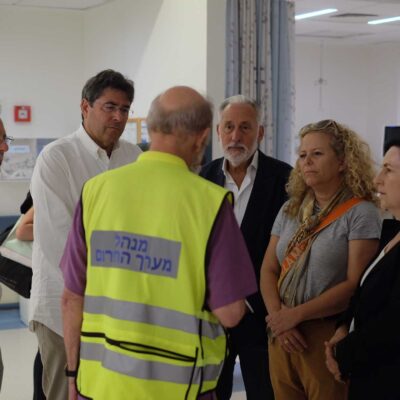
Bruce Sholk from the Jewish Agency for Israel; Eric Goldstein, CEO of UJA-Federation of N.Y.; Eric Fingerhut, president and CEO of Jewish Federations of North America; director of the Fund for Victims of Terror, Ayelet Nahmias-Verbin; and director of JFNA's Israel office, Rebecca Caspi, hear from the head of Barzilai Medical Center's emergency services, Dr. Ron Lobel, while visiting the hospital on Oct. 9, 2023.




 Add EJP on Google
In the days and weeks after Oct. 7, the New Israel Fund began, for the first time, providing direct services to Israelis, calling hotels, buying open rooms to house displaced Israelis and supplying basic needs to survivors and hostage families.
In the middle of the night on Oct. 7, Yotam Polizer, who leads the Israeli humanitarian aid group IsraAid and was in New York at the time, was on the phone to Morocco, pulling his workers who were responding to the devastating earthquake there and directing them to head to Israel. For the first time in its 20-plus-year history, the organization was putting its expertise in disaster relief, cultivated in 65 other countries, into action at home.
Even the families of Israeli hostages, who bore the country’s pain on their shoulders, made sharp pivots in the wake of the Hamas-led massacre. Ruby Chen, whose 19-year-old son Itay was murdered on Oct. 7, is a Brooklyn-born businessman with a 30-year background in technology mergers and acquisitions. But this summer, Chen, believing that rehabilitation couldn’t simply mean going to memorial services for the dead hostages, co-created an American nonprofit, American Prosperity in the Middle East, pushing to establish formal diplomatic, economic and security ties between Israel, America and others in the Middle East.
The Jewish world marks time these days with a sharp designation: Before Oct. 7 and After Oct. 7. And ahead of the third anniversary of the attacks, eJewishPhilanthropy examined how the leaders of groups like the Jewish Federations of North America, American Friends of Magen David Adom, the Joint Distribution Committee, as well as NIF and IsraAid, navigated those emotion-filled early days and helped shape the profound changes in the Jewish nonprofit world that were just beginning to emerge.
Preparation pays
On the morning of Oct. 7, Magan David Adom workers were on high alert — the same way they are for all Jewish holidays. It was both Shabbat and Simchat Torah, the celebration of the ending of one cycle of the Torah and the beginning of the next, a day of dancing and glee, but which — for an ambulance service — can also mean a day of falls, alcohol overconsumption and exhaustion. The year prior, Magen David Adom opened The Marcus National Blood Services Center, named after Home Depot co-founder Bernie Marcus, in Ramla, Israel, a $200 million, 550,000-square-foot, six-story subterranean blood services center, the first of its kind in the world.
“Some people at the time thought, ‘Why on earth do you need an underground and shielded blood bank?” Catherine Reed, CEO of the American Friends of Magen David Adom, told eJewishPhilanthropy. The Oct.7 attacks showed the naysayers why. Soon after sunrise, rockets blazed across the gray-blue sky from Gaza towards Israel, and thousands of terrorists breached the country’s borders, flooding into the Gaza envelope on foot, motorcycle, pickup trucks and paragliders.
At the time, Reed was staying at The Dizengoff Garden Hotel in Tel Aviv, days away from the yearly gathering of Magen David Adom “Friends of” groups from around the world. Soon after waking, she received a rush of calls from colleagues urging her to stay in the hotel. Questions hung in the air. Would there be follow-up attacks? How many people were killed? How many hostages were taken? In those early hours, many didn’t yet know about the massacre at the Nova festival. The terrorists were slaughtering paramedics, destroying ambulances and clinics, targeting them specifically so they couldn’t aid civilians. Already, one medic had been shot while driving his ambulance.
Still, Magan David Adom put the call out to its 32,000 volunteers and 10,000 leapt into action, providing first aid and transporting victims to hospitals. The organization mobilized its fleet: 1,430 ambulances and intensive care units, hundreds of emergency motorcycles, three helicopters and 24 mass casualty response vehicles, which became mobile treatment sites. The organization airlifted supplies and additional ambulances, and volunteers went days without sleep. During the massacres, four medics were murdered.
Unity through tragedy
In the months leading to the Oct. 7 attacks, Sam Grundwerg, world chairman of Keren Hayesod–United Israel Appeal, was worried that the judicial overhaul protests raging through Israel since January would impact fundraising.
Typically, the organization raised $200 million per year, with the funds going toward supporting aliyah, strengthening Israeli society and bonding Diaspora Jews with the State of Israel. After hundreds of thousands of Israelis had taken to the streets week after week, in response to Prime Minister Benjamin Netanyahu government’s plan to curtail the power of the courts, Keren Hayesod was having a terrible fundraising year.
“I would have happily signed off on that if that would have kept Oct. 7 from happening,” Grundwerg told eJP. “Then when Oct. 7 happened, all of that just disappeared instantaneously.”
Once word hit donors about the attacks, Diaspora Jews stepped up, no matter their views on Israel’s government, according to Grundwerg. “Even some of those very same donors that I had… sat with, trying to explain why they should not hold back their support for Israel because of the judicial reform debate… they just wanted to know what they could do to help,” he said.
The Jewish Federations of North America and its 146 member organizations saw a similar push to donate in the wake of the attacks, raising $500 million within three weeks, supporting 800 Israeli NGOs in providing medical and emergency services, mental health support, economic support and aid for the victims of terror. The organization was prepared, Eric Fingerhut, president and CEO of the Jewish Federations of North America, told eJP.
He had seen the organization through the COVID-19 pandemic and Russia’s invasion of Ukraine, but “the magnitude of this we understood immediately was greater than anything that we had dealt with in a long time, but the nature of it wasn’t that different,” he said. “You don’t build a firehouse when the house is on fire. You build a fire department to be ready for a fire.”
Bitter homecoming
A month prior to the attacks, Polizer moved to New York for a nine-month stay to promote IsraAid. He had recently received the Charles Bronfman Prize for his decade- plus- work providing humanitarian aid across the globe with the organization. On the night of Oct. 6, just before midnight, he was having drinks with friends at a pub near Chelsea when his phone blew up with initial reports about the attacks — and despair swept through him.
“What drives me to do the work I do on a very selfish level is this feeling of helplessness,” Polizer said. It was a feeling he knew well — from when other countries were rocked by tsunamis, Ebola and war. This was the feeling that motivated him into action in the Philippines, in Nepal, in Greece and around the world. It was that feeling of hopelessness — suddently deeper and more personal than ever before — that launched him to take action at home for the first time in IsraAid’s existence.
Within days, less than a month-and-a-half after moving to the U.S., Polizer was back living in Israel, leaving his wife and 4-year-old twins in New York, visiting them when he could. He was happy they weren’t with him, as he was constantly racing to shelters as Israel fielded attacks from Hamas, Hezbollah and the Houthis. But his family couldn’t avoid the trauma of being Jews in New York, where his wife witnessed people ripping hostage posters off walls near the preschool that their children attended.
IsraAid launched a $20 million operation in 16 communities in Israel, providing mental health support and emergency supplies, raising new schools in Kibbutz Be’eri, which was among the hardest-hit areas during the attack, and building 62 bomb shelters for Bedouin communities that lacked protection.
After establishing its framework in Israel, IsraAid also crossed the border into Gaza, as well, Polizer said. The Strip was devastated by the war with Israel, its infrastructure in ruins, with much of the population displaced and the civilian death toll climbing. Beginning in early 2024, IsraAid began quietly helping international aid organizations coordinate with the Israeli government and military, increasing aid as the humanitarian crisis continued during the war and after.
“I thought our name and our identity [were] a huge disadvantage,” Polizer said. “Thankfully, I was wrong. I actually found out that our identity is a huge advantage because we’re the only or one of a handful of organizations who understand Israel’s security concerns and also understand the humanitarian needs and can help mediate and coordinate and facilitate aid and work with the Israeli authorities to make sure that the aid reaches civilians and not Hamas.”
From funding to doing
NIF was uniquely prepared to leap into action because the organization was entwined with the civil society organizations that led the anti-Netanyahu protest movement and were organized with centers in towns across Israel.
In the months after the attacks, with the government “paralyzed,” it was these advocates who mobilized to provide food, clothes, transportation and housing to those affected by the massacres, Shira Ben Sasson Furstenberg, the director of New Israel Fund in Israel, told eJP. They were also the people to hit the streets to advocate for the hostages, with NIF serving as one of the first sponsors of the Hostages and Missing Families Forum.
In 2023, to support the protest movement, NIF nearly tripled its grant budget and permitted emergency grants within 24 hours, allowing funds to be immediately accessed after the attacks to support Israelis. For the first time, NIF pivoted to offer direct services to Israelis. Many recipients were not their typical beneficiaries; some may have disagreed in the past with the progressive organization, which has historically been tied to supporting freedom of speech, religious tolerance, gender equality and Arab rights.
While other Jewish organizations prided themselves on partnering with government agencies, NIF looked to Israel’s most overlooked communities, including Bedouin villages in the Negev, asylum seekers and Arab towns lacking shelters, to ask for their needs.
Building on a basis
The attacks created 800,000 new vulnerable people, Ariel Zwang, CEO of the American Jewish Joint Distribution Committee, estimates — families of the over 300,000 reservists called to duty, displaced families, the injured and people struggling with newly formed mental illnesses.
“These are people that before Oct. 7 had a home and jobs, intact families, slept through the night, they were fine,” Zwang said.
At the same time as JDC was supporting Israelis — even cooking meals for displaced families out of the organization’s offices in Jerusalem — it was still assisting vulnerable Jews across the world, including in Ukraine, where needs were more significant, she said, but funding had decreased as the conflict was no longer front-page news.
Meanwhile, antisemitism exploded across the globe, often in the guise of anti-Zionism and with deadly consequences, and JDC provided services in Western European Jewish communities that were not poor, but needed security and help cultivating positive Jewish events for communities suddenly under attack.
“If I had to summarize the largest ‘aha’ for me and for JDC,” Zwang said, “I would say, in the last five years, not only in the last three, [it] is that crisis has become constant for the Jewish people.”
JFNA too pushed more funding into security over the past three years. Before the October 2018 mass shooting at the Tree of Life synagogue in Pittsburgh that left 11 worshippers dead, there had only been a handful of communities with security initiatives. Today, there are 141 full-time professional security programs in local federations. According to a recent JFNA report, the American Jewish community spent over $1 billion on security in 2025 as antisemitism surged through communities, turning increasingly violent.
Federations also were faced with new obstacles. For decades, they relied on trips to Israel to cultivate Jewish identity, Fingerhut said, but with trips now canceled, JFNA had to fill those gaps; they increased funding to schools, youth groups and camps, which were also overburdened by the mass surge of so-called Oct. 8 Jews, looking to newly connect with their heritage.
Too many, too little
For hostage families, there were actually too many organizations rushing to help with too little coordination, Chen told eJP.
Chen found himself an unlikely advocate for hostage families when his son, a dual U.S.-Israeli citizen who served in the Israel Defense Forces, was believed missing after the attacks. When Chen looked for help advocating for his son, he felt that many organizations “overexposed and used” hostages struggling with trauma, he said; at the same time, they didn’t provide enough services for the families of deceased hostages.
“For the families of the killed, the rehabilitation is even more difficult and more challenging [than for the living hostages],” Chen said. “A hostage that came out alive that is 25 years old has a life ahead of him that he can build on. We on Oct. 7 are going to memorial services, which is a bit different type of rehabilitation is required.”
This summer, Chen co-created an American nonprofit, American Prosperity in the Middle East, pushing to expand the Abraham Accords, which would bolster economic ties between America, Israel and its neighbors.
“Economic integration that will create a stronger, safer Israel,” he said. “If you have economic integration, people [are less likely to] go fighting one another when [they’re] making money [together].” He also hopes to see a statue erected in Washington recognizing the 50-plus Americans killed in the aftermath of the attacks. His son was one of those killed, though he refused to believe it at first.
In March of 2024, the IDF informed Chen that his son was killed by terrorists while he was defending civilians on the Gaza border during the attacks, but Chen prayed for a miracle, that the military was wrong. In November 2025, his son’s remains were returned; he had been killed in his tank during the attacks. Itay was the last American hostage to be released. He wants to believe that his “loss was not in vain,” he said. “How do we make sure that this doesn’t happen again? And more families [don’t] need to have [this] type of tragedy associated with them.”
Renewed purpose
When hostage bodies began being returned, murdered, Ben Sasson Furstenberg also found herself running “through the whole Kübler-Ross thing,” spiraling through the early stages of grief: denial, anger, bargaining and depression.
She was a member of Hakal, a halachic egalitarian minyan in the Baka neighborhood of south Jerusalem. Although she wasn’t in attendance that morning, when the sirens caused services to be canceled that morning, Ben Sasson Furstenberg’s husband locked up the synagogue along with a friend who lived nearby. The friend’s name was Jon Polin, and his only son, Hersh, was in attendance at the Nova festival. During the time that her husband and Polin were walking home together, Hersh would text his parents a pair of messages. First: “I love you.” Then: “I’m sorry.”
After 328 days in captivity, Hersh Goldberg-Polin was murdered in a tunnel in Gaza alongside five other hostages. He was 23. When his body was returned to Israel days later, it was riddled with six bullet holes — shot at point-blank range, according to reports.
When Goldberg-Polin was found murdered, Ben Sasson Furstenberg said, “I thought the war was over. I couldn’t fathom that the war will continue after ‘the beautiful six’ were killed,” she said. To her, it was proof that a military solution failed and that Israel would turn to a diplomatic solution. When it didn’t, she didn’t have time to protest, because she was busy planning Goldberg-Polin’s funeral, but then she gave in to despair, unable to return to the rallies.
Since Oct. 7, NIF has continued a shift away from gender equality, religious freedom, poverty and housing, which other organizations had picked up funding for, to increasingly focus on Israeli democracy and human rights, something Ben Sasson Furstenberg said is under attack during times of war.
“The easiest thing is to turn a blind eye to what’s happening in the West Bank with settler violence,” she said, referencing the spate of severe attacks by Israeli extremists that has included shootings, arson and assaulting Israeli troops if they protected Arabs.
Prior to the massacres, NIF’s donor base, which was predominantly American, began shifting. In 2023, 20% of donors were Israeli, and after NIF began providing services in Gaza through partners including the World Central Kitchen, half the donors to the $3.5 million emergency fund were Israeli; 85% were new to the organization.
Ben Sasson Furstenberg doesn’t use the word “hope” to describe her view of her work. “Hope sometimes is very far from reach, so commitment and strategy and solidarity is what you use, and those are important for me, as important as hope.”
In time, she mustered the strength to cry out in her personal life, too, founding a Shabbat vigil alongside other members of Hakhel. Every week hundreds from her congregation and others gathered in Baka after services, singing and praying alongside hostage families.
Beating burnout
Over time, Grundwerg said, a new challenge arose for fundraisers: burnout.
After Oct. 7, “all I saw and witnessed was a tremendous response” from donors to Israel, said Grundwerg, whose tenure with Keren Hayesod ended in August. But Israel has been at war for three years — “much longer than the War of Independence was… and to keep going back to our campaigns, what we call our appeals, our communities and our donors, and to be almost in a constant state of an emergency campaign, you can imagine how challenging that is.”
Even before Oct. 7, there was a trend in the philanthropic world where donors wanted to give in a more targeted way. That only increased after the massacres; donors wanted to support hostages and communities hit by missiles. But the old needs remain, he said. Even though numbers are down, Jews continue to make aliyah. Israel still has at-risk youth, Holocaust survivors and elderly citizens. In addition, the country is struggling with a so-called “brain drain” after nearly 270,000 Israelis left the country after the massacres, many of them with academic degrees, according to a 2026 Tel Aviv University study.
Grantmaking and nonprofit employees also find themselves having to work harder since the attacks, Mark Charendoff, president of Maimonides Fund, told eJP. After the attacks, the fund increased its budget by 50%. With increased funding, the foundation pushed into uncharted territory, such as mental health and rebuilding the agriculture of the kibbutzim, leaning on partner organizations for guidance.
“People are willing to work really, really hard if they see it’s for something that they really believe in and that their work is making a difference,” Charendoff said. “We gave people much more authority than they had before, just because we didn’t have time for the normal process of things.”
Even when it felt like the world was crumbling, Charendoff “felt grateful to be getting up in the morning and being able to fight this fight, and grateful to have a team that I didn’t have to explain anything to.”
Post-traumatic growth
In 2016, Polizer gave a Ted X talk in Tokyo titled “Post-Disaster Innovation” based on the notion that tragedies can lead to innovation and progress. For instance, the tsunami in Japan led IsraAid to provide mental health workshops for thousands of teachers, who ended up using their new skills to support students throughout the country, not just those directly devastated by the natural disaster. The storm also provided an unexpected personal gift — Polizer met his wife, who is Japanese. But after Oct. 7, Polizer couldn’t see a positive outcome in sight.
But after IsraAid began providing services in Gaza, Polizer found his organization facing an opportunity. The organization hired Arabic-speaking doctors, nurses, psychologists and social workers and partnered with humanitarian organizations from surrounding countries, many of which don’t have diplomatic relations with Israel. Today, providing aid in the Middle East is a pillar of IsraAid’s work.
Before the attacks, Polizer rarely thought about the Israeli identity of his organization. Now, it was an asset, one that could show neighbors how much Israel had to offer. He sees the potential down the line for helping cultivate a new Middle East.
“If we can make it in Gaza, we can make it everywhere,” Polizer said. “We want to be leading the solution on everything related to humanitarian aid and recovery.”
The world has changed in the years since Polizer was sitting in that Chelsea bar and his phone lit up. After nine months of living in different countries, his wife and children rejoined him in Israel. In September, IsraAid returned to Morocco with a group of leaders from northern Israel, who learned about the country’s healing after its earthquake. Even former hostages Aviva and Keith Siegel have joined the cause, becoming IsraAid ambassadors, healing their own trauma by helping others, touring refugee camps and meeting with First Lady Melania Trump and the U.N. Secretary-General Antonio Guterres to advocate for human rights.
“I can’t think of a better story of post-traumatic growth than that,” Polizer said. “They were in the tunnels in Gaza, and they’re now supporting the most vulnerable communities around the world.”
Related News
PRESIDENTIAL REBUKE
Israel’s Herzog: Mamdani ‘makes no effort’ to hide disdain for Israel, Jews must fight back

MAGICAL EXPERIENCE
Shefa launches psychedelics retreat for Jewish professionals suffering burnout
ADVANCING A VISION
N.Y. federation donates $1M toward building shared-society center named for peace activist killed on 10/7
CLOSING WORDS
In AZM address, Cosgrove links communal ‘orthodoxy’ on Israel to rising anti-Zionism among young Jews
EXIT INTERVIEW
Elizabeth Sokolsky, longtime EVP of Birthright Israel, to retire next year