Opinion
UNDER PRESSURE
After Oct. 7, Jewish parents chose Jewish schools. Now we have to keep the door open.




 Add EJP on Google
After Oct. 7, 2023, Jewish parents started asking different questions — not only whether their children are safe, but what does it mean to raise a Jewish child in this moment? What do I want my children to know about who they are? And what will ensure there is a next generation that not only knows it is Jewish, but wants to be?
For many families, those questions led somewhere very concrete: a Jewish school.
There is something deeply Jewish about that response. Nearly 2,000 years ago, with Jerusalem under siege, Rabbi Yochanan ben Zakkai famously asked for Yavneh and its sages. He understood that if Jews still had a place to learn and to teach, the Jewish people could survive even catastrophe.
Oct. 7 did not only awaken alarm. It awakened a determination to hold tighter to the people, traditions and identity that suddenly felt more fragile than ever. We saw families put on Stars of David they had not worn in years and walk into synagogues they had rarely attended.
And we saw parents choose Jewish education.
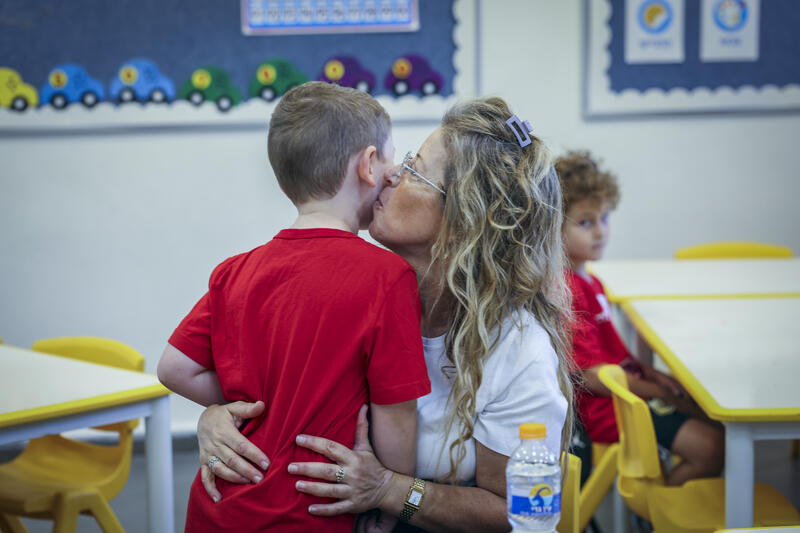
Some had been considering it for years. Others had never imagined it. Schools began hearing from parents looking for a place where their children would not have to explain who they are, hide a Jewish symbol or wonder whether being visibly Jewish made them a target. But safety was only part of it. If their children were going to encounter hatred because they were Jewish, parents wanted them to understand what being Jewish meant.
The numbers suggest this was more than anecdotal. Teach Coalition’s research found 175,798 students enrolled in New York’s Jewish schools this year, 8,502 more than in 2022-23, even as the state’s broader nonpublic-school sector declined. In Pennsylvania, Jewish school enrollment grew nearly five times faster in a single year than its prior average.
That should be one of the most hopeful Jewish stories of the past three years. In a moment when hatred sought to make Jewish life smaller, families chose more of it.
But just as Jewish education has become more urgent, it has also become more expensive.
Security is now a major added cost. Teach Coalition surveyed 63 Jewish schools across New York, New Jersey, Pennsylvania and Florida and found that the average school is spending more than $400,000 a year on security, 124% more than before Oct. 7. Per student, the cost has more than doubled. Increasingly, families are being asked to bear it. Nearly 6 in ten students now attend a school that charges a separate security fee.
That creates a painful contradiction. At the very moment more parents are asking how to give their children a deeper Jewish identity, we risk making that future harder to afford.
I have met those parents. They are sitting up at night with a tuition bill, calculating what they can cut, whether grandparents can help, and whether the school they want for their child is simply beyond their reach.
That cannot be theirs to solve alone.
The good news is that we know we can solve this problem. At Teach Coalition, we have seen what happens when families speak up. In state capitals from Albany to Tallahassee, lawmakers have funded security guards, STEM teachers, transportation, and other costs that would otherwise land on the tuition bill. That happened because tens of thousands of parents, grandparents, and school leaders called their legislators and told their stories. They made clear that Jewish families are not asking for special treatment. They are asking that their children count, too.
Now there is a chance to reach families nationally. Beginning Jan. 1, 2027, the Federal Scholarship Tax Credit will offer a federal tax credit of up to $1,700 ($3,400 for couples filing jointly) for contributions to scholarship organizations, but only in states that choose to participate. Governors are making that decision now.
Rabbi Yochanan ben Zakkai did not know what the future would look like. He knew only that if Jewish learning continued, the Jewish people would too. After Oct. 7, Jewish parents are reaching for that same answer. Our job is to make sure cost is not what stands in their way.
Our greatest obligation is not only to inherit what generations before us protected. It is to pass it on.
Sydney Altfield is the CEO of Teach Coalition, which advocates for government funding for nonpublic schools in New York, New Jersey, Pennsylvania, Florida and Maryland.