JUST DESERTS
Seeing Stars: Inside the Jusidman Foundation’s big bet on Bedouin leadership in Israel
Desert Stars aims to boost Israel's long-struggling Bedouin community through education and leadership training programs
Desert Stars/Facebook
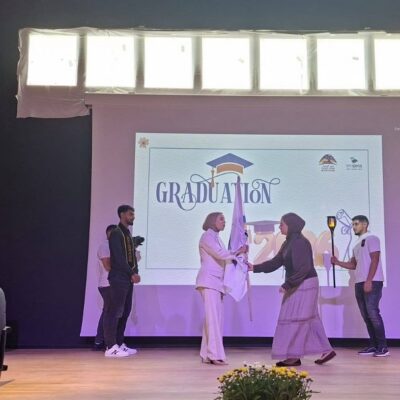
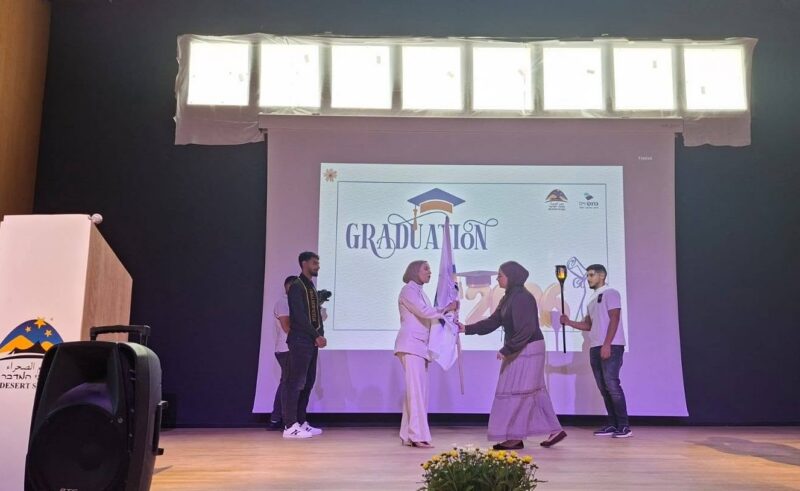
Desert Stars holds a graduation ceremony in June 2026.




 Add EJP on Google
THE NEGEV DESERT — On a bright day in June, a group of high school students ambled out of a sparkling new building and stood chatting on freshly planted grass. Among them was Rabie Salm Abu Medegam from the Bedouin city of Rahat, a bespectacled, open-faced and exuberant senior who chatted breezily with visitors in a mixture of perfect Hebrew, English and Arabic. He spoke about how important it was for him to use his voice to raise up his community, and about an anti-bullying project he and some friends had started at their school.
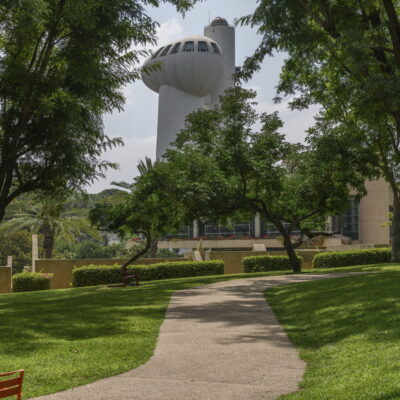
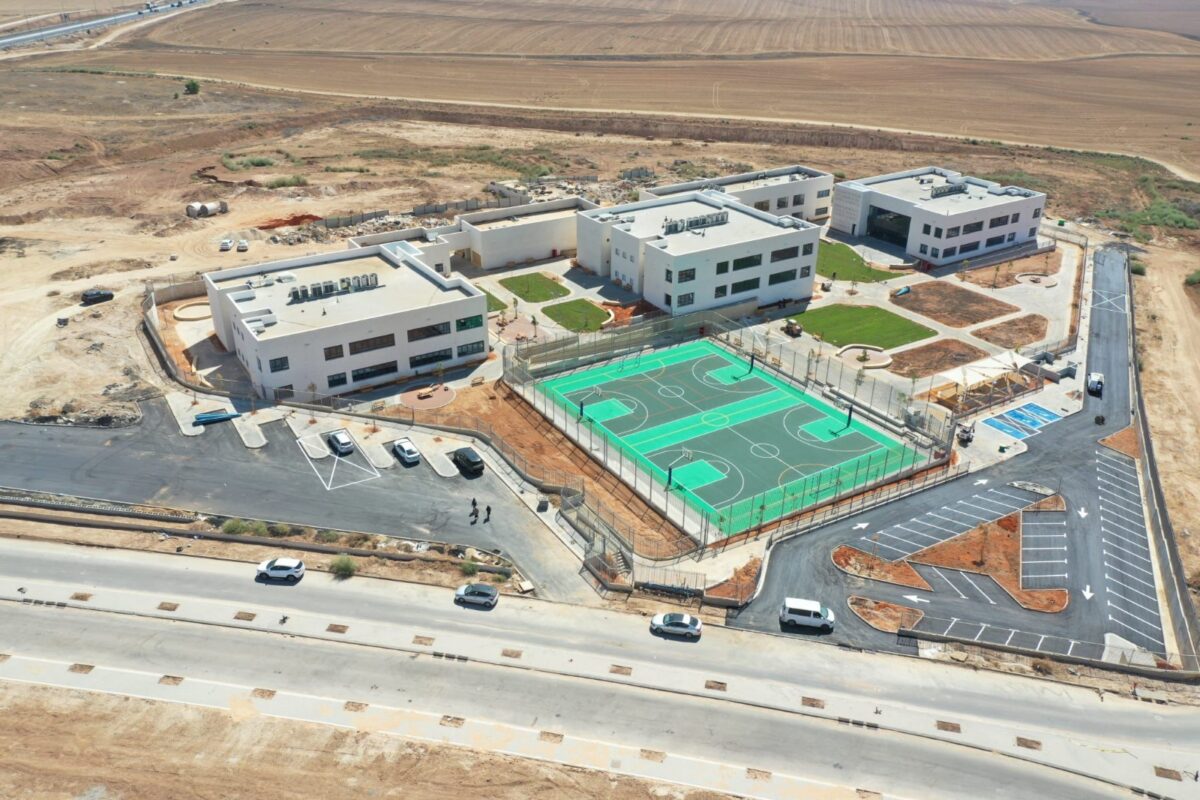
Last week, Abu Medegam graduated from Desert Stars, a Bedouin leadership organization whose new Jusidman Campus for Bedouin Leadership sits in the northern Negev. The brand-new campus — gleaming with new buildings and state-of-the-art classrooms with clear walls, nothing like the overcrowded and under-resourced schools that are common in the area — is the embodiment of a vision that Igal Jusidman, president of the Jusidman Foundation, has been pursuing for more than a decade.
“The Bedouin community is at the very bottom of any socioeconomic measurement you can find,” Jusidman told eJewishPhilanthropy. “It’s not a huge problem today, but it will grow exponentially. It’s a recipe for disaster.” The goal of the Jusidman Foundation, he said, is a stronger, more secure Israel — one that is both Jewish and democratic. “We want to see a strong Israel. A secure Israel. And we understand that we need to do something about it.”
According to Israel’s Central Bureau of Statistics, of the estimated 300,000 Bedouin living in the Negev, over half are under 18 — and by 2035, the community is projected to constitute half the region’s population. The gaps they face are staggering: The Knesset’s Research and Information Center recently found that roughly one-in-six Bedouin Israelis aged 16-17 has dropped out of high school — roughly five times the rate of Jewish Israelis. The most recent study, conducted in 2021, found that roughly 60% of Bedouin men and 25% of women are employed; while the rate for men is similar to that of other Arab Israelis, the rate for Bedouin women is nearly half that of Arab Israeli women overall and less than a third of the rate of Jewish Israeli women. The majority of Bedouin Israelis in the Negev live in poverty, in towns contending with overcrowding, poor health, rising crime and murder rates, and limited access to quality education. Many of their communities are also not recognized by the state, creating infrastructure and security problems. Entrenched tribal systems control schools, resources, and appointments, leaving no unified leadership able to advance the community as a whole.
Desert Stars was founded in 2013 with a gap-year leadership program for young Bedouin men. The model was distinctive from the start: rigorous Hebrew-language instruction, preparation for higher education and an extended outdoor leadership component — long hikes, group challenges, physical hardship — designed to instill the belief that participants could accomplish things they never imagined possible. A women’s gap-year program, Raidat, followed. Then a high school.
The Jusidman Foundation’s partnership with Desert Stars unfolded over time. “Normally, when we go into a program, it’s like a partnership — a long-term partnership. We don’t marry the first one we meet in the street,” Jusidman said. He spent two to three years following Desert Stars and its co-founders — Matan Yaffe, a fifth-generation Israeli and former IDF officer, and Mohammed Al-Nabari, a Bedouin community leader and former mayor — before bringing his father, Daniel Jusidman, in as a funder. “I wanted to understand that it’s a great organization with a good future, that it’s doing something very important, and doing it very well,” said Jusidman.
Yaffe is also the founder of a new political party, El HaDegel (To the Flag), a new Zionist political party founded by IDF reservists and civil servants, hoping to fight for universal military conscription, among other aims.
The Jusidman Foundation was established in 2010 by Igal’s father — a prominent Mexican businessman and philanthropist who built one of Latin America’s largest hardware companies before dedicating himself to philanthropy in Israel on a sweeping scale, most recently pledging NIS 200 million ($67 million) toward Israel’s largest rehabilitation hospital. The foundation has long focused its priorities on reducing socioeconomic gaps in Israel through education. When the family began mapping the landscape of Israeli society, two communities stood out as strategic priorities: the ultra-Orthodox and the Bedouin. With the Bedouin, the trajectory was clear: the birth rate is among the highest in the country, and the gaps are widening. The window to act, Igal Jusidman believes, is now.
About 10 years ago, Yaffe began talking to the Jusidman Foundation about a dream: a permanent campus that would become Israel’s first Bedouin youth village, modeled on the long-established Jewish Israeli youth village concept. In November 2025, the Jusidman Campus for Bedouin Leadership opened its first phase after nearly a decade of planning. Israeli President Isaac Herzog attended the inauguration, telling the students he believed one of them would someday win a Nobel Prize.
The campus now serves 330 students in grades 7 through 12, drawn from across Bedouin society — from Rahat, the largest Bedouin city in Israel, to unrecognized villages with no running water, paved roads or bomb shelters. The school year opens with intensive Hebrew immersion; students arrive speaking almost none and leave fluent. The results are impressive: 92% of students earn their bagrut, Israel’s matriculation certificate, with a 0% dropout rate, compared to a 60% bagrut rate nationally among Bedouins.
According to Menucha Saitowitz, the organization’s director of development who is an Orthodox Jewish resident of the city of Beersheva, the secret to the success of Desert Stars isn’t just about good test scores. Rather, the program teaches kids about their identity as Bedouins, gives them a sense of belonging in their community and country, and the belief that change is possible. “We have to encourage them to want to be part of Israeli society — and to feel welcomed into it,” she told eJP.
The curriculum moves through what she calls concentric circles of belonging. Students first explore Bedouin society itself — visiting different villages, meeting tribal leaders, encountering communities they’d never seen even though they grew up nearby. “I hear it every year,” Saitowitz said. “Somebody who grew up in Rahat has never been to an unrecognized village. They don’t know what it is, they don’t know the customs.” From there, the circles widen: Arab society in Israel, then wider Israeli society — secular Jews, the Haredim, Ethiopian Israelis, Russian speakers. “Instead of Jews and Arabs, it becomes: Israel is made up of hundreds of different groups, and Bedouin society is one of them.”
According to Desert Stars’ own 2024–25 attitudes survey, participants’ sense of belonging to Israeli society more than doubled over the course of the gap-year program — from 21% to 46% among women, and from 22% to 63% among men. Desire to get to know Jews better rose from 65% to 96% among women, and from 44% to 74% among men. Among alumni, 97% report having close friends from other tribes — a striking figure in a society where neighborhoods and schools are typically segregated by clan.
Khitam Abo-Badr, who founded the women’s gap-year program and now works in resource development at Desert Stars, experienced the barriers the organization works to dismantle firsthand. She grew up in an unrecognized village, the daughter of a mother who could not read or write. “My mother understood that education would make us into something,” she said. Under her mother’s encouragement, all eight of her siblings, along with two stepchildren, went on to earn university degrees.
Located mostly in Israel’s South, the Bedouin community was uniquely bound up in the violence of the Oct. 7 terror attacks. Twenty-one Bedouins from the city of Rahat were killed in the Hamas attack and the rocket fire that followed; six members of the Ziadna family were taken hostage. Stories of Bedouin civilians and soldiers who rescued Nova festival survivors that day have since become widely known, including that of Remo Salman Elhozayel, a Bedouin police officer credited with saving roughly 200 Nova survivors, and Youssef Ziadna, who personally rescued festivalgoers in his minivan and was among the first recipients of President Herzog’s newly created Medal of Civilian Bravery.
For many in the community, Oct. 7 marked a turning point — a sense of shared tragedy, and, briefly, a shift from feeling like outsiders to feeling truly part of Israeli society.
According to Saitowitz, in the semi-recognized Bedouin village of Kukhleh, in the immediate aftermath of Oct. 7, residents began putting Israeli flags in their yards for the first time in memory. “They were saying, yes, we are Israeli, we’re proud,” Saitowitz said of students from the village. “And then there was a housing demolition in the village. It completely deflated the whole village.”
The initial sense of shared fate between Bedouin and Jewish Israelis gave way, in the months that followed, to unease in the increasingly complex political landscape: A harsh political environment, intensifying home demolitions under the hard-line National Security Minister Itamar Ben-Gvir, and mistrust between Jewish and Arab Israelis.
Further complicating the picture, most Bedouin Israelis also have family in Gaza. “It’s very hard to see them [Gazans] as the other side when it’s somebody that you’re related to,” Saitowitz said. “If we don’t acknowledge that there are differences, we’re never going to be able to overcome them.”
“As a Bedouin, you feel hated by everyone — by Arab people and by Jewish people. And it’s really, really hard, ” said Abo-Badr. She deleted her Facebook account after the war began. “I couldn’t see the posts from my Jewish friends. I lost a lot of friends because they were saying hard things — like ‘erase Gaza.’ I can’t hear violent speech from either side.”
The war has made Desert Stars’ work both more urgent and more complicated. At school, the criminal violence has been impossible to keep out. One student’s father was killed in a shooting in Rahat. The school counselor lost her own son to clan violence. Students arrive carrying trauma that the formal curriculum cannot fully address. Desert Stars’ response is to create a space — perhaps the only one many of these young people have — where they can speak freely about what they’re carrying, without fear of social media exposure or retaliation. “If they talked about their feelings outside, maybe they would get arrested,” Khitam said. “So we allow them to bring it all here — even their hardest thoughts.”
For Jusidman, Oct. 7 opened a window. “It showed that we can be partners, that we can work together, that we care about each other. On the other hand, the divisions are deep and long-standing. The good things that happened between Jews and Bedouins after Oct. 7 aren’t going to suddenly heal them. It opened a window, and we have to work for it.”
The first phase of the Jusidman Campus is fully funded and debt-free. The next phase — dormitories, a career center, a cultural center with a mosque, and a dining hall — is still seeking a lead donor. Jusidman noted, with a hint of exasperation, that his father’s high-profile Israeli friends routinely call Desert Stars the most important program the family funds, yet few have been moved to write checks of their own. “Maybe we should start telling them: Put your money where your mouth is.”
For the graduating class of 2026, the money is well spent. Back on the lawn outside the new campus building, Rabie Salm Abu Medegam was asked what comes next, “I’m graduating, and I’m sad,” he said, “because I’m not sure if university will be like school — if it will give me what we get here. We get everything we need here. I’m sad I’m leaving.”
Related News
EXIT INTERVIEW
Elizabeth Sokolsky, longtime EVP of Birthright Israel, to retire next year
EXCLUSIVE
Detroit-based philanthropists Nancy, James Grosfeld donate $8M to renovate JDC’s Israel campus

MAGICAL EXPERIENCE
Shefa launches psychedelics retreat for Jewish professionals suffering burnout
PRESIDENTIAL REBUKE
Israel’s Herzog: Mamdani ‘makes no effort’ to hide disdain for Israel, Jews must fight back
ADVANCING A VISION
N.Y. federation donates $1M toward building shared-society center named for peace activist killed on 10/7