Opinion
READERS RESPOND
What happens when students lead Jewish learning: An experiment in Jewish male engagement




 Add EJP on Google
On a Tuesday night at Penn State, groups of fraternity brothers gather in their living rooms to talk about masculinity, responsibility and what it means to be a Jewish man. There is no rabbi or teacher at the front of the room. The conversation is led by a peer, for their peers.
Zack Wainer, Isaac Kurtz and Doron Kenter recently wrote in eJewishPhilanthropy about the Jewish community’s need to confront “a growing body of data” revealing that “on many of the measures that matter most for a flourishing life, men are falling behind” (“Engaging men and boys in Jewish life: What we know, what we don’t know and what we can do,” May 26) They concluded with a challenge: if we want different outcomes, we need to experiment with different approaches. So what might that different approach look like on college campuses?
Courtesy/Hillel International
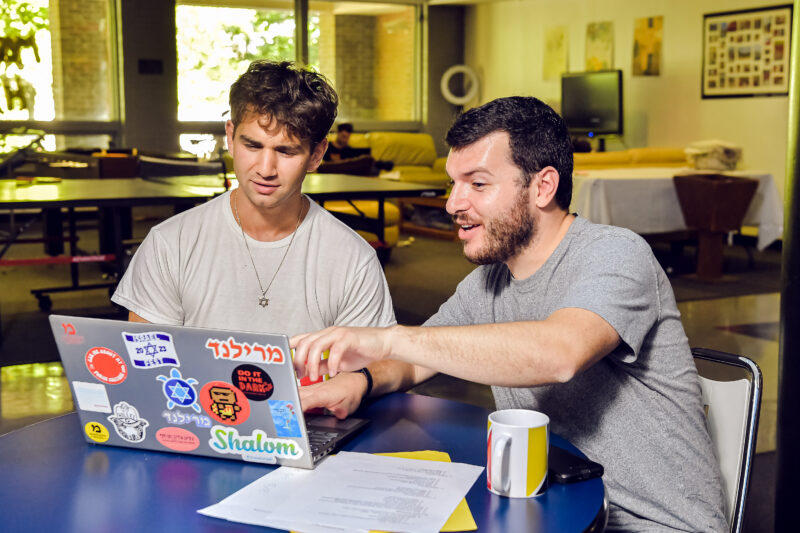
Illustrative. Two male Jewish college students.
For decades, Hillel has built learning programs designed to help students explore Jewish ideas in meaningful, relationship-centered ways. This model has proven remarkably effective at cultivating Jewish identity and a sense of belonging on campus.
And yet, a set of converging trends is impacting the landscape in which this work unfolds: First, as noted, male student engagement continues to lag behind that of their female peers. Second, students increasingly trust their peers much more than they trust institutions or traditional authorities. Third, we’ve found fewer students are stepping into leadership roles in the post-COVID-19 era, absent compelling frameworks for doing so. These trends are both root causes and outcomes of one another, affecting Jewish life on campus as well as Jewish communities beyond the college years.
The Men to Mensches (M2M) program, developed at Penn State Hillel and supported by the Maimonides Fund, offers a response to these converging realities, as well as the larger problem outlined in Wainer, Kurtz and Kenter’s piece. M2M is a four-session, peer-led, Jewish values and identity conversation that takes place within an existing male-networked community, such as a fraternity or an athletic team.
Each week, peer facilitators participate in a Men to Mensches session with a Hillel educator, and then lead that same conversation with a group of peers in their home community. In this model, the educator and institution provide the wisdom and structure that is passed on to a larger group through the peer facilitator. The role of the professional educator shifts from primary facilitator to trainer, thought partner and coach, modeling the sessions and supporting peer facilitators to reflect and improve between their sessions each week.
M2M has had a significant impact on past student participants. Peer facilitators come to see themselves as owners, creators and contributors to Jewish life on campus. Moreover, when students see a peer confidently leading Jewish conversation, they begin to imagine themselves as capable of Jewish leadership too. In both directions, this sense of ownership and reflective learning inspires an interest, curiosity and openness to continued Jewish learning and leadership.
One participant shared, “When I saw my [fraternity] brother teaching, I saw him in a totally new light. He wasn’t just a frat guy — he had wisdom to share.” Another participant said, “We were talking about real stuff — not just classes or parties, but who we want to be.”
This demonstrated success affirms Wainer, Kurtz and Kenter’s idea that “young men were drawn in not because they belonged, but because their participation mattered.” In M2M, the goal is not to attract students who aren’t coming into the Hillel building. Rather, it is to bring Jewish conversation into places where students already feel they belong and to invite them to take ownership of it. By empowering students to facilitate meaningful conversations for their peers within existing male-networked communities, M2M transforms these male students’ participation in Jewish learning from passive to active.
This spring, Hillel International piloted M2M on 17 campuses to test whether the model that succeeded at Penn State Hillel can scale.
This R&D approach aims to address this sector-wide male engagement challenge: seek out inspiring and impactful campus initiatives, understand the conditions that make them successful and invest in testing them across the movement. By scaling local innovations through national pilots, we can generate new knowledge, identify promising practices and actively explore strategies to strengthen male engagement and contribution across Jewish life.
Our hope is not only to replicate the success seen at Penn State Hillel, but to learn and to challenge our own assumptions in ways that might strengthen the broader Jewish ecosystem. M2M invites Jewish educators — working on campus and beyond — to consider:
What emerges when we place meaningful responsibility in the hands of young men?
What other experiments might invite young men to see themselves as contributors, leaders and builders of Jewish life?
How might we leverage existing communities where young men belong, rather than establishing new ones?
M2M is one attempt to empower young Jewish men to bring meaningful Jewish conversation into their closest social networks, and we’ve seen great promise. The work ahead is to continue learning, refining and sharing insights to collectively shape meaningful change across the field.
Rabbi Rob Gleisser is the senior Jewish educator at Penn State Hillel.
Mollie Feldman is the senior director of the Meyerhoff Center for Jewish Experience at Hillel International and is studying toward rabbinic ordination in the Shalom Hartman Institute’s Beit Midrash for a New North American Rabbinate.