Opinion
THE STORIES WE TELL
Why short films should matter to Jewish funders




 Add EJP on Google
In Short
When Jewish funders overlook short films, they miss one of the most efficient ways to invest in the future of Jewish culture.
In his interview for Reboot’s oral history project, “Silver Screen Studios: Coming of Age in 2020,” the legendary agent and producer Lawrence Kubik shared a story about one of the great missed opportunities of his professional life.
Kubik, who represented Sylvester Stallone and Arnold Schwarzenegger early in their careers, was producing “Zachariah,” a psychedelic Western backed by ABC Pictures, when the production ran into trouble. After the film fell behind schedule, ABC executives came to the set in Baja California and told Kubik he had to fire the director, George Englund.
Reboot Studios
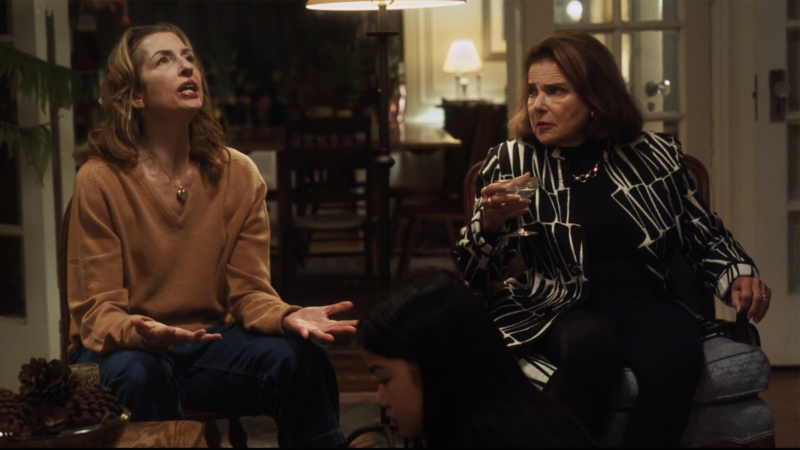
Alysia Reiner (left) and Tovah Feldshuh in Reboot Studios film "We Should Eat" by Shaina Feinberg.
It was, as Kubik remembered it, a brutal introduction to what it meant to be a producer. ABC then began sending him films by possible replacement directors. One day, they called about a young filmmaker whose work they wanted him to see. Universal was going to put the director under contract, they told him. He was going to be “the next great thing.”
Kubik went to a screening room and, by his own account, was not exactly overwhelmed. A guy walking down the road. Not much dialogue. Not much plot. What’s the deal, he remembered thinking.
ABC told him he should hire the director. Kubik said no. Recounting the story years later, he could laugh at the enormity of the miscalculation.
The film was called “Amblin’.” The young filmmaker was Steven Spielberg.
Today, “Amblin’” is part of Hollywood history. Spielberg’s 1968 short was not “Jaws,” “E.T.,” “Schindler’s List” or “Jurassic Park.” It was a modest 26-minute film about two young people hitchhiking through the desert, made by a director at the very beginning of his career. And yet, in that small film, some people saw something. One of them was Universal executive Sidney Sheinberg, who did in fact offer Spielberg a long-term contract. Spielberg would later name his production company Amblin Entertainment after the short that helped open the first major doors of his career.
There is also a connection to my work in this history. Decades after “Amblin’” helped launch his career, Steven Spielberg and Kate Capshaw’s Righteous Persons Foundation would help co-found Reboot, a nonprofit Jewish arts and culture organization. Today, I lead its production arm, Reboot Studios, alongside CEO David Katznelson.
Most short films are not going to lead to “Jaws,” but Kubik’s lesson still matters — especially for those of us thinking about the future of Jewish storytelling.
Jewish philanthropy often asks how to reach new audiences, strengthen Jewish identity and make Jewish life feel relevant to the next generation. One of the most effective tools for doing that has been hiding in plain sight: short films.
For too long, shorts have been treated as stepping stones to “real” work rather than as serious cultural investments in their own right. They are seen as calling cards, festival pieces or preliminary exercises, something to be admired briefly and then passed over in favor of features, television series, documentaries or large institutional projects. That is a mistake.
When Jewish funders overlook short films, they miss one of the most efficient ways to invest in the future of Jewish culture. Shorts offer an accessible entry point for new artists, a flexible format for urgent ideas and a relatively low-risk way to support creative work before it has to prove itself at a larger scale.
They are also natural spaces for experimentation. Artists can test tone, style, subject matter and audience response without the financial burden of a feature or series. A filmmaker can explore a family ritual, a historical memory, a comic premise, a horror concept, a cultural tension, a queer coming-of-age story or a diasporic identity question with precision and immediacy. The work does not have to carry the full weight of representing “the Jewish experience.” It can represent one Jewish experience, sharply and honestly.
Jewish storytelling is not one thing. It can be funny, strange, painful, sacred, rebellious, traditional, secular, intimate, global or completely unexpected. When funders support only the projects that already look legible at scale, they risk narrowing the field to stories that feel familiar, safe or institutionally pre-approved. Shorts create room for work that is more idiosyncratic, formally daring and creatively ambitious, which is often where the most interesting cultural energy begins.
Short films also give funders earlier access to emerging talent. By the time a filmmaker has a feature package, major attachments or a television deal, they are already operating in a more crowded marketplace. The opportunity for Jewish philanthropy to have meaningful impact is often much earlier, when a filmmaker has a voice, a point of view and a story, but not yet the resources or infrastructure to prove what the work can become.
That kind of early support can be transformative. It can help an artist move from idea to execution. It can give them a completed piece of work to share with festivals, funders, producers, community partners and audiences. It can create the first real evidence of a creative voice. In a field where so many artists struggle to find seed funding, modest investments can have outsized consequences.
Shorts are also an important tool for expanding who gets to tell Jewish stories. Because they require fewer resources than long-form projects, they can open doors for artists who are not yet connected to traditional industry pipelines. That includes younger filmmakers, Jews of color, Sephardi and Mizrahi creators, queer artists, disabled artists, Jews from smaller communities, international voices and artists whose relationship to Jewish identity does not fit neatly into existing communal categories.
If Jewish funders are serious about diversity, they cannot support diversity only after it has become institutionally validated. They have to support it at the point of emergence.
There is also a practical argument. Shorts can function as research and development for larger projects. A short can become a feature, a television series, a documentary, a podcast, a game, an immersive experience or a digital-native series. It can test whether a premise works, whether a character has depth, whether a world is compelling and whether audiences respond. In an entertainment environment where development is expensive and attention is fragmented, shorts offer a more flexible way to discover what has life.
And the definition of short-form storytelling is expanding. The same argument applies not only to traditional short films, but also to proof-of-concepts, animated shorts, documentary shorts, short-form comedy, vertical microseries and other platform-native formats. Audiences, especially younger audiences, do not experience stories according to the categories the entertainment industry uses to finance, package or distribute them. They respond to voice, emotion, specificity and momentum. Jewish storytelling should be present in the formats where audiences are already discovering new voices.
This does not mean every Jewish organization should chase every platform trend. It means we should recognize that short-form work is increasingly central to how stories travel, how artists build audiences and how cultural ideas enter public conversation.
At Reboot Studios, short films have been central to how we think about supporting Jewish creativity. We have seen how much can happen when artists are given room to take risks before a project has to explain itself to every possible audience. Sometimes the result is a complete work of art in itself. Sometimes it is the seed of something larger. Often, it is both.
Our recently announced partnership with ChaiFlicks, a leading streaming platform dedicated to Jewish storytelling, is one example of how this ecosystem can be strengthened. Through the partnership, Reboot Studios is curating and supplying an ongoing slate of short films to ChaiFlicks, combining original productions with selected acquisitions and helping create a more visible home for Jewish short-form work. The goal is not only distribution but also to help audiences encounter films that might otherwise remain scattered across festivals, private links and limited community screenings.
Our inaugural slate reflects the range that Jewish short-form storytelling can hold. Arava explores identity, belonging and selfhood through a deeply specific lens. Anne and The Anne Frank Gift Shop offer two radically different approaches to Holocaust memory, one intimate and reflective, the other darkly comic and deliberately uncomfortable. We’ve Been Here Before connects punk, resistance and the ongoing fight against white nationalism. Days Between Rest centers Ugandan Jewish experience through music and an intimate documentary lens. Lion of Zion follows Yuri Foreman, the only Israeli world champion boxer, on a journey from the ring to the rabbinate.
These are very different films, formally and thematically. Jewish stories should not all look, sound or feel the same.
For funders and community leaders, the opportunity is not simply to support individual shorts, though that is important. The larger opportunity is to build the infrastructure around them: development funds, commissioning programs, festival pipelines, streaming partnerships, community screenings, traveling showcases, educational use, artist mentorship, audience-building and pathways from short-form experimentation into larger creative opportunities.
This is where philanthropy can play a role that the commercial marketplace often will not. The market tends to reward what is already familiar, proven or easy to categorize. Philanthropy can take chances on new artists, unfamiliar stories and forms that have not yet been fully validated. It can help audiences, institutions and the industry recognize the value of work before the market knows what to do with it. And in doing so, it can help ensure that Jewish culture is not only preserved, but renewed.
There is a tendency in communal life to think about storytelling as a matter of representation: Are Jewish stories being told? Are they accurate? Are they positive? Are they reaching people? Those are important questions, but they are not enough. We also have to ask where new Jewish stories are allowed to begin.
Often, they begin small. A short film. A strange idea. A young filmmaker. A story that does not yet have a market category. A piece of work that may look, to someone watching too quickly, like a person simply walking down the road.
But sometimes that road leads to a career, a movement, a new audience or a story that changes the way a community sees itself.
Jewish funders who care about the future of Jewish storytelling should care about short films because they are not peripheral to the work. They are where talent is discovered, where risk is possible, where underrepresented voices can emerge, where larger projects can take root and where Jewish creativity can stay nimble enough to meet the moment.
That’s the long and short of it.
Noam Dromi the managing director and executive producer of Reboot Studios. Dromi is an Emmy Award-winning producer and writer whose work spans film, television, digital media and emerging storytelling formats.