Opinion
MEETING THIS MOMENT
Why optimism about Israel’s future is an act of moral resistance




 Add EJP on Google
In Short
The future is not a forecast; it is a construction project, particularly when it comes to Israel.
We should be optimistic about Israel’s future. I’m saying that in the first breath, before the caveats (and the eye rolls), because right now it feels like almost no one will say it, at least not out loud. And that silence — a silence that demands resistance — has become part of the moment itself.
It’s a strange moment. Maybe the strangest I can remember. For most of my adult life, where you stood on Israel told me roughly where you stood on many other things: self-determination and co-existence, rules-based order and realism. Now that map is gone, and the anger seems to come from every direction at once. There’s frustration on the left and frustration on the right, frustration from people who love Israel and frustration from people who have never set foot there. There’s even frustration that contradicts itself and rarely pauses to notice it. The war with Iran and the conflicts in Gaza, Lebanon and the West Bank have become a screen onto which everyone projects the thing they were already furious about.

Seth Cohen
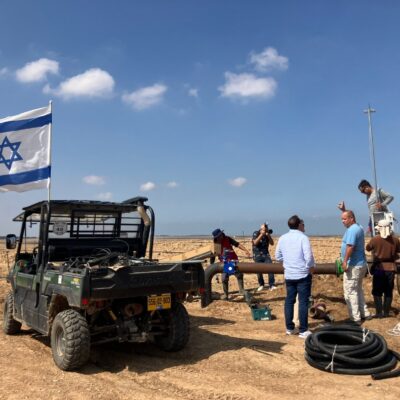
Illustrative.
And the exhaustion is real. You can feel it in rooms that used to hold real conversation and now hold only flinching. Even more troubling, people have stopped talking because conversation has become expensive — emotionally and socially. The cost of one honest sentence about Israel keeps climbing, so I have found more and more of my friends quietly deciding to opt for silence instead.
That is the climate: anger that is certain, grief that feels bottomless and a creeping sense that the future is already decided — the only question left is how bad it will get.
I don’t believe that. Not the bad part, and not the decided part.
I come to this moment with the insight and humility of experience, as well as the weight of work that I still feel is unfinished. Early in my career I was wide-eyed and energetic as a volunteer in a number of Jewish organizations ranging from the hyper-local to the multinational and from social services to Israel-positive politics. Then I spent years at Charles and Lynn Schusterman Family Philanthropies, focused on helping share an inspiring vision of the future of Israel.
I went on Birthright trips. I went on Encounter experiences. Then I spent years helping take thousands of leaders to Israel. I want to tell you what those years did to a person.
They ruined cynicism for me. They made it impossible. Because the real work, the kind you do when the cameras are off and the outcomes are years away, taught me something I have never been able to unlearn, regardless of the wars, regardless of the events of Oct. 7 and regardless of rising antisemitism.
The future is not a forecast; it is a construction project, particularly when it comes to Israel.
The future also never truly “arrives.” Rather, it gets built by people who decided to build it, usually before there was any evidence it would work.
Back when I was working at Schusterman, we had a phrase. We said it constantly, to each other and to ourselves, half mantra and half marching order: Make it happen. Three words. Not a slogan stitched on a hoodie (although it was that too) but more of a theory of how the world actually moves.
To me, it meant the gap between the way things are and the way things could be is not a wall; it is an assignment. It meant nobody is coming to do it for you. It meant that hope, if it is real, has a to-do list attached. You can’t wait for the moment to improve. You walk into the moment and you make it improve, and you keep walking even when the moment fights back.
That is what I think applied optimism actually is. Not in a mood, but a discipline of possibility. The cheerleader and the doom-scroller are doing the same thing from opposite ends, and each has already decided how the story ends so they can stop carrying the weight of not knowing. The applied optimist, the gritty one, refuses to put the weight down. Instead, that kind of person holds the grief and the hope in the same two hands, keeps both eyes open and still gets up in the morning with gratitude for sight and a belief the next chapter can be better than this one. That refusal to be dismayed is an act of moral resistance against the people who profit from your exhaustion. Against the feed that fattens on your despair. Against the easier version of yourself that would rather feel certain than stay in the fight.
And when it comes to Israel, here is what the anger gets wrong, from every side: It mistakes the difficulty of the present for the certainty of the future. They are not the same thing. The present is hard — genuinely, no asterisk required. There are soldiers who haven’t slept in their own beds in two years. There are people in Gaza and in the north and in towns whose names became headlines who are fearful and grieving more than any of us scrolling can hold. None of that is small, and an optimist who pretends otherwise is just a liar with good posture.
But the future is open. And anyone who tells you it is closed is selling you the cheapest thing in the store: the comfort of being done.
We aren’t done.
Which is exactly why the to-do list matters more now, not less. Optimism that stays in your chest is just a feeling. Applied optimism that moves your hands is a force. So to me, “make it happen” looks like something specific in this moment. It looks like refusing to let the conversation die in your own kitchen, at your own Shabbat table, in your own group chat. It means keeping the argument alive because the argument is the proof we still believe the outcome is unwritten. It looks like backing the Israelis and Palestinians who never stopped doing the patient, unglamorous work of building something shared while the rest of us were busy being furious. It looks like investing in the next generation’s vision of the place instead of mourning the last one’s.
It looks like telling a story about Israel’s future that is truthful enough to include the grief and stubborn enough to refuse despair anyway.
A nation that survived its own founding, that built a democracy on contested ground, that absorbed millions of strangers and called them family, that turned argument into a national pastime? That is not a nation whose story is finished. In fact, the argument is the sign of life. To be honest, the day everyone finally agrees is the day to start worrying.
So no, being optimistic about the future of Israel is not naïve. Naïvete is cheap. What I am talking about is expensive. It costs you the clean narrative, the straightforward path and the satisfaction of certainty. You pay all of it, and you keep your eyes open anyway, and then you reach for the to-do list. For Israel. For us. For the future.
That is the act of moral resistance. Hope is not the absence of clear sight. It is what you build with your eyes open and your sleeves rolled up.
So let’s make it happen. Again.
Seth Cohen is the co-founder of Optimistic Labs, a team of experts that helps leaders build communities that make their impact stronger, their growth stickier and their organizations more human-centered. He was previously the chief impact officer of Forbes and the senior director of Charles and Lynn Schusterman Family Philanthropies.