Opinion
IT'S THE PEOPLE, STUPID
When we make space for relational work, our community flourishes




 Add EJP on Google
In Short
By funding peer connectors to do relationship-based engagement, Jewish Federation Bay Area and its partners helped more young adults find meaning and belonging in Jewish life — and transformed how Bay Area organizations operate in the process.
A few years ago, after returning home from his Birthright trip, 24-year-old James received a message from the local Repair the World, a national organization inspiring young adults to serve their communities. That message led to a coffee, and the coffee to Souper Saucers — one of Repair’s recurring service programs making soup for the food-insecure in West Oakland, Calif.
James kept coming back to make soup. Not for one event or one season, but for years. He didn’t return again and again because of the program; he stayed active because someone took the time to find out what he was looking for, connect him with a like-minded community, and create a space where he belonged. That’s when Repair started to notice that the thing driving retention wasn’t the program calendar; it was the relationships underneath it.
Maskot
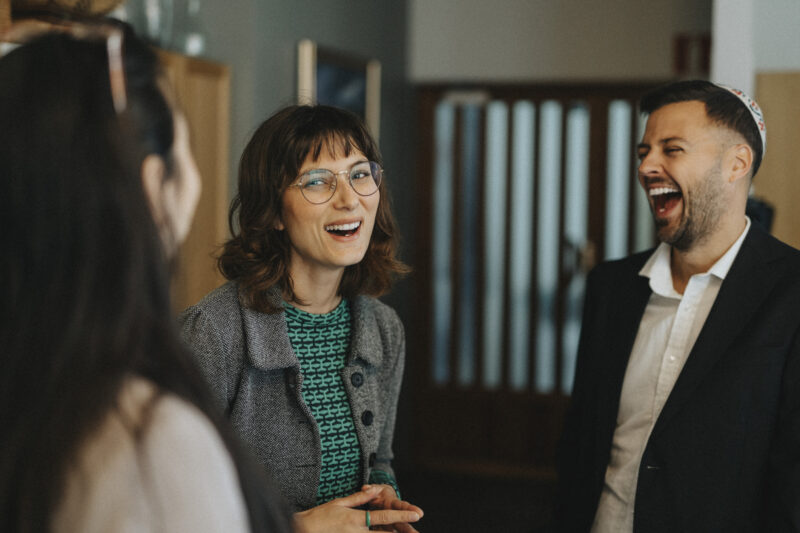
Illustrative. Jews at a synagogue.
Since 2019, the Jewish Federation Bay Area has funded peer connectors embedded into seven organizations, including Repair. By centering relationship-based engagement (RBE), these peer connectors help build relationships with Bay Area young Jewish adults, introducing them to programs and people with similar interests.
GatherDC, a Washington-based young adult engagement group with expertise in building connections in the Jewish community, defines RBE as a systemic approach to centering relationships and building connections, trust and belonging among community members. It’s the act of proactively reaching out to people, getting to know their interests and passions and then weaving together a community through large and small beats. The Washington federation worked with Gather to train, coach and convene the connectors as a peer network to deepen their knowledge.
Over the seven-year grant term, which ended this summer, the connectors had coffee chats with more than 2,600 young Jewish adults in their 20s and 30s, many of whom were either disengaged or under-engaged in Jewish life. Forty-three percent of those young adults stepped up to create Jewish community for others, and nearly 90% of those surveyed reported feeling a sense of belonging in Jewish life since meeting their connector.
What began as a new way to engage community members fundamentally transformed how organizations approach their work. The connectors’ relational work unexpectedly created a multiplier effect, enriching the lives of far more than the young adults originally targeted. Many have since adopted this people-first lens as their own, strengthening engagement pipelines across demographics and creating microcommunities of belonging.
Relationship-based engagement is both an art and a science. While meaningful conversations often start over coffee, lasting relational work requires much more than one-on-one meetings. Through training, tools, data collection and analysis, and a shared methodology, RBE can become a model that shapes every aspect of an organization’s work.
This philosophy guided Gather’s partnership with the federation, equipping connectors and their organizations across the Bay Area with the skills necessary to make relationships — not just programs — the foundation of community-building. After all, people don’t need more programs to go to; they need people to go with.
When Repair the World added a peer connector to its Bay Area team, local engagement grew nearly three-fold. This led to a mindset shift from counting attendance to tracking connections (with connectors and between community members). Repair now treats a personal touchpoint as the start of a journey, improving engagement organization-wide. They are also training other city-based staff in relational strategies and coaching their alumni leaders to be Jewish Service Ambassadors and act as peer connectors within their own networks.
The Kitchen, a nondenominational Jewish community in San Francisco, adapted a different model to sustain relational work past the grant term. Through its lay-led Kitchen Social Club for young adults, it aims to bring together people who feel connected enough to co-create their Jewish community. “Kitchenites” are encouraged to bring a friend to events, which have led to groups organically forming outside of programming, from book clubs to Shabbat dinners.
“When I was new to San Francisco, The Kitchen made the city feel like home,” says lay leader Sophie Teitelbaum. “If you spend time on relationships early on, people feel like it’s their community, too.”
The Jewish Community Center of San Francisco (JCCSF) committed to integrating RBE across its organization, working with Gather to adapt the methodology into its internal language and processes to deepen engagement. JCCSF looked at its data infrastructure through a relational lens, built relevant metrics into existing systems and now has a dedicated connector for all ages that empowers people to build their own microcommunities and Jewish experiences.
Erica Aren, senior director of Roots and Culture at JCCSF, said: “Relational engagement becomes sustainable when team leaders understand it as a core strategy, worthy of time and attention, rather than an add-on to the work.”
Local RBE-trained professionals inspired their colleagues to adopt this relational lens, spreading it across the Bay Area Jewish community — so much so that organizations began rewriting job descriptions to focus on people before programs.
RBE is long-term work and doesn’t always show an immediate return. When the focus is on the number of programs, participants, or dollars raised, it can feel hard to justify relational work to donors or executives. This work is slow and moves only at the speed of trust, often requiring an organizational commitment to a new way of thinking, doing, and measuring its impact.
But the work is worth it, and we see that RBE ripples far when we invest in it. Our organizations become kinder places to work, our community members feel a sense of belonging every time they walk through the door, and our Jewish ecosystem starts moving toward the same shared goals.
For funders, this is a case study emphasizing the why of a project over the how to sustain impact after funding winds down. For organizations, this is a reminder that people and relationships are the foundation for vibrant, thriving, sustainable Jewish communities. Instead of asking, “Did people show up?” let’s ask: “Did people show up for each other?”
Amanda Cohen is the director of community partnerships and grantmaking at Jewish Federation Bay Area. She loves strengthening the connective tissue across Bay Area organizations and professionals, color-coded spreadsheets and babka.
Lauren Halperin is the Bay Area senior city director at Repair the World. She is passionate about creating experiences that help people connect deeply with their neighbors, their spirituality and themselves. Her background, spanning Jewish education, urban agriculture and mutual aid, fuels her drive to cultivate meaningful change through the power of collective service.
Alexandra Meyer is the executive director at GatherDC, where she leads the organization in reimagining how Jewish communities can meet and grow with the next generation. Her work sits at the intersection of relational engagement and organizational strategy, translating what young adults need today into stronger Jewish communities for tomorrow.
Noa Nir is the engagement director at GatherDC. She loves relationship-building within the 20s and 30s Jewish community in the Washington-area, skipping the small talk and getting to know her city on foot.