Opinion
NEW YEAR'S RESOLUTIONS
Every Holocaust remembrance budget should help a living survivor




 Add EJP on Google
In Short
'There will come a time when Holocaust philanthropy is about memory alone because no living witnesses remain. We are not there yet.'
Every Rosh Hashanah, Jewish tradition asks us to take an honest accounting. We look back at whom we helped, where we fell short and what we intend to change. In the midst of the High Holy Days, Jewish philanthropy should apply that same scrutiny to the way we fund Holocaust remembrance.
Our community rightly invests in museums, exhibitions, curricula, commemorations, archives and digital testimony. That work is essential, especially as the number of living witnesses rapidly declines. Only about 31,000 Jewish Holocaust survivors remain in America, and the median age of survivors worldwide is 87. The Claims Conference estimates that 70% of the survivor population will be gone within a decade.
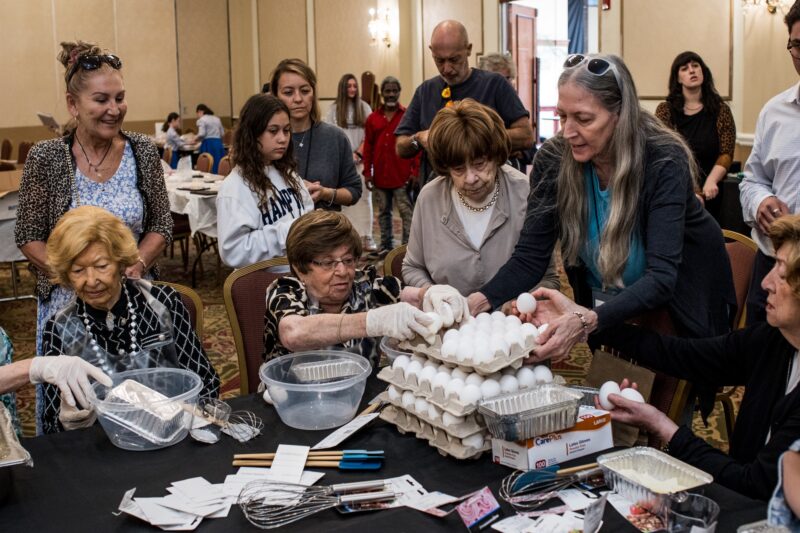
Ohad Kab/DADA Studio
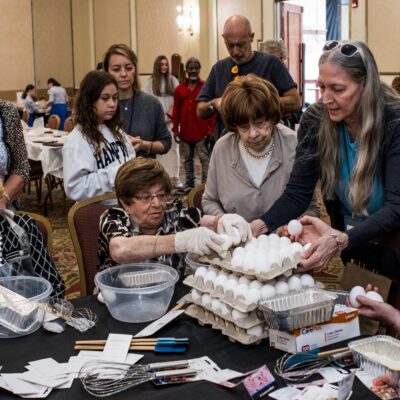
Holocaust survivors make kugel during an annual summer retreated hosted by the Blue Card and Nachas Health and Family Network at the Hudson Valley Resort and Spa in the Catskills on Aug. 19, 2025.
In this new year, Jewish funders and institutions should adopt a Living Memory Standard: Every major Holocaust remembrance initiative should include a concrete commitment to helping survivors who are still alive. The commitment can fit the institution and the project, but it should be planned from the beginning, visible to donors and tied to a real need. If an institution uses a survivor’s story to educate the future, it should also help protect a survivor’s dignity in the present.
For many survivors, dignity depends on ordinary things that have become increasingly difficult to afford. They need groceries, rent and utility assistance, prescription co-pays, hearing aids, dentures and transportation to medical appointments. Some need home health aides, emergency-response devices, stair lifts or repairs that allow them to remain safely in their own homes. Others need trauma-informed mental health care or regular calls and visits to ease isolation.
Survivors also need help navigating the systems meant to assist them. Insurance forms, benefits applications, medical appointments and compensation programs can be difficult to manage, especially for someone with limited English, declining mobility or no nearby family. Trusted case managers can coordinate services before a missed payment or health problem becomes an emergency. That care must be person-centered and trauma-informed because an unfamiliar caregiver, a medical setting or the prospect of leaving home can revive fears rooted in persecution and displacement.
These needs are not marginal to the survivor population. According to the Claims Conference’s latest data, 71% of survivors worldwide received social welfare services in the past year, and approximately 66,700 were eligible for additional food-security assistance. At their advanced age, one uncovered medical expense, a rent increase or a broken appliance can quickly become a crisis. Timely help can mean the difference between independence and displacement.
A Living Memory Standard would connect those needs to the enormous communal commitment already devoted to remembrance. A new exhibition could include a matching campaign for survivor assistance. A federation or school launching an education initiative could partner with a direct-care organization. A digital testimony project could give donors the option to support both the preservation of a survivor’s words and the immediate needs of survivors still living.
Restricted grants and donor intent are real considerations, but they can be addressed when new campaigns are designed. Funders could ask applicants how a major remembrance project will connect to living survivors, and boards could consider that answer during approval. Institutions could then report what they preserved and whom the related care commitment helped. This would create accountability without imposing the same formula on every organization.
There will come a time when Holocaust philanthropy is about memory alone because no living witnesses remain. We are not there yet. Rosh Hashanah asks us to correct what is lacking while we still can, and survivors need more than the promise that their stories will outlive them. The most meaningful Holocaust remembrance budget is one that ensures a living survivor is better off because we remembered.
Masha Pearl is executive director of The Blue Card, the nation’s leading nonprofit providing direct aid to Holocaust survivors.