Opinion
A sukkah is not a home




 Add EJP on Google
In Short
A week of impermanence is a ritual. A lifetime of it is a system failure.
In an interview with eJewishPhilanthropy published Sept. 2, Latet founder Gilles Darmon called poverty an existential threat to Israel. As a fellow Israeli working on the same problem from a different angle, I agree completely.
But the same interview also laid out the facts: Over the 30 years that Latet grew from a small operation into a major one reaching 100,000 families, food insecurity in Israel also grew dramatically. Without Latet, it’s hard to imagine how much worse it would be, but even with their extraordinary work to help the people who need it the most, 867,000 families in Israel remain food insecure. This stubborn persistence of poverty despite decades of truly impressive work points to a larger truth: relief can protect families from the worst consequences of poverty, but relief alone cannot change the structures that keep families poor.
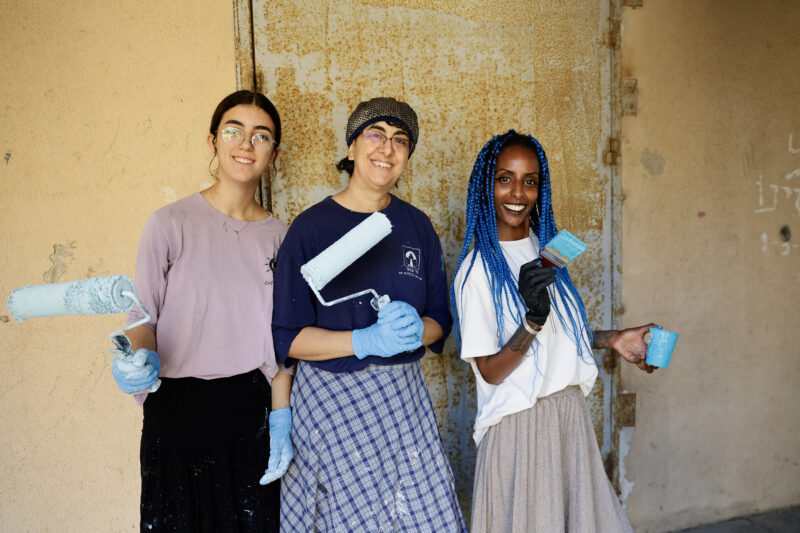
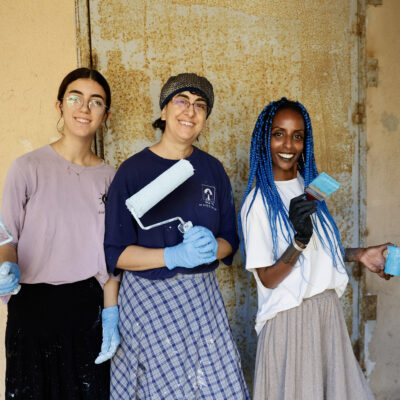
Courtesy/Manof
Residents and volunteers come together to renew public spaces with Manof in Ashkelon, Israel.
The rising level of poverty in Israel should provoke a harder question for all of us who give, allocate and receive philanthropic dollars: What happens when we become very good at relieving the consequences of poverty without changing the conditions that keep producing it?
Yes, there will always be a need for emergency aid for those left behind. Inspirational organizations like Latet will always have a critical role in providing frontline aid; in Israel today, so many people could not make it without them. But alongside that immediate relief, our driving goal should be to look deeper: Are we doing enough systemic work to prevent poverty, and to help those already living in poverty find a path out of it?
Traditionally, Diaspora philanthropy has funneled direct aid to programs that address an identified need. I believe donors who wish to support Israel, no matter where they live, can play a more ambitious role: changing the conditions that create those needs in the first place.
A true catalyst does not simply supplement what already exists but changes what becomes possible. In Hebrew, we have a word for that: manof — a lever. That is not just a figure of speech (though it is, in fact, the name of the organization I run); it is a financing structure, and there is an entire field built on it that will fill a Chicago convention hall next month. The question for Jewish philanthropy is: What if more Jewish philanthropic dollars were designed to fundamentally change the economics of what’s possible, and then be deployed again?
For families in Israel’s poorest neighborhoods, housing is not simply where poverty is experienced — it can be one of the structures that perpetuates it. Aging buildings, costs that exceed 50% of monthly income, lack of safe rooms, weak infrastructure, low property values and decades of underinvestment can trap entire neighborhoods outside the economic growth taking place around them. The problem is not that the market does not work; in many places, it works exactly as designed.
As happens in American cities, in areas of Israel deemed to have strong potential for return, for-profit real estate developers demolish aging buildings and replace them with better ones at no cost to the state or any nonprofit organization. The cities are transformed; people move in who can afford the new, higher rent, and the investors profit. But the mechanism doesn’t reach every neighborhood. In geographically peripheral areas, low land values can make redevelopment unattractive to private developers, leaving residents there without access to the same life-changing investment (assuming they could find a way to stay in their homes once rents goes up).
That is where catalytic philanthropy can play a different role. It can take the first risk, change the equation and bring other forms of capital to the table.
In Ofakim, a southern development town where a 1950s-era neighborhood houses 600 families, more than half of whom live in public housing, Manof tried something new. With the help of our growing group of Diaspora funders—including JNF Israel, the Leon and Toby Cooperman Family Foundation, the Nitzan Foundation, International Fellowship of Christians and Jews, the Samis Foundation and two North American Jewish federations — we put $3 million of philanthropic capital toward making the first move. (Additional support for other programs has come from Bader Philanthropies, the Ronald S. Roadburg Foundation, the Rashi Foundation, Migdal, JTLV, Adama and several other federations.) That money is currently structured as a lever to move roughly $280 million in developer equity, public subsidy, bank debt and presales.
The important part is not simply the ratio. It is what the $3 million is doing. We did not spend $3 million to build $3 million worth of housing. Rather, we used philanthropic capital as a lever to unlock roughly $280 million in other capital. Then, when a for-profit developer enters the partnership, the original investment will return to the funders or roll into the next neighborhood. Six similar projects are underway across Israel, with nearly 3,000 new homes in the pipeline.
What further separates this model from conventional development is the social programming that starts long before anything is built so that the renewal can uplift the entire neighborhood without causing displacement. Program staff help residents claim benefits, connect to employment and organize to fix conditions on their own streets. Across the program, participants gain an average of more than NIS 20,000 (approximately $7,000 USD) in additional income a year, roughly a 30% increase; 85% of them still hold at that level three years later.
The model we use is not originally ours. McCormack Baron Salazar rebuilt distressed neighborhoods in more than 50 American cities, and its co-founder now advises us. What we imported from America was a method — a catalyst, a lever.
That may be one of the most underused expressions of Jewish peoplehood: not simply transferring money but sharing ideas, structures and ways of solving problems. The Diaspora has always supported Israel in a few ways: aliyah, donations and the exchange of ideas — the last of which being the oldest of the three and the one we discuss least. Israeli tech has run on that exchange for decades, to the benefit of both sides. Social policy, on the other hand, has barely tried it.
Jewish philanthropy has spent decades getting better at identifying needs, funding organizations and measuring outputs. But we have been much less creative about the capital itself and about systemic change.
What I am carrying to North American communities next month is bigger than any one organization. What would change if more Diaspora giving to Israel worked this way? What would a federation allocation look like if it were built as a lever?
Every year on Sukkot, wherever they are in the world, Jews build sukkahs, sit in them for seven days (more outside of Israel) and then take them down and go back inside. A sukkah is built to be temporary, to remind us of the huge value of stability and safety on every other day of the year. Shelter sits at the heart of this holiday.
After Sukkot, most of us reading this will take our sukkahs down and walk back into our permanent homes, safe and secure that we will have a real roof over our heads until next fall when we celebrate the holiday again. The 1.98 million people living in Israel’s poorest neighborhoods have no such assurances — yet.
Avital Blonder is CEO of Manof.