END OF AN ERA
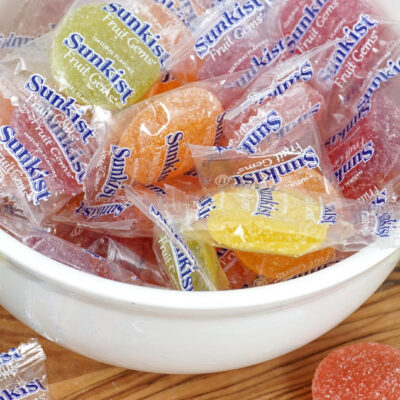
Sunkist Fruit Gems, a colorful staple of synagogue celebrations, discontinued
The kosher confection appears to be the latest victim of private-equity firms acquiring classic candy brands and then shaping them for the mass market
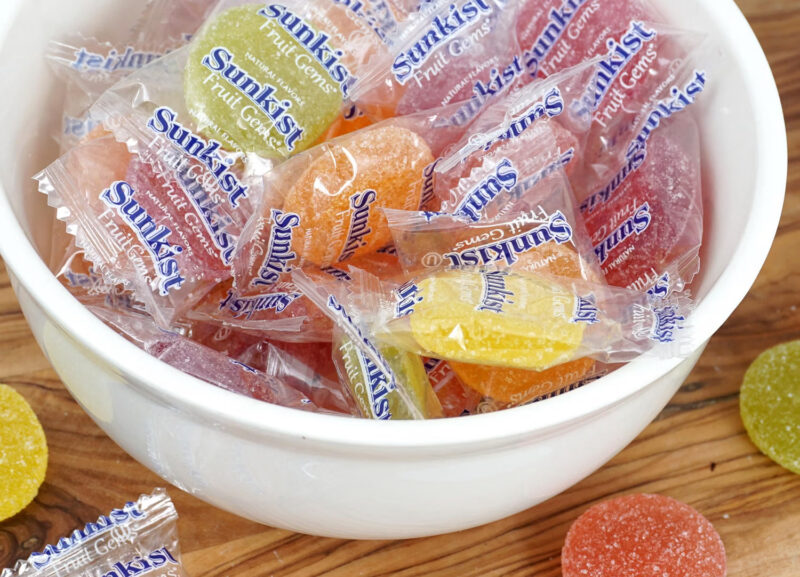
COURTESY
Sunkist Fruit Gems




 Add EJP on Google
After more than a half-century of sweetening Jewish events, the kosher staple Sunkist Fruit Gems has been discontinued as of May, eJewishPhilanthropy has learned.
The neon-colored candy is ubiquitous with Jewish celebrations; nearly every bar and bat mitzvah and aufruf in America features the celebrants getting showered in the candy. The omnipresent gems line tables at nonprofit galas, propel candy drives and fill Purim-fundraiser mishloach manot.
“They’re an iconic American candy brand,” Jon Prince, the owner of CandyFavorites.com and McKeesport Candy Co., a candy wholesaler established in 1927, told eJP. While many American vendors still have the candy stocked, “we have a very limited amount left,” Prince said. “They’ve gone from being a classic candy to being a collectible.”
The discontinuation is part of a trend in the candy world, Prince said, where private-equity firms acquire classic brands and market them for the masses — in the process often rendering them non-kosher. This same trend has caused other historically kosher candies to lose their hechsher.
“Kosher food is a niche,” Prince said. “It’s a niche for a specific audience, and to that audience it’s extremely important, but to a company that is interested in quantity versus quality, it’s not so important.”
Fruit Gems was launched in 1955 by the Los Angeles-based Ben Myerson Candy Company, which struck a licensing deal with Sunkist — one of the first of its kind in the candy world — in 1966. The company remained a family business until 2006 when it was acquired by Jelly Belly Candy Co. In 2023, Jelly Belly was acquired by The Ferrara Candy Company, the owner of Atomic Fire Ball, Fun Dip, Sweetarts, Nerds, Red Hots, Pixy Stix, Lemonhead and Laffy Taffy. The company discontinued selling Sunkist Fruit Gems on May 1, according to a Ferrara customer service representative.
“Believe it or not, it’s due to lack of consumer demands across the country,” the representative, Fred, who wouldn’t share his last name, told eJP. “If something doesn’t perform, [the company] move[s] onto something else.”
Prince, who is a third-generation owner of McKeesport Candy Co., said that Sunkist Fruit Gems were one of his business’s top sellers — last year he sold well over 1,000 pounds. Over the years, he’s sold mountains of them to synagogues, including for Purim and Sukkot fundraisers. He found out that the gems were discontinued in August, when he tried to order them and was informed by Ferrara that wasn’t an option.
“My dad always joked [that] the day comes when this job will not be as fun when you have nothing to sell,” Prince said. That is becoming a reality as more acquisitions occur in the candy world. Big business looks at the bottom line and slashes brands that aren’t selling across the mass market, he said. Ferrara has discontinued selections of other brands, including Lemonheads, which once offered Appleheads, Grapeheads and Cherryheads.
Private-equity firms have also been cutting back on the kosher status of many formerly kosher favorites, including Sour Patch Kids and Swedish Fish. When this happens, sellers aren’t often informed until the product is in hand, Prince said. “Ordering kosher candy in today’s day and age is caveat emptor, buyer beware.”
McKeesport Candy Co. was one of the first wholesalers to provide candy buffets — spreads of containers of assorted candies and treats — in the aughts. Today, employees need to sift through candy individually to ensure it contains a hechsher.
Brands often lose their hechsher when the factory that makes them adds brands to their production line that aren’t kosher, the Ferrara customer-service representative said. He recommends that buyers check candy packaging every time they make a purchase and don’t depend on online photos, which are often dated, for proof of kosher certification.
Other brands are likely to be available that can serve as a substitute to the Sunkist Fruit Gems, Prince said, including one produced by candy company Sunsations. “But the Sunkist Fruit Gems as you and I know it — gone.”
There’s also a chance that a discontinued candy can come back, the Ferrara employee said, but it would take a massive demand from across the country.
“You never know,” Fred said, “but that’s not likely.”
Related News

CLOSING WORDS
In AZM address, Cosgrove links communal ‘orthodoxy’ on Israel to rising anti-Zionism among young Jews

EXCLUSIVE
Detroit-based philanthropists Nancy, James Grosfeld donate $8M to renovate JDC’s Israel campus

PRESIDENTIAL REBUKE
Israel’s Herzog: Mamdani ‘makes no effort’ to hide disdain for Israel, Jews must fight back

HIGHER EDUCATION
As Jewish donors reconsider academia, Jan Koum doubles down, endowing Israel studies at Stanford

MAJOR GIFTS
Center for Jewish History celebrates 25 years with a $25M matching grant