RECOVERY NATION
Portland Trust pilots program to move wounded IDF reservists into lucrative tech careers
After initial run of 19 participants, the initiative, dubbed Oz Ve’Ruach, plans to expand to 160 next year and 280 in 2028
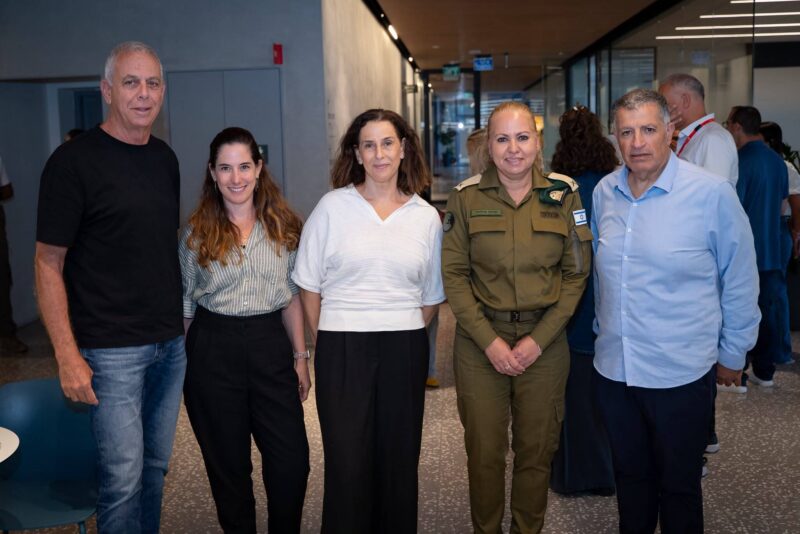
Gal Raveh Massas
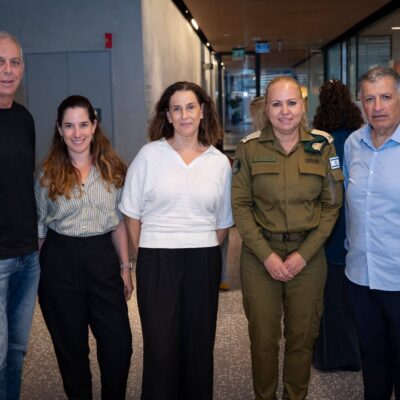
From left: Portland Trust CEO Rami Schwartz; Portland Trust partner and Oz Ve'Ruach co-founder Einat McMory Aharon; Oz Ve'Ruach CEO Maya Ayron; IDF Chief Casualty Officer and Head of the Casualties Division Brig. Gen. Edna Ilya; and ; Maj.Gen. (res.) Yoav 'Poli' Mordechai.




 Add EJP on Google
In late 2023, as artificial intelligence and cybersecurity rapidly reshaped the needs and dynamics of Israel’s tech-focused economy, hundreds of thousands of Israelis — most of them young — put their careers on hold to serve in Gaza and Lebanon. Most were in their 20s, fresh out of university or just beginning their careers.
When they came home, the fields they had spent years training for had moved and changed quickly — and for the thousands who returned wounded, in body or mind, the climb back to work is an uphill battle. A new program from Sir Ronald Cohen’s Portland Trust Israel, dubbed Oz Ve’Ruach (“Strength and Spirit”), is piloting an effort to close that gap, training reservists in AI and other tech fields to help them reintegrate into the Israeli tech workforce.
“Those who have sacrificed themselves to protect Israel represent invaluable human capital. They deserve more than rehabilitation; they deserve a promising and fulfilling future,” Cohen, the British-Israeli venture capitalist and impact investor, who serves as chairman and co-founder of the Portland Trust, told eJewishPhilanthropy. “Helping them achieve quality employment isn’t just compassionate, it’s a high-impact investment in Israel’s future… from injury to meaningful employment, empowering human and economic progress to advance hand in hand.”
So far, 19 participants have gone through its pilot cohort, and the four-day-a-week, three-month program intends to scale up to 160 participants in 2027 and 280 in 2028.
Oz Ve’Ruach is run by Maj. Gen. (res.) Yoav “Poli” Mordechai, a partner at Portland Trust Israel. In addition to Portland Trust Israel, the program is backed by Dora Nazarian and the Magbit Foundation.
Mordechai has served in a number of senior positions in the military during his 36-year career, including as IDF spokesperson and as head of the military’s Coordinator of Government Activities in the Territories, which oversees much of Israel’s official interactions with Palestinian civilians in the West Bank and Gaza. He is thus no stranger to the challenges inside and outside the army.
For “A.,” a 25-year-old who served as a paratrooper and studied computer science at an Israeli university before the war, imagining his future is a challenging task. Severely injured fighting Hamas terrorists at Kibbutz Be’eri on Oct. 7, A. — whose full name cannot be published for security reasons — spent two years in daily rehabilitation treatment. After learning about Oz Ve’Ruach through a WhatsApp group, he participated in the pilot program, which led him to a job at the international communications technology company Amdocs.
Oz Ve’Ruach’s approach is to first identify the hiring needs of desirable tech companies with above-average salaries, and then help mold courses that provide participants with the knowledge and specialized skills to meet those needs, Mordechai said.
“We guarantee employment — before everything — rather than training people and hoping they’ll find work,” Mordechai said.
Mentorship, along with advice for how to best manage post-traumatic stress disorder in the workplace, is also embedded within the three-month program.
Oz Ve’Ruach is designed around the idea that each job placement is a benefit to the state – not an act of charity. Using a model it says it built with the Bank of Israel, the program calculates every graduate’s contribution to GDP and tax revenue, counting a placement as cash-flow positive from day one — even before factoring in the disability payments a veteran would otherwise draw. That’s why it won’t place a veteran in a job paying less than about NIS 12,000 ($4,000) a month — roughly what they’d get in disability support from the government.
The past three years have brought the topic of mental health in Israeli society —especially among Israeli men who served in combat roles — out of the shadows.
Speaking to eJP about the PTSD portion of the program, A. reflected: “This part is very special to me, and they help me understand that I am not alone.”
He noted that the program gave him “a toolbox” of skills and practices to help him manage his PTSD in the workplace, adding that the return to routine and work brings its own challenges that Israel’s reservists face in the quiet battle against PTSD.
A. credits the program with bridging what he learned in school and the tools employers now want: “Technology is moving so fast, we were fighting and then recovering, how could we keep up?”
Seeking to give back a sense of routine to the reservists who fought for the country is critical, Mordechai said. “The most important thing is the feeling that you’re useful to the community,” he said. “You’re back at work, you wake up every morning, you go out and you work.”
Asked whether the government should be doing this work, Mordechai responded: “Let’s be honest — there’s a vacuum in the government. In an ideal world, it is the role of the government. It’s a crisis that the government doesn’t know how to handle in these huge numbers.”
This summer, Israel’s Defense Ministry reported that some 26,000 soldiers have been injured — physically, mentally or both — since the Oct. 7 terror attacks, with its Rehabilitation Department expected to care for more than 90,000 wounded veterans in total. The ministry warned that it was struggling to cope with the burden.
In order to meet the needs of the tens of thousands of soldiers like A., Mordechai’s plan is to grow the program to 280 participants per year by 2028. Mordechai also noted that Oz Ve’Ruach is in touch with Friends of the Israel Defense Forces’ CEO, Maj. Gen. (res.) Nadav Padan, about exploring a partnership between the organizations.
Trying to harness agility and speed to meet the needs of Israel’s reservists — who in recent years spent more time on the battlefield than coding or learning AI — Mordechai casts the pilot as example of the agility that philanthropy can operate in a way that government struggles to do. “We ran this fast, the way only philanthropy can,” he said.
Related News
CLOSING WORDS
In AZM address, Cosgrove links communal ‘orthodoxy’ on Israel to rising anti-Zionism among young Jews
HIGHER EDUCATION
As Jewish donors reconsider academia, Jan Koum doubles down, endowing Israel studies at Stanford

EXCLUSIVE
Detroit-based philanthropists Nancy, James Grosfeld donate $8M to renovate JDC’s Israel campus

MAJOR GIFTS
Center for Jewish History celebrates 25 years with a $25M matching grant

EXIT INTERVIEW
Elizabeth Sokolsky, longtime EVP of Birthright Israel, to retire next year