Q&A
Expanding community relations work, UJA-Fed. N.Y. promotes Hindy Poupko to executive vice president
Rise of anti-Israel sentiments and politicians, as well as antisemitism, demanded that the federation take a more active role in advocacy and political organizing efforts, Poupko says
Screenshot
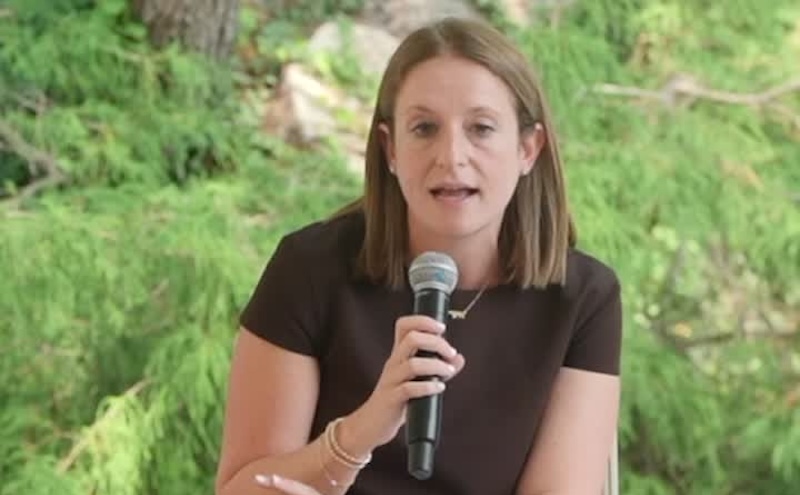
Hindy Poupko, executive vice president for community strategy and external relations.




 Add EJP on Google
This evening, thousands of people will gather near the United Nations’ headquarters in New York City to demand that world leaders take serious action against antisemitism as Jewish communities continue to face violent attacks — most recently in Canada, where a gunman opened fire at a synagogue on Yom Kippur evening, seriously injuring a police officer stationed outside.
The demonstration — held in partnership with a wide range of local and national Jewish organizations — is the latest such event to be spearheaded by UJA-Federation of New York, as the group, which historically focused on raising and distributing philanthropic funds, deepens its political advocacy and community relations work. As part of that expansion, the organization has promoted the head of those efforts, Hindy Poupko, who will now hold the title of “executive vice president for community strategy and external relations,” and also grow her department.
This increased focus on advocacy and community relations has been developing for over a decade, since both Poupko and outgoing CEO Eric Goldstein joined the federation, but it has also accelerated in the wake of the Oct. 7 terror attacks, the election of New York City Mayor Zohran Mamdani and the rise of other Democratic Socialists of America-aligned candidates, whose politics — particularly their anti-Israel stances — are at odds with those of the mainstream Jewish community. Speaking to eJP earlier this year, Goldstein said that those elections served as a wake-up call for the federation that it needed to be more civically engaged, particularly on a local level. “We still have significant numbers, significant influence, and we need to use it more effectively in local government moving forward. And I think that this situation will result in a Jewish community that’s stronger, more coordinated, more focused and involved in local civic politics, civic engagement in ways that are only beneficial to the community,” he said.
As one of New York City’s largest philanthropies, which funds a broad array of social and educational programs, UJA-Federation of New York has considerable sway in the city. It is also supported by some of the city’s wealthiest and most influential Jewish families and maintains regular communication with a large number of local Jews, allowing it to effectively organize them. Bolstering the federation’s own political advocacy efforts — on top of those of the Jewish Community Relations Council of New York — grants the Jewish community greater ability to participate in official lobbying, which is legally limited based on organization size.
Last week, eJewishPhilanthropy spoke with Poupko to discuss her expanded role, representing New York City’s politically diverse Jewish community and how the federation is preparing for anti-Israel demonstrations this week.
This interview has been lightly edited for clarity.
Judah Ari Gross: I understand that you have a new title. Tell me how this came about it.
Hindy Poupko: Yes, executive vice president for community strategy and external relations. This promotion is a reflection of probably a 10-year journey that started, in many ways, when Eric came on board to lead UJA.
I’ve been here now for 11 years. Eric’s been here for 12. And this department that I lead, called Community Organizing and External Relations, didn’t exist before a few years ago. And over the course of my tenure here and Eric’s tenure, I think we built a new muscle. We are far more in-community than we ever used to be.
We launched a community organizing unit that never existed here before, where we have local professionals working across our catchment area to ensure that we are attuned to the very hyper-local needs of the Jewish communities in our catchment area.
And also because, Judah, there were things happening in Jewish life where we felt like actually we were the best positioned to do the work. Right? Historically, and it’s still true today, that UJA’s base has been and still is: When something needs to be done in the world, let’s find the right Jewish nonprofit to do it. And alongside that, as the world changed, it became increasingly clear that there was a body of work that we at UJA needed to lead ourselves. And increasingly, with the challenges facing our community, our initial instincts and Eric’s initial instincts about that was that UJA needed to do more itself, that we needed to be more connected to local communities. we needed to be more involved in government relations and public policy, that we needed to do more to respond to growing antisemitism.
All of these things that are now so obvious to us, 10 years ago were actually instincts that we needed to do more, that this would be a growing area of work. And in many ways, this department and, sure, my promotion, but more the elevation of the department and its work, is a culmination of the building of a muscle, a new muscle over 10 years, at a moment when I think it is needed more than ever.
JAG: A lot of the community relations and advocacy work that you mentioned has historically been the purview of JCRC-NY, with which UJA-Federation of New York works very closely — as you well know, having previously worked there. So why is this something that the federation needed to take on itself as opposed to financially supporting and boosting there?
HP: JCRC is an indispensable partner. And honestly, Judah, we’ve never worked more closely together. Not a day goes by that we aren’t on the phone with each other. We are both needed.
What separates us from all Jewish organizations in New York, I would say, is our role in this city as a major funder of social services. And what that means, Judah, is that UJA is considered part of sort of the civic and social service fabric of New York City. Which means that we are often the only Jews in lots of rooms, right? So we sit alongside many secular philanthropies. We sit alongside secular health and human service providers. We work with city agencies, around city and state contracts for our agencies. So we play a very unique role in this city. And because of that, that also comes, I believe, with it, a sense of responsibility.
We know that when we speak, people hear us. And they also know that our concerns are broad. They know that we care deeply about this city, and not just our own Jewish community, but the future of this city. And because we know that people hear us when we speak, that also means that we have more of a responsibility to use our voice when we need to, to use it judiciously and responsibly, but to use it.
JAG: Besides your new title, what does this expansion look like? New hires? New departments?
HP: Over the past two years, we’ve doubled the size of our government relations team — and we’re still filling some of those new roles as of a couple months ago. Three years ago, I think to this day, we brought on Daniel Rosenthal, who was an New York state Assembly member, to expand the scope and scale of our government relations team.
By the way, I’m a lobbyist, Daniel’s a lobbyist, and our CEO is always a registered lobbyist, so we all do lobbying in some form. Traditionally, our government relations portfolio was primarily advocating for funding for social service agencies. funding for Holocaust survivors, it was primarily around our historic social service agenda. That continues to be true. And we also needed over the past few years a more robust Jewish communal policy agenda, right? So work around funding for Jewish security, right? Our work to advance and successfully make into law the buffer bill to better protect synagogues and other Jewish institutions from menacing protests. So our government relations team now continues to uphold that historic social service agenda, but is also keenly aware of our capacity to advance legislation that protects the Jewish community in a time of increased antisemitism. We will continue to use that muscle.
The other new role that we just hired for is a full-time civic engagement director. Our Jewish community is now keenly aware of the importance of local politics and local elections. Over the past couple of years, we have invested over a million dollars in get-out-the-vote efforts in local Jewish communities. This past June, we made a whole campaign called “June is the new November,” aimed at increasing Jewish participation in primaries, which is where the majority of these elections are decided in New York, given that we’re a blue state. We are now pushing and investing resources into ensuring that our Jewish communities are engaged in year-round civic engagement, not just episodic around elections. So that requires more resources. That means we want every 11th grader in a Jewish school to pre-register to vote, because you can do that when you’re 16. We want Jewish institutions to be engaged in year-round voter registration work and voter education work. We want every synagogue to have relationships not just with their police precinct, but with their local elected officials. We want communal leaders coming with us to City Hall and to Albany — and they are.
Last year, we asked people to come with us to Albany to advocate for the buffer bill. It used to be nobody would answer those emails. Nobody wanted to come to Albany with us. [This year,] the mission sold out in 24 hours. And we had a host of rabbis and interfaith leaders in the halls of government for the first time, testifying in Albany about the importance of this specific piece of legislation, and they want to do more.
So this year, every eight weeks, we’re going to bring our communal leadership together and actually educate them. Here are the bills that are important to us. Here are the bills that we’re nervous about. Here are the elections coming up in your neighborhood. We are going to be far more… I don’t want to say in your face, but far more “in it” with local communities around key policy issues that they need to be well versed on and active on and around key elections where they really need to show up and vote.
JAG: What other kind of advocacy work is the federation taking on? Are there other ways that this is not just redundant with the work of the JCRC?
HP: A few months after Oct. 7, [2023,], elected officials in New York said to us, “We hear from you all the time, but we don’t hear from your community. And the other side is in our face all the time.” They would tell us how they would go to the grocery store in November 2023, and people would be yelling in their face, “Ceasefire! Ceasefire!” and they said we need to hear from you more. So we had to figure out how to do that, but also uphold the norms of our community. We still want to be polite citizens. We don’t want to be bullying our elected officials, but how do we ensure that they’re hearing from us? And that’s when we launched something called UJA Action.
If you’re part of UJA Action, you’ll get an email that says something like, “Your city council member just went to Israel. Click here to thank them.” Or, “Assemblymember Linda Rosenthal is going to be faced with whether or not to vote on the buffer bill. Click here to send her a personal email, you’re her constituent.” So through this new program called UJA Action, we got thousands of individual emails from actual constituents — and they’re all written in a customizable way. It’s not just New Yorkers yelling at a summit, but actual constituents of local elected officials [sending emails] around issues of concern. We do it on the city level, we do it on the state level. And this was a new attempt on our part to lift up the voice of the Jewish community around these issues of public concern.
Regarding the JCRC dynamic, this is an all-hands-on-deck moment. So right now, we, together with the JCRC, are training our JCC leaders in how to do community relations and how to do civic engagement. No longer can our community get away with outsourcing these functions to one or two organizations. Everybody needs to be doing this work and doing this work well.
JAG: What is the total number of people in your department now?
HP: Twenty-four.
JAG: And what had it been?
HP: So there are three “verticals” underneath my department.
There’s the community organizing department. Those are the community organizers I told you about, where we have professionals who live and work in Queens, Brooklyn, Westchester, Long Island to ensure that we are connected to the local needs there and also doing work in those communities, specifically around civic engagement and bridge building. That whole department is about six years old.
We have our government relations team, which has doubled in size over the past year and a half.
And we have our antisemitism response. And those are two new professionals in that vertical. And that houses the totality of our grant-making response to antisemitism — from security, to education in the K-12 spaces, to work now in arts and culture to ensure that Jewish narratives are not being shut out of critical cultural conversations, in the publishing conversation, all of that.
And as you can imagine, there’s a lot of interplay between those three. So when government relations has a public policy priority, the community organizing unit comes into play to ensure that they’re mobilizing lobbying missions from those communities, ensuring that people are showing up, pushing out our calls to action through UJA Action. So there’s a very nice one-two punch between our government relations team and our community organizing unit that is really embedded in community.
JAG: This is not necessarily unique to New York City, but as the city with the largest Jewish population in the world, New York is particularly ideologically diverse. How do you navigate that? A not insignificant minority of the Jewish community voted for Mamdani, supports Mamdani. Even those coming out against the buffer bill are not just a handful of fringe weirdos — they are certainly not the mainstream of the Jewish community, but they are also not a disconnected from it entirely. How can the federation speak for or be representative of the wider Jewish community when the Jewish community is so divided today?
HP: I’m going to quote some statistics. We studied the Jewish vote for Mamdani very much. And over 80% of the Jews who voted for Mamdani want to see a two-state solution to the conflict. In other words, they uphold Israel’s right to exist as a Jewish state, and they’d like to see the conflict resolved in that kind of way. Which is another way of saying that 80% of the Jews who voted for him actually don’t share his vision for the Middle East. That’s very important to know.
And in study after study, we continue to see that the vast majority of New York Jews support Israel’s right to exist as a Jewish and democratic state. UJA, as you know, does not take particular policy positions on the moves of the Israeli government. But we very much view it as our role to support Israel’s right to exist as a Jewish state, which remains a consensus issue among Jewish New Yorkers.
And I would say that we represent Jewish communities that want to be represented by us, right? We know that the Jewish community is far from a monolith. I think our grant-making represents the idiosyncratic nature of our Jewish community. It’s incredible diversity. There is no city that has more offerings for a young Jew today than New York. If you want a high-end Shabbat downtown, or you want a musical experience on the Upper East Side, or you want to go to Chabad, there’s all of that.
So I would say on the big stuff, Judah, there remains a consensus.
JAG: But there are those issues where there isn’t necessarily consensus. For example, there is less division over the federal income tax credit on donations to scholarship organizations because it is not designed to come at the expense of school budgets, but more broadly the issue of government funding for Jewish day schools is something that parts of the Jewish community strongly supports and other parts are staunchly opposed. How does the federation handle those issues?
HP: We are encouraging the governor to opt into the tax credit.
But I would say that there were certain issues that used to be big issues that are not really big issues any more. Yes day school funding, no day school funding — that used to be a big issue. It’s not an active fissure in the Jewish community.
[In general,] it is our job to have our ear to the ground. So not only do we conduct annual studies to understand where our Jewish community is. But our lay leadership tables are designed to be representative of the Jewish community. Before we take public policy positions, we reach out. We talk to local stakeholders. I get on the phone with key rabbis in our community, school leaders, JCC leaders. Probably in a given week, I speak to 30 Jews in positions of communal authority from partner organizations: ADL, AJC, Conference of Presidents, New York Board of Rabbis, obviously the JCRC. And over the course of the past few years, most of the time, there is a strong emergent consensus around the issues where you’ve seen us speak out.
I honestly can’t think of, Judah, a time when we did something and got a lot of pushback from that group. Particularly since Oct. 7, I would say. There’s even more consensus around these issues.
And while it may be more of an art than a science, I think we are quite good at intuiting, in a given moment, what does our Jewish community want from us right now? What do they want us to be doing? What do they want us to be saying?
JAG: You said that the expansion of the federation’s community relations work has been going on for more than a decade. Can you take me through that process? Was this something that the professional side was pushing for or was this an area that lay leaders wanted to see? Where did this push come from?
HP: So I’m truncating nearly 10 years of history, which will always mean a little bit of an oversimplification, but I think there was a general sense — on the part of professional and lay leadership — that the city was changing. Before the 2018 Tree of Life shooting, we had a task force on the rise of hate crimes in New York. Pre-Tree of Life, we were already thinking about what the right security apparatus was for our community. And then right after Tree of Life, we were poised to design and launch the Community Security Initiative, which is now, I think, the best security program in the country for a Jewish community. So there was a general sense that antisemitism was increasing, that the demographics of New York were changing, and that UJA needed to evolve alongside those changes.
[Former UJA-Federation of New York Executive Vice President] John Ruskay has an old adage: We were there on Sept. 11 because we were there on Sept. 10. That is, in many ways, how I feel about this moment that we were building toward in the history of the New York Jewish community. We are now poised to ensure that our community meets this moment.
When I was at JCRC, we were asking elected officials to take popular positions. We had waiting lists for our trips to Israel. There were waiting lists for people who wanted to speak at our pro-Israel rallies. Now we are asking our elected officials, in many instances, to take positions that are unpopular with their constituents. This is a whole new reality for us. And when you’re in that position, when you’re asking elected officials to take a stance that is morally correct, justified, but unpopular, you need to be stronger. You need to be louder. You need to be more out there. And that’s what you’re seeing from us.
You’re seeing a much more robust, I would say effective, and louder Jewish community. And I believe it is our role to enable that voice and make it stronger and louder and ensure that it’s being heard in the halls of government.
JAG: In terms of Israeli Prime Minister Benjamin Netanyahu’s upcoming speech at the United Nations General Assembly and planned demonstrations against him, what efforts has the federation made to ensure the safety of the Jewish community?
HP: We have the rally on the 23rd, which is an attempt to ensure that our narrative doesn’t get drowned out during this U.N. week.
[Regarding anti-Israel demonstrations,] we work very closely with the New York Police Department, and we have every confidence that they will handle the protests carefully and responsibly as they always do.
We do anticipate that there will be anti-Israel protests on the 24th [when Netanyahu is scheduled to address the UNGA], and we have every confidence that our police department will handle them carefully and responsibly, while upholding people’s First Amendment rights to be out there.
Related News

MAGICAL EXPERIENCE
Shefa launches psychedelics retreat for Jewish professionals suffering burnout

MAJOR GIFTS
Center for Jewish History celebrates 25 years with a $25M matching grant
EXIT INTERVIEW
Elizabeth Sokolsky, longtime EVP of Birthright Israel, to retire next year

EXCLUSIVE
Detroit-based philanthropists Nancy, James Grosfeld donate $8M to renovate JDC’s Israel campus
PRESIDENTIAL REBUKE
Israel’s Herzog: Mamdani ‘makes no effort’ to hide disdain for Israel, Jews must fight back