Q&A
After latest trip to Israel, N.Y. federation CEO says country’s needs greater today than post-Oct. 7
Eric Goldstein says New York community was insufficiently focused on local politics head of mayoral race: 'This is a moment of recognition that, as a community, we need to take nothing for granted. We need to be smart.'

Yonatan Katz
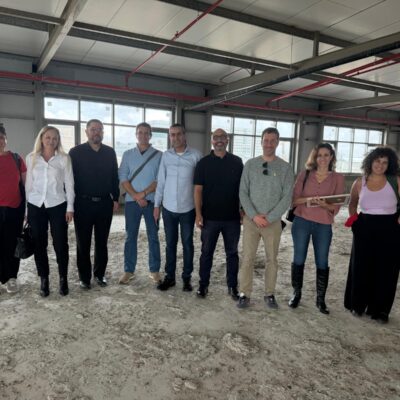
Eric Goldstein (second from left), CEO of UJA-Federation of New York, cuts the ribbon to a new Beit Nova center for survivors of the Oct. 7 terror attack at the Nova music festival, outside the Israeli city of Netanya, with Mark Medin (left), executive vice president of the federation; Ofir Amir, co-founder of the Tribe of Nova Foundation; and Reef Peretz, chair of the foundation, on Jan. 14, 2026.




 Add EJP on Google
Last week, UJA-Federation of New York CEO Eric Goldstein, who is stepping down this summer after nearly a dozen years at the helm of the country’s largest Jewish federation, cut the ribbon on the new Beit Nova center for survivors of the massacre at the Nova music festival on Oct. 7, 2023, which his organization had supported with a $2 million donation.
This was one of Goldstein’s many visits to Israel in the past two years — he flew back to New York shortly after the ceremony — as his organization has emerged as, by far, the Jewish federation that has donated the most funds to Israeli causes in the wake of the attacks. Donating roughly $325 million since Oct. 7, 2023, UJA-Federation of N.Y. has provided more than a third of all the donations made through the North American federation system’s Israel emergency fund.
In recent months, the federation has faced scrutiny for some of its donations, such as a $1 million pledge for IsraAid’s operations in Gaza and more recently, the organization supported the launch of the Arab-Jewish shared society-focused AJEEC-NISPED’s new center, which was named in honor of slain peace activist Vivian Silver.
At the same time, the federation has found itself standing in opposition to a mayor, Zohran Mamdani, whom much of the Jewish community views warily for his long history of anti-Israel activism. Last month, at a UJA event, the federation’s board chair, Marc Rowan, declared Mamdani an enemy of the Jewish community, sparking backlash from Jews on the political left.
This week, eJewishPhilanthropy spoke with Goldstein about how he and the organization are handling this complicated period.
This interview has been lightly edited for clarity.
Judah Ari Gross: I saw that you were just in Israel. Unfortunately, I wasn’t able to attend the ribbon-cutting ceremony for Beit Nova last week, but I wanted to check in with you both as you are nearing the end of your tenure and because this appears to be a particularly complex time for UJA-Federation of New York. So, generally speaking, how are you navigating this highly politicized point in time?
Eric Goldstein: This is a fraught moment in the community, resulting from the crises around us: the events of Oct. 7, [2023,] not only what happened in Israel, but the reverberations in America. The reverberations in America were deeply unsettling to so many in our community. People we thought were allies were silent or worse, and so it’s increased the level of fear and uncertainty about living in the largest Jewish community in the world outside of Israel.
That said, I think that we are a strong, vibrant community, and I believe we will continue to be a strong vibrant community.
Since Oct. 7, UJA has been among the very largest — no, the largest — North American philanthropic funder of the State of Israel. I think we’re the largest philanthropic funder of Israel’s north. Israel is core to who we are. I think that American Jewry is stronger when Israel is vibrant and strong, and I think Israel is stronger when American Jewry feels a deep sense of connection to it. If history’s taught us anything, it’s how central Israel needs to be to a global Jewry. And so we are deeply supportive, and our community has stepped up in really significant ways to support the State of Israel, which is on the front lines of this battle. At the end of the day, Israelis are sacrificing for us and for our well-being, and so the very least we can do as an American Jewish community is be supportive of the State of Israel.
We have given — not given — we have invested over $325 million in Israel since Oct. 7.
JAG: In the immediate aftermath of the attacks, when the American philanthropic contributions were so direct and apparent, Israelis seemed to really recognize and viscerally feel that support. Having just come back from Israel, meeting with people that UJA-Federation of New York supports, do you still see that recognition of Diaspora support and connection?
EG: First of all, I think that it’s undeniable that the needs in Israel are greater today than they were on Oct. 8, 2023, or on Oct. 8, 2024.
As a result of two-plus years of fighting, there are 800,000 newly vulnerable Israelis, who weren’t vulnerable on Oct. 6, 2023. When you consider the population of Israel, that’s a staggering percentage of newly vulnerable people. And unless Israel, unless we all succeed in putting a significant percentage of that population back on track, it’s a dramatic challenge to the future of Israel.
So, it’s true that you don’t see the same headlines, but the needs in Israel have only amplified over time. And you only have to be in Israel and spend a little bit of time to see that.
Now I’ve been in Israel many, many times since Oct. 7. I was actually there on Oct. 7 —
JAG: I don’t know if you remember because it was such a difficult, surreal time, but you and I and Eric Fingerhut and Bruce Sholk visited Barzilai Medical Center in Ashkelon on, I believe, Oct. 9.
EG: Oh, yes, I do remember that.
In terms of the most recent trip, I still think that one of the broader challenges is that Israelis are not sufficiently still familiar with the breadth and depth of American Jewry, of world Jewry, but many, many more today than before Oct. 7 have a sense of the real connection that American Jews feel for the well-being of Israel.
We were one of the largest, if not the largest funder of the Hostages Family Forum and its activities. We funded its New York-based staff. We’ve brought over hundreds of hostage family members, hostages who have been released, people from the south whose homes were devastated on Oct. 7. And until they came, I think many of them had no sense that there was this community.
I’ll give you one anecdote: We fund the Celebrate Israel parade every year. In June 2024, the first parade [after Oct. 7], even though it was not ‘pom-pom celebratory’ parade — it was very somber and the focus was on the hostages and the devastation of the communities in the south — Eden Golan, who had just come from Eurovision, came and was on our float. She had never ever been to America, and she’s going down Fifth Avenue, and she’s stunned by the fact that there are thousands of people lining the parade route who are singing back her song, which was playing in a loop. She starts crying because she never knew this community existed. That is the reaction that we got and we still get from a significant percentage.
At the Beit Nova opening a week ago, last Wednesday, we had Elkana Bohbot, who was a hostage for 738 days, who basically says, this is a community that’s embraced me, that I never really knew about. And there’s enormous gratitude. Now we’re not doing it for the gratitude. We’re doing it because it’s in our deep self-interest to strengthen Israel in this moment.
It’s not perfect, and I’m amazed at the number of Knesset members who come over [to the U.S.] who have such a lack of awareness of American Jewry. We’ve been working for a long time with the Ministry of Education, saying that “Israeli culture” [that’s taught in Israeli public schools] should not simply be about the Jewish holidays. It should be teaching about a living global Jewry so that there’s a greater sense of connection, and obviously there’s much more that we in America should be doing to link our community to Israel in a real way. But I think that we are in a new period where there’s a very significant interconnectedness and interdependence that we need to understand, and we need to do our best in a realistic way to further it.

JAG: To segue a bit, you noted the Celebrate Israel Parade — or is it the Israel Day Parade? Or Israel on Fifth? — what’s the terminology these days?
EG: It was Celebrate Israel, and then post-Oct. 7, it was Israel on Fifth. This year, we’re going back to Celebrate Israel Parade.
JAG: Thank you. So for the Celebrate Israel Parade, that was an event that, historically, New York City mayors attended. I imagine that’s not going to be the case with Mamdani. Though I imagine that someone like Julie Menin, the speaker of the New York City Council, probably will attend.
EG: Julie Menin surely will attend. Mark Levine, our comptroller, surely will attend. Our governor, our senators may attend. But yes, our mayor will not be there.
JAG: I know that the event is several months away, but are there already tensions around an event like that, between the Jewish community and City Hall? Are there concerns within the Jewish community about having such a public event in the wake of the Bondi Beach attacks and the arson fire in Jackson, Miss.?
EG: Look, it’s deeply unsettling for the Jewish community to have a mayor who doesn’t believe that Israel has a right to exist as a Jewish homeland, who thinks that Israel is genocidal. It creates enormous cognitive dissonance. It’s something that is really, you know, a stab in the heart for us, and there’s no getting around that.
On the other hand, let’s understand that we have the first Jewish woman speaker of the city council, Julie Menin. The largest vote-getter in the citywide election was Mark Levine, who got a lot more votes than Zohran Mamdani and who ran as an unapologetic Zionist. His son served in the IDF. Mark speaks Hebrew. When he was borough president, he did a sort-of sister community with Bat Yam [outside of Tel Aviv]. You have significant, significant numbers of people who are very supportive.
I think the lesson of what’s happened for our community is that we all knew our members of Congress, we knew our senators from New York, but we were much less conversant about who was our city council member, who was our state senator, our state assembly member. We weren’t as civically engaged in local government. Now we didn’t think we really needed to be, but this is a moment of recognition that, as a community, we need to take nothing for granted. We need to be smart. We still have significant numbers, significant influence, and we need to use it more effectively in local government moving forward. And I think that this situation will result in a Jewish community that’s stronger, more coordinated, more focused and involved in local civic politics, civic engagement in ways that are only beneficial to the community.
JAG: Obviously, the Celebrate Israel Parade is a large public event, and I don’t imagine that is going to change. But for smaller events, it’s becoming much more common to, for instance, not publicize their locations in advance or only giving out information to people who register. I have seen that drawing flack from people who see it as the Jewish community going into hiding. How does UJA-Federation of New York strike a balance between security measures and being openly, proudly Jewish?
EG: The reality is — and another thing that we need to highlight — the mayor made the decision to keep Jessica Tisch as the police commissioner. I can say with real firsthand knowledge that Jessica Tisch is super focused on the safety and well-being of the Jewish community of New York.
Every anti-Israel demonstration that the police department hears about is treated super seriously. And the mayor has committed — and we’ll see if it proves to be true, but I suspect it will— that while he won’t likely march in the Celebrate Israel parade, he will make sure that it has the same level of security that Mayor Eric Adams and the police department under Jessica Tisch provided last year.
But I don’t have any sense that our community is going underground. I live on the Upper West Side. I can tell you on a typical Shabbat, I see no difference in the number of people who are out with yarmulkes, with tallitot, clearly observant Jews walking in the streets of New York. And I think that’s true across the city. Are people more mindful that they need to be smart? Sure. But I don’t think our community is going underground.
For sure, we are spending much more time focused on Jewish communal security. In fiscal year 2017, UJA-Federation didn’t have a single dollar directly devoted to Jewish communal security or combating local antisemitism. This year, it’s going to be over $21 million, and that number is only going to grow in all likelihood. So we need to recognize the reality of the moment, but at the same time, I think that our community is vibrant, proudly Jewish and strong.
JAG: Along the lines of communal security, some of the biggest targets of antisemitic attacks — specifically violent attacks — are Haredim. The terror attack on Bondi Beach in Sydney, Australia, was against a Chabad event. In New York City, especially, Hasidic Jews are often targeted, largely because they are constantly, visibly Jewish. At the same time, Hasidic communities do not always have the tightest relationships with the wider Jewish world. How does that factor into your work especially today?
EG: In the wake of the Tree of Life massacre at the shul in Pittsburgh, which was in October 2018, and then the Poway, Calif., Chabad killing, which was April 2019, and then almost the daily incidents in Brooklyn of of violence against visible Jews, we created something called the Community Security Initiative, CSI, which now has over 30 full-time members headed by the former head of NYPD intelligence. It has become an essential resource around Jewish communal security and works with local law enforcement and global law enforcement every day. They have multiple people who do nothing all day but scour the deep, dark web for threats against the Jewish community of New York, and they’re constantly saving lives.
We are increasing their activities, and they deal with the totality of the Jewish community, including the Haredi community. In fact, in Rockland County, in Monsey, the federation there had less resources, and they approached us about having CSI, our group, help support security needs in Rockland County, overwhelmingly for Monsey’s Haredi community, and we did it.
Our view is an attack on one Jew is an attack on all Jews.
I can’t say it’s all ‘kumbaya’ and great, but we engage with the Haredi community around security issues, and provide funding to the Haredi community around security needs, and they are regularly in touch with the folk at CSI. So we’re all in this together in a very real sense.
JAG: Getting back to your recent trip to Israel, what was your focus besides the opening of the Beit Nova?
EG: Our focus is still Israel’s north and south. The north and south are essential to the future of Israel. Israel can’t be Israel without its northern and southern borders. And while some 85-plus percent of the north is back home, in critical places like Kiryat Shemona, Metula, Manara, it’s closer to 50%. And the people who are not there are the people who have the economic mobility to stay away, and they are critical [to the region’s] well-being. So we’re spending an enormous amount of focus on areas the government is not to try to stabilize north and south. The single most important issue in the north, beyond security, in terms of going back is educational opportunity for kids. If you were sending your kids to do robotics in the afternoon in Tel Aviv [when you were displaced], you’re not going to go back north to a dirt field. So we’re providing opportunities that create community resilience, that incentivize people to come back to these communities.
And we’re also doing some very significant capital projects in the [Gaza-adjacent] Shar Hanegev and Eshkol regions, to all of these hard-hit regions. I think we’re working with 27 particularly hard-hit communities, where we have resilience managers, people working with the communities in a not one-size-fits-all way. What are the most important strategies to maintain people? Many of the people who are there are still contemplating leaving. So the north and south are dramatic.
And I think it would be a real mistake for anyone to think that because we don’t see the day-to-day fighting, that the needs in Israel are lesser today than they were before. They’re greater, and I think that’s an important message for the broader community, and it’s one that we’re very much amplifying and spotlighting here in New York.
By the way, Beit Nova is just one building that’s part of a 10-acre complex. All told, we’ve brought funders with over $15 million into that project. That’s gonna be such an important center of recovery in central Israel. At the [injured veteran] Beit Halochem center, we provided $3 million for a pool complex, where thousands of people will come each week.
Philanthropy can’t replace government, it shouldn’t be a substitute for government. It supplements, but there are so many critical things that we as a broader philanthropic Jewish community still need to be doing and the more we talk them up the better.
JAG: Before we finish our time, the end of your tenure is approaching in a few months’ time. What can you tell me about the search for your successor?
EG: First of all, let me just say that I was the vice chair of our board and on the search committee to find the next CEO when my predecessor was leaving. I never thought I would do this. It wasn’t my plan. And then the CEO, John Ruskay, asked me to lunch and said, “Would you consider getting off the board, getting off the search committee, stepping down as vice chair, and becoming a candidate?”
And I agonized over it, and in the frame of now 11 ½ years, I can say that it was the most blessed judgment I ever made. No nonsense. This is an incredible organization, an incredible way to spend the day, and so I’m incredibly grateful to him, and I’m incredibly grateful for the opportunity to have done this.
In terms of the search committee process, there’s a very, very good search firm leading this and a very, very good search committee. And I have every confidence that they will pick someone even better than me to lead the organization forward.
Related News
PRESIDENTIAL REBUKE
Israel’s Herzog: Mamdani ‘makes no effort’ to hide disdain for Israel, Jews must fight back

MAJOR GIFTS
Center for Jewish History celebrates 25 years with a $25M matching grant
HIGHER EDUCATION
As Jewish donors reconsider academia, Jan Koum doubles down, endowing Israel studies at Stanford
CLOSING WORDS
In AZM address, Cosgrove links communal ‘orthodoxy’ on Israel to rising anti-Zionism among young Jews

MAGICAL EXPERIENCE
Shefa launches psychedelics retreat for Jewish professionals suffering burnout