Opinion
REAL TALK
The conversation we avoid but need to have




 Add EJP on Google
Over the past few years running IPF Atid, the young professionals’ division of Israel Policy Forum, I’ve sat with Jewish lay leaders, philanthropists, college students and community leaders across the country and from a variety of political backgrounds to have conversations about Israel. With new data emerging regularly demonstrating the declining support for Israel in America, there is a question looming large for American Jews that I am hearing in every meeting: How do we engage in constructive conversations about Israel amid a toxic discourse both inside and outside of our community?
The first thing I’ve learned is that not everyone is persuadable. Roughly 10% of both the right and the left have hardened into positions that no amount of nuance will move. Investing our energy in engaging them (or fighting them) is what leaves so many of us burnt out and demoralized. Our audience is the persuadable majority — and yes, they are the majority.
Now for what actually works.
Start where you have shared ground
The most effective tool for changing hearts and minds isn’t a social media post, a well-crafted talking point or a compelling op-ed. It’s a personal relationship built on genuine trust — and I say this knowing this requires far more time and sustained investment than anything that scales. But personal relationships give us something no algorithm can: the ability to choose a starting point based on shared values rather than contested ones.
In rooms with the pro-Israel community, I lead with my Zionist identity, because I know we’re likely aligned. With non-Jewish Americans, I open with support for a two-state solution, a plurality position that cuts across partisan lines. With those whose views I genuinely can’t read, I start with specific policies on the ground, where agreement is often more accessible than on the underlying ideology. Assessing where alignment might exist and leaning into that at the outset isn’t a compromise of your convictions — it’s how you build enough trust to get through to people.

A few practical habits also help: Define your terms, since words like “Zionism” mean radically different things to different people, and arguments often collapse under the weight of that confusion. Don’t make assumptions about where someone stands before they’ve told you. And don’t take it personally; the person across from you is most likely working through genuine uncertainty, not attacking you.
Stop acting like the IDF’s attorney
This is the harder truth and the one I’ve seen cause the most damage. There is a reflexive instinct among many pro-Israel advocates to contest every negative claim and never concede an inch, because any concession, the thinking goes, risks being weaponized by those working to delegitimize Israel entirely. I understand that instinct, but I’ve watched it backfire consistently, with exactly the people we most need to reach.
The movable middle — both Jewish and non-Jewish Americans who are genuinely trying to make sense of a complicated conflict — is not looking for a spokesperson. They are looking for someone who will engage honestly. When we refuse to acknowledge Israel’s real shortcomings, we don’t protect Israel’s image; we simply forfeit the credibility to defend it. Acknowledging hard truths may occasionally hand ammunition to bad-faith actors, but it consistently builds trust with people who haven’t made up their minds yet, and who want serious conversation rather than talking points.
Generate hope
In all of these spaces I notice a creeping fatalism — a tone that treats the current moment as the permanent state of conflict and mistakes exhaustion for realism. No one wants to engage with a discourse that is purely defensive, reactive, and defeatist, but too much of ours is exactly that. The movable middle isn’t looking for someone to tell them why everything is hopeless. They are looking for a reason to stay engaged and a picture of what we’re working toward, not just what we’re defending against and complaining about.
The majority of American Jews, and the majority of thoughtful people trying to engage seriously with this conflict, are still reachable. I’ve seen it. They are waiting for someone to meet them where they are, speak to them without spin, and give them something worth holding onto. Managing our expectations means accepting that some people can’t be moved while refusing to forget that most people can.
That is the conversation we keep avoiding. It’s also the only one worth having.
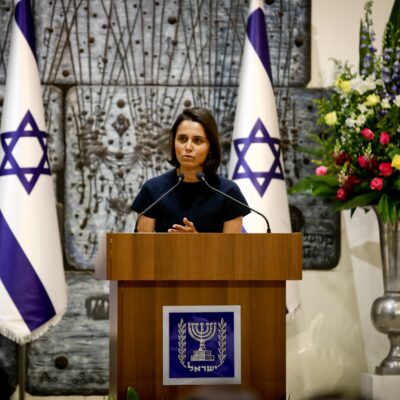
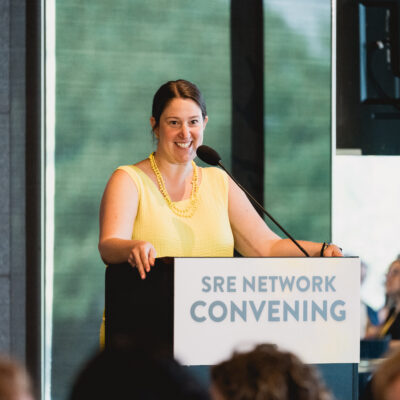
Shanie Reichman is the Israel Policy Forum’s director of strategic initiatives and director of IPF Atid, where she works to elevate the discourse around the Israeli-Palestinian conflict. Reichman served on the board of the Hadassah Foundation and Forum Dvorah. She is a participating author in the book Young Zionist Voices and is pursuing her master’s degree in Middle Eastern studies at CUNY Graduate Center.