Q&A
From newsroom to boardroom: Ofer Foundation CEO Yaniv Halily stresses storytelling in philanthropy
Top executive at one of Israel’s leading family foundations calls on Diaspora Jewish donors to deeply engage with Israel, not pull back when times get tough
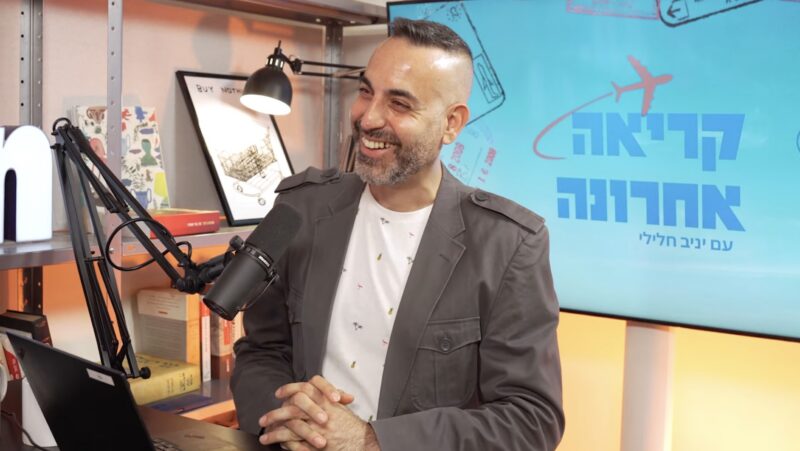
SCREENSHOT/YOUTUBE
Yaniv Halily, CEO of the Idan and Batia Ofer Family Foundation, appears on a podcast in August 2025.




 Add EJP on Google
Since he was 13, Yaniv Halily has been chasing stories. He built a journalism career that took him across Europe — spending more than a decade as the European correspondent for Yedioth Ahronoth. It was during that time that he first crossed paths with Batia and Idan Ofer, a connection that would eventually lead him to trade the newsroom for the boardroom and join the Idan & Batia Ofer Family Foundation, the philanthropic arm of one of Israel’s most powerful and widely recognized industrial families.
Today, Halily oversees a foundation portfolio that ranges from a leadership program for Druze women to a fellowship at Harvard Kennedy School that has expanded since Oct. 7.
Speaking to eJewishPhilanthropy, Halily broke down what it means to lead a major foundation at this particular Jewish moment, wrestled with the larger question of what Jewish and Israeli engagement at America’s elite universities should look like in a post-Oct. 7 world, and made the case to American donors for staying connected to Israel — even as frustration with its government runs high.
This interview has been edited for length and clarity.
Justin Hayet: Coming to philanthropy from journalism is a unique path. How did that background shape the approach to this role?
Yaniv Halily?: It’s very interesting to have a foundation executive come from journalism. Jewish foundations have professionalized to a point where they’re not always innovative, but if you come from a different background, you can bring a fresh perspective — something someone who has been in the same industry for 20 years may not see. Sometimes you need an outside eye. One of the things I’m happy I brought from my previous career is the entire understanding of storytelling. If I have a social project or social initiative, how do I create a unique story around it?
JH: What does storytelling in action actually look like at the foundation?
YH: Last year, we set up a leadership program for the Druze community. There are quite a lot of leadership programs for the community already, so we asked ourselves: what can we do differently?
We created a story around our initiative — we named it the Salman Habka Leadership program after a commander who died on the battlefield. We also realized that while there are many leadership programs for the Druze community, the majority of beneficiaries are men, and there is a strong problem in the community around education and opportunities for women. So we built the program around women. Most programs give scholarships to members of the community. We said a scholarship in itself is not enough. So we built a program that teaches life skills. We integrated many new elements: public speaking, confidence and self-confidence building, and we offer paid internships every summer in some of Israel’s leading companies
JH: Beyond storytelling, how does your journalism background inform the foundation’s communications strategy?
YH: It’s critical, and not just because it’s important for philanthropy to have good coverage. It’s important because if you build a social project and down the line you want partners, you need people to be aware of what you do. For example, with our youth program, we now have philanthropists who want to join — they learned about it and called asking how they can be part of it. That means if this year we have 20 students, next year we can have 60. Without the media, that would have been much more difficult.
JH: What should American philanthropists understand about Israeli philanthropy that might surprise them?
YH: In the last 20 years, the amount of money donated by Israelis has grown four times. Four times! The culture of giving has changed dramatically.
Israel has transformed from a country that was largely supported by outside donors to one with a significant domestic philanthropic sector. Part of that is the high-tech sector — many companies had exits, many people became millionaires and billionaires. Second, the type of philanthropy has changed. It’s not just, let’s raise money and send a check and come to the ceremony.
American philanthropists need to understand that Israel doesn’t need philanthropy done for it — it needs philanthropy done with it. That’s one thing. And the other: It’s not about rebuilding infrastructure anymore. It’s about rebuilding human resilience.
JH: What practical advice would you give an American Jewish foundation looking to make a meaningful impact in Israel today?
YH: Try to understand what the real issues of the country are — not necessarily what’s important to you personally. Naturally, people donate to something close to their heart, but if you really want to help Israeli society, try to understand what the core issues are. Don’t do philanthropy for Israel — do philanthropy with Israel.
One of the things I love most about the Ofer Family Foundation is that you can make decisions and execute immediately. That is something I really love — and it’s very Israeli. I can have a meeting on Wednesday, make a decision and on Thursday, we start operating. American foundations and larger institutions are, by nature, slower — partly because of American culture, but also because they’re large institutions.
JH: The Ofers made headlines for resigning from the Harvard Kennedy School board and canceling a major donation after Oct. 7, 2023, and yet the Idan & Batia Ofer Fellowship at the Kennedy School continued and expanded. How did that strategic decision come about?
YH: [After Oct. 7,] the Ofers were the first philanthropists in the entire world to respond to the issue of antisemitism in any campus — they resigned from the board of Harvard Kennedy School and canceled a major donation that was supposed to be transferred a few weeks later. It is important to understand that the first statement to emerge from Harvard in the aftermath of the Oct. 7 atrocities was issued by a coalition of 31 Harvard student organizations, which blamed Israel for the attacks. Because the statement was released so quickly and received widespread attention, many people were left with the impression that it reflected the university’s official position. In the eyes of many observers, Harvard’s administration did not respond forcefully enough to distance itself from or condemn the statement.
[Eventually] we made a strategic decision not only not to resign or cancel our program, but actually to expand it. We have more fellows today than we had on Oct 7.
There were a few elements behind this decision.
The first is very Israeli: If there is a problem of antisemitism or anti-Israel sentiment, we’re not running away. We’re not escaping. We’re standing strong and tall and saying: you’re trying to threaten us, you’re trying to push us out.
The second element: if you leave the building, you lose all influence over what happens there. We didn’t want that. We didn’t want Harvard to become more hostile. We wanted to make sure it remains a safe space for every Jewish and Israeli student. And I’m very happy to say that we have reached that point — every Jewish student at Kennedy School, where we operate, feels safe and welcome.
The third element is strategic. We give scholarships to master’s students at the Kennedy School. Statistically, every student in that program sits in a class with three or four future heads of state. This year, there are students from 90 countries in that school. For us, having an Israeli fellow at Harvard Kennedy School is the best representation of our country.
JH: What would you say to American Jewish donors who are considering pulling funding from universities over their handling of antisemitism?
YH: It really depends on the university. The case of Harvard is not the same as Berkeley. It’s case-by-case. American campuses are not going to change without us helping them.
We are not the only people who donate to American universities. You have Qatar, you have Kuwait — they donate quite a lot of money, and they buy influence. The biggest risk is that if you pull out, Qatari money gets in. And then not only have you not solved the problem — you may have helped the opposition become stronger.
JH: You mentioned shared society — how urgent is that issue right now, and what role can American funders play?
YH: It’s super important. There’s a very delicate fracture in our society. We’ve worked for almost 80 years to build trust between Jews and Arabs, and a lot of that trust has been damaged in the past three years. We also have an extreme right-wing government right now that certainly doesn’t help bring Jews and Arabs together.
If you are a Jewish American philanthropist and you deeply care about the State of Israel, then you should think about shared society — how you can contribute to a more integrated society, even if your political opinions aren’t there yet. Because newsflash: you’re not going to wake up tomorrow morning and see Arabs disappear. And I say the same thing to my Arab friends: you’re not going to wake up and see Jews disappear.
We need to live here together. When you see people actually meeting each other, the prejudice that is so often portrayed in the media just isn’t there.
JH: As a final word, what is your message to American supporters about this moment in Israel?
YH: I am very grateful for everything that American Jewish support provides. I don’t take it for granted, and I hope most Israelis don’t either. My message is: Be more involved in Israeli society, be more involved in the projects on the ground.
And don’t forget something very important: even if you disagree with the current government, the country is not the government.
In the past year, I’ve spoken with many American Jewish people, and some of them expressed real anger toward the government. Some said, “I don’t want to hear about this country anymore.” And I told them: But the country is not the government. The country is me. Do you not want to hear from me? And they said, “No, no — I love you, I care about you.” So yes — the government and the country are two very different things. Don’t let one push you away from the other.
Related News
CLOSING WORDS
In AZM address, Cosgrove links communal ‘orthodoxy’ on Israel to rising anti-Zionism among young Jews

MAJOR GIFTS
Center for Jewish History celebrates 25 years with a $25M matching grant
HIGHER EDUCATION
As Jewish donors reconsider academia, Jan Koum doubles down, endowing Israel studies at Stanford
PRESIDENTIAL REBUKE
Israel’s Herzog: Mamdani ‘makes no effort’ to hide disdain for Israel, Jews must fight back
EXIT INTERVIEW
Elizabeth Sokolsky, longtime EVP of Birthright Israel, to retire next year