HOOP DREAMS
Renovating Israeli basketball courts, ballplayer Jared Armstrong offers respite to war-weary kids
Courtesy/JAB
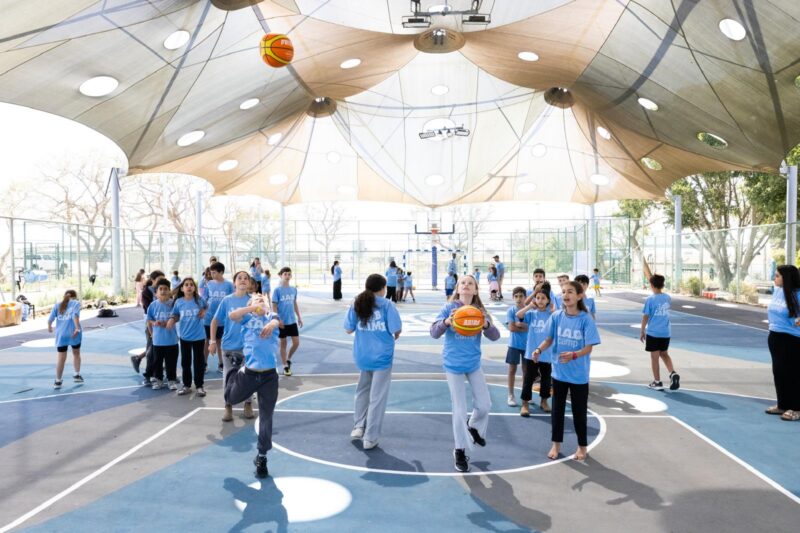
Israeli kids play basketball on a newly renovated court in the southern Israeli town of Dimona, in an undated photograph.




 Add EJP on Google
HERZLIYA — Believing that basketball can provide children with “an outlet to heal in a tough time” of war, American Israeli professional ballplayer Jared Armstrong is on a fast break, repairing and improving courts throughout Israel. Armstrong’s nonprofit, JAB Courts, which has already repaired 17 courts in towns near the Gaza border, is planning to renovate 18 new courts per year, every year, as a long-term commitment to healing and community rebuilding.
“Basketball is my ethos,” Armstrong, a 29-year-old Philadelphia-born hoopster, told eJewishPhilanthropy as he visited one of his organization’s courts in the central Israeli city of Herzliya. Born to a Jewish mother and raised in Philadelphia and Maryland, he has been playing the game since he was 3. His parents raised him to be community-minded and to give back: “They always talked about community and being able to inspire the next generation.”
That next generation of Israeli children can grow up with the sights and sounds of war all around them. A good run on the court, then, could offer much-needed respite, according to Armstrong.
JAB — short for Jared Armstrong Basketball — operates two distinct initiatives: JAB Camp, a Philadelphia-based youth basketball and leadership nonprofit founded in 2023, and JAB Courts, which focuses on renovating courts in underserved and conflict-affected communities.
In 2020, Armstrong moved to Israel, playing for Hapoel Haifa, Hapoel Rishon, Ashkelon and Eilat. The path was not straightforward: the Israeli Ministry of Interior initially refused to recognize his right to citizenship, a case that drew national attention and accusations of racism before being resolved in his favor in 2021. Armstrong says he holds no bitterness towards the state.
On Oct. 7, 2023, Armstrong was living in Ashkelon, 10 miles from Gaza. A rocket landed 100 feet from his apartment. Nearby, Hamas had infiltrated Sderot, killing more than 50 civilians and 20 police officers.
JAB Courts in Israel began on April 17, 2024, when Armstrong dedicated his first renovated court in Ashkelon — renamed the JAB Camp Court — in the city where he had lived when the war broke out. He then followed up with five more courts.

Armstrong had resumed playing for HaPoel Eilat after Oct. 7, once the league resumed and played through the 2023–24 season. But when September came and a new season loomed, Armstrong was needed in Philadelphia.
“We initiated the JAB Resilience Tour when I decided not to come back, due to my mother’s health, in order to still have an impact on Israel,” he said. Last month, Armstrong returned with the goal of launching 10 courts and 10 camps across 10 communities, from the South to the North, over 20 days. The tour brings JAB Courts’ total to 17 renovated courts, reaching more than 3,000 Israeli children.
The communities on the tour map almost directly onto the geography of Oct. 7 and its aftermath: Kibbutz Alumim and Kibbutz Zikim — both attacked on Oct. 7 itself — along with Ofakim, Sderot, Ashkelon and Dimona. The inclusion of Majdal Shams, the Druze village in the Golan where a rocket attack killed 12 children in July 2024, signals that JAB Courts is deliberately building across communal lines, according to Armstrong. “We wanted to impact not only the Jewish community, but Arab communities, Christian communities,” he said.
At the dedication of a new court at the Ze’ev school in Herzliya on Sunday, Armstrong explained that it was important to have one court in the center of the country, which was less impacted by Oct. 7, because, as he put it, “everyone was impacted by 10/7, whether it was them personally or someone in their family.”
For Armstrong, the magic lies not just in the physically beautiful courts, but also in the team-building, coaching and leadership he provides. Armstrong and his team led a group of middle schoolers through drills atop the freshly painted surface. Gathering them in a circle, on top of letters spelling “Unite,” Armstrong told the youth: “After Oct. 7, we decided to start renovating courts to inspire kids like you to change their dreams, and give you an outlet to heal during a tough time. I want you guys to use this place as a way to get away from what’s happening around you — and also inspire you for now and for later in your life.”
JAB Courts completed construction on a new court in the southern Israeli town of Dimona on March 19. Two days later, an Iranian missile struck residential areas of Dimona and the nearby city of Arad, wounding approximately 180 people and causing massive structural damage. But the basketball court was unharmed.
“It is surreal,” Brian Shankman, Armstrong’s partner at JAB told eJP. “You see the destruction, and then just 300 yards away, there is this beautiful court that wasn’t impacted.” Towns like Arad in Israel’s periphery, he said, where there is so much stress and chaos, require a different level of investment. “Basketball creates a place where the community comes together — a place to share and take pride in,” he said.
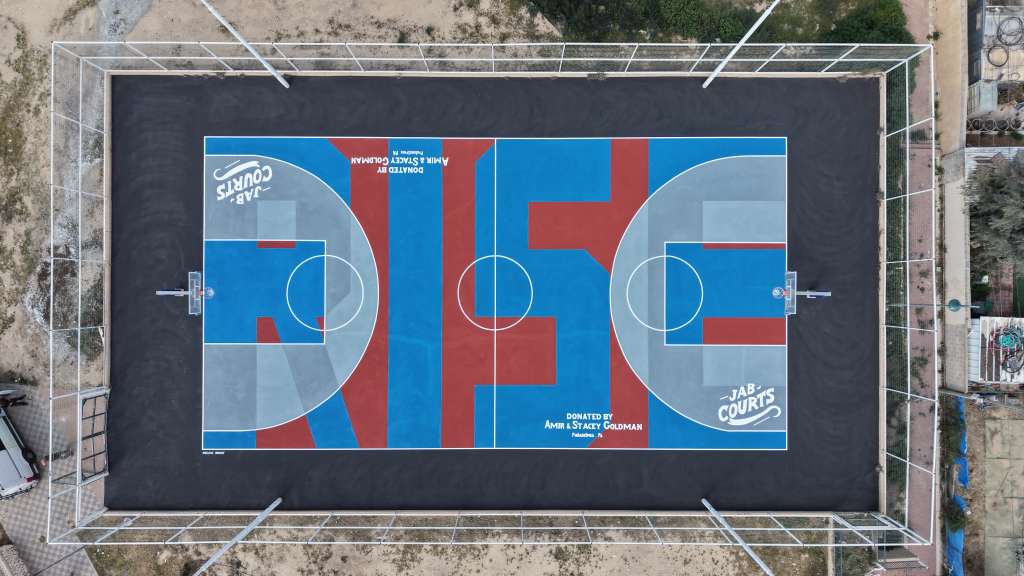
The courts themselves are the work of a third-generation Israeli contractor whose father holds contracts for most of Israel’s indoor arenas. Each court is thoughtfully designed, carrying a word at its center — “Rise,” “Empower,” “Stronger Together,” “Hope,” “Believe”— chosen deliberately for its resonance with that community. Color choices are calibrated to avoid shades that might be psychologically triggering for communities still living inside a war. “There’s a mental health side to this,” Armstrong said. “We’re really trying to cover this in the right way.”
Armstrong is sensitive to the way in which his project can help Israel rehabilitate its image and build bridges with young American Jews. “When you’re posting these things and showing the genuineness and the opportunity for kids, it shows the diversity of the country — which a lot of people, unfortunately, with American media, don’t see,” he said.
Using his athletic credibility and social media reach — his posts from Dimona, Zikim and Majdal Shams have reached audiences who, as he puts it, are “not looking at it from a political stance, they’re just looking at it like, you’re helping kids.” Shankman, his partner, brings nearly three decades of American Jewish institutional experience, including 15 years at AIPAC, where he built relationships between Diaspora communities and Israel. “We are obsessed with building the bridge between the next generation of kids in America and here, and we think that sports is one of the least controversial ways to do that,” said Shankman.
Funding for the Resilience Tour comes from a mix of individual families and foundations, with three or four courts sponsored by donors whose names appear on the courts. Armstrong noted that donors from the sports world have also come on board.
The Herzliya court was sponsored by the Grosberg family of Scarsdale, N.Y., a relationship that began when their son did a bar mitzvah project with JAB in Ashkelon. The father subsequently hosted a parlor meeting to bring additional donors into the fold. “He understands the impact that basketball can have — not only physically, but mentally, spiritually and emotionally,” Armstrong says.
That pipeline — from b’nei mitzvah project to court sponsorship to parlor meeting — points directly to where Armstrong and Shankman want to take JAB Courts next. Beginning this fall, the organization plans to formally reach out to b’nei mitzvah classes across the United States, offering families the opportunity to sponsor courts, participate in the design process, and travel to Israel for the dedication. The pitch is both philanthropic and experiential: your family’s name on a court in Sderot or Zikim, a trip to dedicate it, a physical connection to a country that can otherwise feel abstract.
“Five, 10 years from now, kids are coming, they’re seeing this, they’re appreciating it,” Shankman said. “We think it’s critical.”
Every court comes with a formal agreement with the local municipality or school administration, setting expectations for ongoing maintenance and stewardship. “We want the community to take pride in this investment,” Shankman says. “It’s not a one-off piece.”
On-the-ground support comes partly from Sheliak Bryant, a Dimona resident and member of the Black Hebrew community who is a former league player now part of the JAB Courts Israel team — a deliberate effort to root the initiative in local ownership rather than importing it wholesale from the outside.
After this pilot tour of 10 courts, Armstrong plans to return next year with an expanded goal of 18 courts, spending approximately a month in Israel. Summer camps in Israel are on the horizon as well, to complement the four JAB Camp sessions already running in Philadelphia, starting June 15. A girls’ sports component is also in early planning stages — Armstrong and Shankman both flagged it as a priority, acknowledging it will require finding the right coaches and building institutional commitment before it gains traction.
The broader vision, as Armstrong describes it, is a permanent physical record of Diaspora investment scattered across the Israeli landscape — courts in kibbutzim and development towns and Druze villages, each with a family’s name and a word at the center, waiting for the next generation of American Jewish youth to come find them.
“I always believe a court can change a life,” Armstrong says. “And that emphasis has always stayed with me throughout my career.”
Related News

PRESIDENTIAL REBUKE
Israel’s Herzog: Mamdani ‘makes no effort’ to hide disdain for Israel, Jews must fight back

EXIT INTERVIEW
Elizabeth Sokolsky, longtime EVP of Birthright Israel, to retire next year
CLOSING WORDS
In AZM address, Cosgrove links communal ‘orthodoxy’ on Israel to rising anti-Zionism among young Jews

MAJOR GIFTS
Center for Jewish History celebrates 25 years with a $25M matching grant
HIGHER EDUCATION
As Jewish donors reconsider academia, Jan Koum doubles down, endowing Israel studies at Stanford