Shabbat shalom?
After Trump proclamation, Jewish groups scramble to plan ‘Shabbat 250,’ even as some have concerns
Some Jewish organizations — mainly Orthodox and conservative — hail the initiative for spotlighting Jews and the day of rest, while others have misgivings over the mingling of religion and state
Rafael Ben-Ari/Getty Images
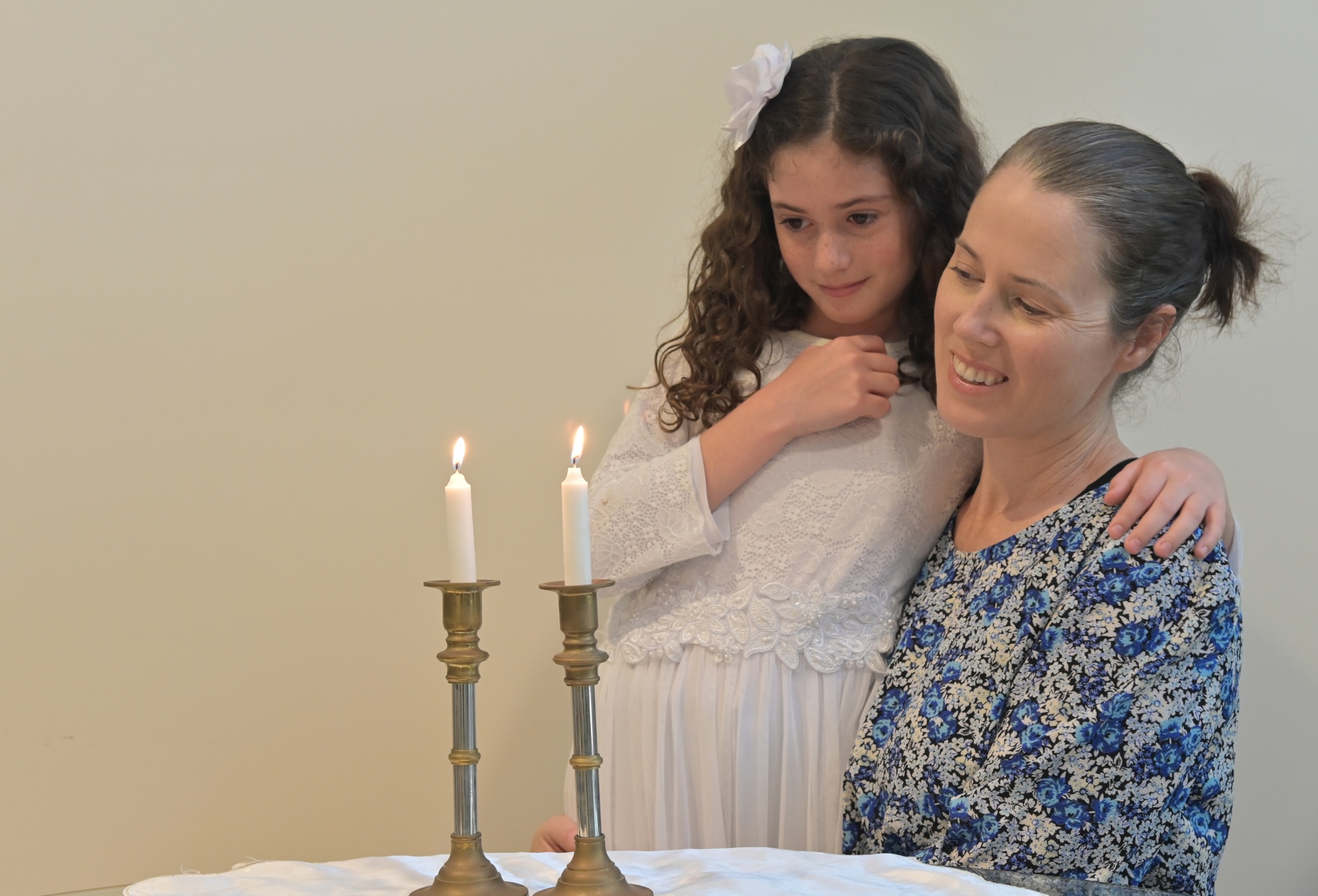
Illustrative. A mother and daughter admire the Shabbat candles.




 Add EJP on Google
Last week, President Donald Trump proclaimed this year’s Jewish American Heritage Month and left many Jewish leaders floored.
In addition to the perfunctory celebration of “the countless contributions” that Jewish Americans have made to the nation, Trump declared the first national Shabbat, beginning at sundown on May 15, “in special honor of 250 glorious years of American independence.”
“I was blown away,” Rabbi Eliezer Wolf of Miami’s Beit David Highland Lakes Shul, told eJewishPhilanthropy. “I [couldn’t] believe what I [was] reading. No president has ever done that. A president doesn’t need to do that. This was something that was very unique, especially during a time like this, where Jews, even in America, are feeling a lot of hate.”
Immediately, Wolf, a Chabad-ordained rabbi, knew that he needed to get planning, and two days after Trump’s proclamation, his congregation announced “a Shabbat dinner celebrating religious freedom for 250 years in the great USA.”
While many Jewish groups — predominantly Orthodox and conservative ones — have wholeheartedly embraced “Shabbat 250,” as it was dubbed, other more progressive organizations and congregations have expressed ambivalence and misgivings about it, concerned that such an initiative erodes the religious freedoms that Jews in particular have fought so hard to establish and protect in the United States.
Rabbi Amicha Lau-Lavie, of the progressive Lab/Shul in New York City, discussed his concerns in a note to members, acknowledging the political issues with the initiative while stressing the importance of Shabbat.
“I propose that we show up for Shabbat, but that we rewrite the guest list. I suggest we each adapt this ‘National Shabbat’ in our own unique way – not because a leader commanded it, but because our humanity demands it,” Lau-Lavie wrote. “I encourage us to set the table for a fabulous Friday night dinner or Saturday brunch as our oldest tech tool for dialogue and discussion. Fill your table with friends, but also with those you don’t agree with. Debate this day and what it means for you in this confusing context.”
For Yitzchok Tendler, the co-founder of Young Jewish Conservatives, the friends that he wants to fill his table with for Shabbat 250 are “young American Jews who are politically conservative, who might not be Orthodox or Shabbat-observant,” he told eJP.
His organization, which functions under the nonprofit Jewish Heritage Movement, is offering $180 micro-grants, supported by anonymous donors, for young, politically conservative Jews to hold Shabbat dinners honoring the occasion.
The organization’s marquee event is an annual Shabbat dinner held at the Conservative Political Action Conference, last hosted in Grapevine, Texas, in March. “Had there been more advanced notice, we would probably have organized in-person Shabbat programs like we do throughout the year around the country,” Tendler said. “Considering the short notice, we figured that the second-best thing we can do is empower people to organize their own Shabbat in their own homes.”
The practice of marking the Sabbath, once confined to Jewish circles, has become increasingly mainstream in politically conservative circles, even non-Jewish ones, he said, particularly since the assassination of right-wing activist Charlie Kirk in September. Kirk’s final book, which he finished writing weeks before his killing, was titled Stop, in the Name of God: Why Honoring the Sabbath Will Transform Your Life.
One hundred and thirty applications for micro-grants flooded into YJC from across the country, and even one from an American student studying in the United Kingdom. The demand was so great that the organization had to shutter the online form within days and will have to turn down many applicants, but it is prioritizing young right-wing Jews hosting Shabbat dinners for the first time and has already handed out $5,000, according to YJC.
“This declaration of Shabbat 250 is in line with the kind of relationship that we’ve seen from this White House with American Jewry,” Tendler said, pointing to a summit for young Jewish leaders to discuss antisemitism held last June at the White House, which YJC helped organize. “Our organization has had very positive experiences [with the Trump administration].”
As the national Shabbat inches closer, grassroots websites have also popped up, though their provenance and affiliations of these are unclear. One entrepreneurial site, “Shabbat250 kit,” sells traditional pre-cooked meals, complete with frozen cholent and babka.
Chabad – which as a movement distances itself from partisan politics, but whose members generally support conservative parties – has also embraced Shabbat 250, with many local communities holding related events.
“As the Rebbe noted, this nation’s founders recognized that [the United States’] establishment was guided by divine providence — and that the freedoms it affords are endowed by the creator,” Rabbi Motti Seligson, director of public relations for Chabad, told eJP, referring to the late Lubavitcher Rebbe Menachem Mendel Schneerson. “That’s a vision Jews have always understood — and Shabbat is how we’ve always expressed it.”
Representatives from Yeshiva University, Rabbinical Council of America and the Orthodox Union sent an email to affiliated congregational rabbis reiterating Trump’s call and encouraging “that this sense of Hakarat Hatov [gratitude] find particular expression during the recitation of the tefillah [prayers] for the United States government, a moment already designated within our tefillah to acknowledge the kindness and protection afforded to us that we do not take for granted.”
When Rabbi Yehoshua Mizrachi, who serves the B’nai Israel Synagogue in Pensacola, Fla., announced an event tied to Shabbat 250, titled “A Shabbat for America,” the majority of congregants were elated, but others felt “anything that Trump does is inherently tainted,” he told eJP.
“I try to remind these people that this is not political. If President Obama had made a similar declaration, we would be doing the same thing,” he said.
Mizrachi sees the event, held during weekly services with a kiddush luncheon organized by his wife, a professional chef, as an opportunity to bond with non-Jewish neighbors, including Christian congregations and members of B’nei Noach, a congregation of non-Jews who follow the so-called Seven Noahide Laws.
“The Beit Hamikdash [Holy Temple] is called a house of prayer for all people,” Mizrachi said. “The shul is a mini Beit Hamikdash until the Beit Hamikdash is restored, so to have people not of the Jewish faith come join us in prayer is a very, very powerful thing.”
The national Shabbat is “a very important opportunity to make a statement,” he said. “The Torah says those who bless the Jewish people will be blessed, and those who curse us will be cursed. It’s said to Avraham, then it’s reiterated to Yitzchak. It’s reiterated to Jacob. And so we want to give the community a chance to join with us and receive those blessings.”
But other Jewish leaders are uncomfortable with a national event based around any religion, and the majority of organizations that are celebrating Shabbat 250 lean Orthodox, a group that predominantly supported Trump in the last election.
“There’s a fine line between celebrating Jewish heritage and identity, which our government should be doing, and breaking the important barrier between church and state, which has protected the Jewish community and so many others in this country for generations,” Amy Spitalnick, CEO of the Jewish Council for Public Affairs, told eJP.
America provided Jews with refuge because it allowed them to live and practice freely, without privilege or prejudice based on their beliefs, Spitalnick said. When Church and state lines are blurred, no matter which faith seems favored or endorsed, it opens the door to trouble.
“One day you’re in and the next day you could be out,” she said. “When the government starts breaking down that line between church and state, no matter the religion, it ultimately is going to create a situation in which Jews, or any other community, might be on the wrong side at one point, either under this administration or the next.”
Spitalnick noted that Trump in particular has repeatedly weighed in on what makes a good Jew, saying for example that “any Jewish person that votes for Democrats hates their religion.” She also said that this proclamation comes as other members of the administration have been accused of proselytizing from their official platforms.
However, she said, “if it is simply a celebration of Jewish identity and practice, then that’s very different than trying to utilize the government to advance a specific approach to religion or a specific way of practicing.”
Wolf said that some of his congregants were also uncomfortable with the event the synagogue is planning because they are uncomfortable with the president. However, he emphasized that the event is not about who is in power, but about the acknowledgment of respect by the head of a world superpower.
His congregation was one of the first to announce an event and is planning to go all out for the dinner, adorning the synagogue in Americana and pictures of Jewish American accomplishments.
Wolf, who was born and raised in Australia, also hopes to tailor the menu to American foods, which can be tricky, he said, when the first thing people think of are burgers and fries. “America has very sloppy national foods — not such gourmet things for Shabbat dinner.”
Related News
HIGHER EDUCATION
As Jewish donors reconsider academia, Jan Koum doubles down, endowing Israel studies at Stanford
EXIT INTERVIEW
Elizabeth Sokolsky, longtime EVP of Birthright Israel, to retire next year
ADVANCING A VISION
N.Y. federation donates $1M toward building shared-society center named for peace activist killed on 10/7
MAGICAL EXPERIENCE
Shefa launches psychedelics retreat for Jewish professionals suffering burnout
CLOSING WORDS
In AZM address, Cosgrove links communal ‘orthodoxy’ on Israel to rising anti-Zionism among young Jews