COME ALONG OR GO ALONE
NCJW rolls out new strategic plan focused on advocacy, inviting local sections to join or spin off
Experts say the new framework, focused more on advocacy and less on service, was needed to keep the struggling 133-year-old organization relevant
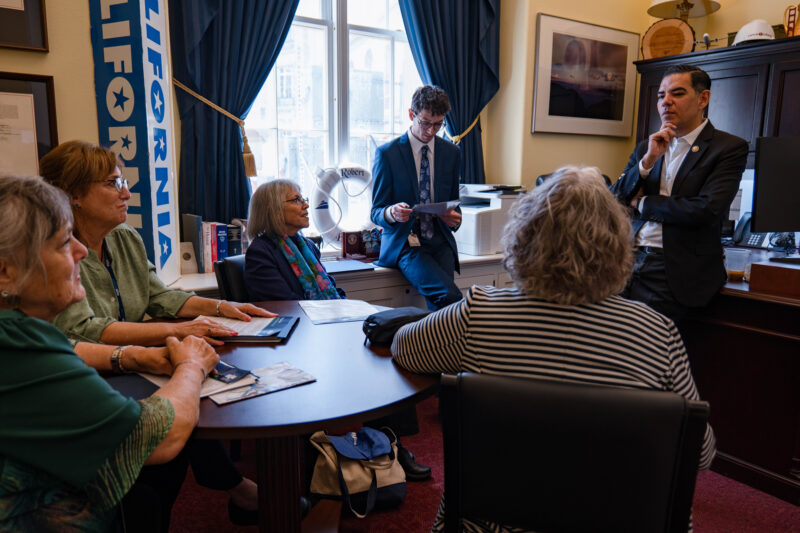
Keren Peter, courtesy of NCJW
Leaders from NCJW Long Beach meeting with Rep. Robert Garcia in May 2025 for NCJW's Day on Capitol Hill




 Add EJP on Google
When National Council of Jewish Women, in a bid to stay relevant in fast-changing times, presented its new strategic plan to local sections last July, it gave them three options: integrate, affiliate or disaffiliate, with the second option only offered to a select few larger sections.
To continue using the NCJW name, sections needed to align with the national organization’s shift away from community service to focus more on advocacy in four core areas — demanding reproductive freedom, advancing economic opportunity, safeguarding civil rights and fostering safer communities, with an increased focus on Israel advocacy. While the organization isn’t completely doing away with community service — something NCJW leaders say it will always be involved with — service is expected to be coupled alongside advocacy.
Five sections have already disaffiliated from the national organization — many spinning off into independent organizations with new names — and two sections, NCJW Houston and NCJW Sarasota-Manatee, in Florida, shuttered.
With a December 2027 deadline for sections to decide which direction to take, NCJW expects 20 to integrate and five to affiliate. The status of 20 others is unclear.
Experts told eJewishPhilanthropy that a new framework was needed for the struggling 133-year-old organization, which once boasted hundreds of local sections and is now down to roughly 50. The changes, they said, will strengthen the organization’s national voice.
For some of the sections, including NCJW Colorado and NCJW Miami, the decision to integrate was simple. They had already shifted most of their work away from community service to advocacy, and the change meant that the national organization would support sections with fundraising and cover administrative tasks, freeing volunteers to focus on the organization’s mission of advancing social change through a Jewish lens.
“Everything that we were doing falls within those four categories anyway,” NCJW Colorado’s board president, Michelle Reiff, told eJP. Working more closely with the national organization meant they would be in tune with successful initiatives in other sections, especially around issues such as gun safety, a topic particularly relevant in Colorado, a state that had 77 mass shootings between 2014 to 2023.
The five-year plan, christened NCJW Forward, came after years of polls by an outside consulting firm, surveying over 2,500 leaders at local sections about their interests and needs. Even though the planning began before the Supreme Court overturned Roe v. Wade in 2022 — ending the constitutional right to an abortion — that decision proved that “that we needed a movement that could be more nimble, that could be stronger, that could be better equipped to respond together,” Jody Rabhan, NCJW’s CEO, told eJP.
By integrating, sections will come under the banner of the larger organization, giving up their individual 501(c)(3) statuses. They will have access to the national office’s administration, operating out of its headquarters in Washington, including its finance, human resource and information technology departments as well as the larger organization’s computing platforms, which NCJW plans to increase investment to better connect sections with one another.
For Reiff, having access to the national organization’s administration takes a load off the local section. NCJW Colorado’s has one “very part-time” bookkeeper who will be let go once the section is fully integrated, which will happen over the next couple months.
Although its membership has grown recently, NCJW Colorado’s board has shrunk, and Reiff finds herself acting as treasurer and managing communications and overseeing membership. “According to my husband, I’m doing it 24/7,” Reiff told eJP about her role with the organization. She estimates half her time is spent on administrative issues. Handing off those tasks will allow her and other volunteers to focus on fundraising, building relationships and supporting local advocates.
In recent years, NCJW Colorado has transferred community service initiatives to other local organizations: a backpack drive was taken over by the local Jewish Family Services; a bookmobile was picked up by the library; and a doctor’s appointment transportation program was acquired by the city. The Colorado section had already been focused on advocacy and national programming such as the annual Repro Shabbat, where rabbis spoke to their congregations about abortion and reproductive rights.
The NCJW set the goal of engaging 1 million “changemakers” by 2030, which will be bolstered by the organization launching the NCJW Center for Leadership, a leadership academy where, according to Rabhan, new and established leaders can get “skilled up” in courses based on advocacy, leadership and building community. “We’re really leaning into building our leaders, investing in Jewish women’s leadership like never before,” she told eJP.
The NCJW is not only the oldest Jewish women’s grassroots organization in the country, but it’s one of the oldest women’s organizations of any kind, according to Steven Windmueller, emeritus professor of Jewish communal service at the Jack H. Skirball Campus of Hebrew Union College-Jewish Institute of Religion in Los Angeles.
The changes NCJW is making exist alongside trends “beyond the Jewish world,” Windmueller told eJP. “It’s sort of reflective of what’s happening to mainstream historic institutions in trying to sort of recapture the marketplace of where they were and what they represented and what they should represent in a new sort of environment or era.”
NCJW was formed in 1893, the same year Colorado became the second U.S. state to grant women full voting rights. It was a time when most women did not work outside the home and antisemitism was surging through America and the world.
The organization provided Jewish women a voice. NCJW leaders set up port and dock stations to support new immigrants from Europe and created sections where they helped pass nearly every piece of civil right legislation in America.
But in today’s America, many gendered organizations are struggling as Americans no longer box themselves in by gender, Windmueller said. Even Hadassah, The Women’s Zionist Organization of America, which was founded in 1912, has experimented with couples’ memberships and now offers an associate membership to male allies. In addition, young people today tend to support initiatives, but not join organizations as members.
NCJW too is shifting away from being membership based, instead depending on donations and fundraising instead of dues. This move mirrors a similar shift made by B’nai B’rith International, the world’s oldest Jewish service organization, founded in 1843, which once operated with a lodge model.
No longer depending on memberships will make the sections more inviting for younger members and elderly, Reiff said. Both young and older potential members often have very little disposable income. Her section has around 500 members. Since her section began the transition away from membership, she is seeing more people attending their lunch-and-learn sessions and showing interest in joining their leadership council.
The plan will lead to a “more uniform presence for a national legacy organization,” Windmueller said. “That couldn’t happen with the distributive leadership that it had operating around the country.”
The Jewish Women’s Action Alliance Arizona, formerly NCJW Arizona, is one of the sections that disaffiliated after a century of working as part of NCJW.
“National organizations, by very definition, believe in advocacy from the top down, and we feel strongly about advocacy percolating from the bottom up,” Civia Tamarkin, president of JWAAA, told eJP. Integrating or affiliating, she said, would hamper her section’s ability to respond to the needs of their local community. They don’t want to require national approval to sue, file amicus briefs or make decisions for the advisory committees they sit on based on issues that are extremely local in nature.
Tamarkin also worried that aligning could impact Ruth Place, a community-trauma recovery center run by JWAAA that the organization hopes will one day become its own nonprofit.
Another area of dispute between JWAAA and the national organization was the plan’s focus on Israel advocacy, something JWAAA does not do, feeling there are enough organizations that advocate for Israel, while their focus is needed locally. Meanwhile, the national organization is looking to create stronger partnerships with feminist advocates in Israel as part of its strategic plan.
In addition, Tamarkin’s organization holds views that may not be in line with the national organization. This includes criticizing the adoption of the International Holocaust Remembrance Alliance’s working definition of antisemitism in state laws regarding education, calling it “unworkable” and a poor fit for the classroom.
The disaffiliation, effective July 1, was done under a “very cordial and respectful manner,” Tamarkin said. “[National] understood our needs.” Other than the name, the JWAAA hasn’t changed, she said, and it is amenable to working with the national organization on common goals in the future.
The amount local sections will be able to continue advocacy and service work on issues other than of the four core focus areas has been understood differently by all of the state and local representatives whom eJP spoke to. To some, the core areas are seen as a limit, preventing advocacy work on other topics, while to others, they are meant as a shared starting point.
Jessica Silver, a lawyer and co-board president at NCJW Miami, a section that also incorporated, believes that many sections are misunderstanding what it means to align with the national priorities.
“There are some older members who have done things a very specific way for a really long time, and it’s maybe hard for them to wrap their minds around [you] can still do it that way,” Silver told eJP. “The process is slightly different, but you still actually are retaining that freedom.”
Rabhan said that the national organization chose only four topics because they “give them the opportunities to continue to show up in their communities where they need to, where there are hot issues.”
Local sections can continue to work on their own individual issues, she said. “Our strength has always come from our local leaders, our local folks who are doing the work in their communities, who are in coalition, who are in relationship with the people making change, and that’s what this new structure is really built to support.”
Still, sections are choosing to leave. “We’re excited for them and looking forward to working with them,” Rabhan said. Under the new model there are currently no new sections set to launch in the locations where sections disaffiliate. “I don’t want to put the cart before the horse as we’re still building the regional model,” she said, when asked if new sections will launch in disaffiliated cities in the future.
According to Laura Monn Ginsburg, NCJW’s immediate past resident, local sections will implement “adaptive advocacy,” where the organization focuses on key issues and local sections interpret those issues for their specific communities. “Advocacy around abortion access is going to look very different for me in Minnesota than it is for my colleagues in Miami.”
In Miami, Silver said that she doesn’t expect the plan’s changes will impact the local section’s work running food and backpack drives and organizing knitting groups where women make blankets for cancer patients. While the national office will not be financially supporting those local initiatives, NCJW and other local sections can continue to fundraise for local programs under the national organization’s nonprofits status, she said.
The organization also hopes to launch a new website and hire new staff. Currently, NCJW has around 30 employees, and by the end of next year it expects to have 41, including three new regional directors based in Chicago, Minneapolis and Miami, with plans to have as many as eight. The directors will support sections, perform outreach and fundraise, bringing a local flair to the national messaging.
For a long time, NCJW was something that you came to because you knew somebody that was in it,” Monn Ginsburg said. “You had a mom; you had an aunt; you had someone in your family that was in it.” These changes are “about making it less of a well-kept secret, and more about having these multiple pathways for folks to come in and be part of NCJW.”
For Monn Ginsburg, this restructuring is critical for the future of NCJW, whose history demonstrates how things have changed. Her name and photo sits on the wall of presidents in the Washington offices beside those of her predecessors, but the presidents representing the first half of the organization’s existence are listed as Mrs., followed by their husbands’ names. Those leaders couldn’t have a mortgage or credit card in their own names. They couldn’t work outside the home.
“We’ve evolved from settlement houses to voting rights, social services to reproductive freedom, local advocacy to national leadership,” she said. “We’ve never been doing anything but reinventing ourselves and reinventing the world around us to make it better, and then saying, ‘OK, great. Now that we did that, what are we reinventing from here?’”
For Reiff, it’s the legacy of the organization that made her and other NCJW Colorado leaders want to integrate. Her section was founded the same year as the national organization. “Everybody really values that connection, being able to call ourselves part of NCJW, and I don’t think anybody here wants to lose that,” she said.
Reiff joined NCJW when she moved to Colorado in 1985, seeking community. Since then, she raised a family and became a lifetime member. Her kids went off to college, and she got more involved. The community NCJW offers her is only growing.
Related News
CLOSING WORDS
In AZM address, Cosgrove links communal ‘orthodoxy’ on Israel to rising anti-Zionism among young Jews

MAGICAL EXPERIENCE
Shefa launches psychedelics retreat for Jewish professionals suffering burnout

MAJOR GIFTS
Center for Jewish History celebrates 25 years with a $25M matching grant
EXIT INTERVIEW
Elizabeth Sokolsky, longtime EVP of Birthright Israel, to retire next year

EXCLUSIVE
Detroit-based philanthropists Nancy, James Grosfeld donate $8M to renovate JDC’s Israel campus