Opinion
GET CREATIVE
Taking the leap: What a skydiving fundraiser taught us about Jewish engagement




 Add EJP on Google
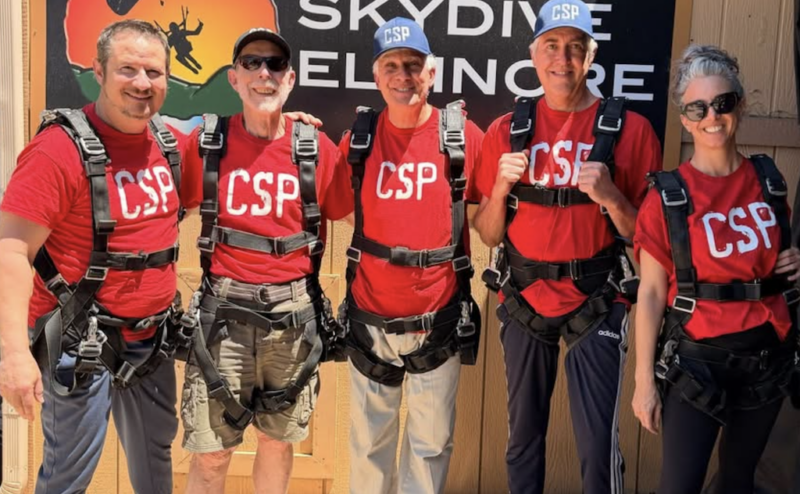
This past Sunday in Southern California, five members of our community scholar program family jumped out of an airplane to raise money for adult Jewish education.
Yes, really.
CSP - Community Scholar Program, Orange County/Facebook
"Masterfully stitched together by Lance from Skydive Lake Elsinore footage, this is what happens when CSP’s idea of experiential Jewish learning involves Rabbi Elie, Marshall, Shirel, Gideon, and Lance voluntarily exiting an airplane," says the post on the group's Facebook page.
Our jump team included a retired Conservative rabbi, our Tel Aviv-based CSP program curator, an 80-year-old donor, a longtime supporter who is genuinely terrified of heights and a CSP board member with exactly one previous skydive under his belt. None were professional daredevils. All were willing to do something bold, uncomfortable, memorable, and just a little absurd in service of Jewish learning.
To the best of our knowledge, this was the first ever free-fall fundraiser for adult Jewish education.
And honestly, maybe it should not be the last.
For 25 years, CSP has worked to reimagine what adult Jewish engagement can look like. For our first 19 years, we were a fully in-person operation in Orange County, Calif., partnering with local synagogues, the JCC, Federation and other local Jewish organizations to bring outstanding scholars, artists, writers, historians, musicians, and public intellectuals to our community. During the COVID-19 pandemic, we pivoted aggressively online and have hosted more than 1,000 Zoom programs to date, reaching audiences around the world. Most of our programs are offered without charge.
Over the course of our history, CSP has raised and spent close to $3 million on adult Jewish education, remarkably without the benefit, at least to date, of any single major donor underwriting the enterprise. Instead, CSP has been sustained by a broad base of more than 600 supporters, with an average annual donation of roughly $400. In many ways, that grassroots support reflects the heart of our model: a community built not around a handful of large checks, but around hundreds of individual acts of participation, curiosity, trust and shared investment in Jewish learning.
We have hosted 25 one-month scholars in residence, including internationally respected figures such as Prof. Jonathan Sarna, Prof. Marc Michael Epstein, Prof. Jodi Magness, Prof. Avigdor Shinan, and many others. We have built immersive travel adventures to Israel, New York City, Poland and Lithuania, Spain, Germany, Greece, and beyond. We have organized retreats, museum tours, concerts, camping trips, archaeological explorations, and now apparently, skydiving.
Along the way, we learned something important: adults are not looking only for content. They are looking for connection, meaning, surprise, friendship, and experiences that make them feel fully alive.
Too often, Jewish organizations continue to frame adult engagement narrowly. We ask: “How do we get people to come to another lecture?” when perhaps we should be asking: “How do we create experiences people cannot stop talking about?”
The skydiving fundraiser worked not because people suddenly became extreme sports enthusiasts. It worked because it embodied something deeper. It reflected trust, vulnerability, adventure, humor, and shared purpose. Donors were not simply giving to keep programs running. They were sponsoring courage. They were investing in a story. They wanted to see whether Rabbi Elie Spitz would really jump. They wanted proof that our Tel Aviv curator, Shirel Horovitz, would survive the experience. They wanted to witness what happens when Jewish community stops taking itself so seriously that it forgets to be joyful.
And the truth is, our participants are hungry for this.
In an era when attention is fragmented and institutional loyalty is weaker than it once was, relevance requires creativity. Jewish organizations cannot rely solely on nostalgia, obligation, or passive membership models. We need experiences that create emotional resonance and shared memories. We need moments that feel alive enough to compete with everything else demanding people’s time and attention.
That does not mean every synagogue or organization needs to start throwing people out of airplanes.
But it may mean we need to take more risks. More creative risks. More experiential risks. More intergenerational risks. We need to blur the line between learning and living. Between audience and participant. Between fundraiser and adventure.
Adult Jewish engagement should not feel like medicine people know they are supposed to take. It should feel like something people eagerly choose because it adds meaning, friendship, curiosity, and energy to their lives.
Ironically, jumping out of a plane reinforced one of the oldest truths in Jewish life: growth often begins with a leap of faith.
This year, we just added parachutes.
Rabbi Arie P. Katz is the founder and CEO of the Orange County California Jewish Community Scholar Program.