Opinion
ANALYSIS
United States vs. Southern Poverty Law Center: How this case could impact Jewish advocacy organizations




 Add EJP on Google
The current federal case against the Southern Poverty Law Center is being viewed as historically significant for a few reasons, and this case has significant implications for other advocacy institutions, including key Jewish organizations.
What makes this case notable is not simply that a nonprofit is under investigation — nonprofits have been prosecuted before for tax fraud, embezzlement, campaign-finance violations and so on. Legal analysts and former prosecutors are saying that the indictment stretches conventional fraud doctrines in ways rarely used against advocacy nonprofits.
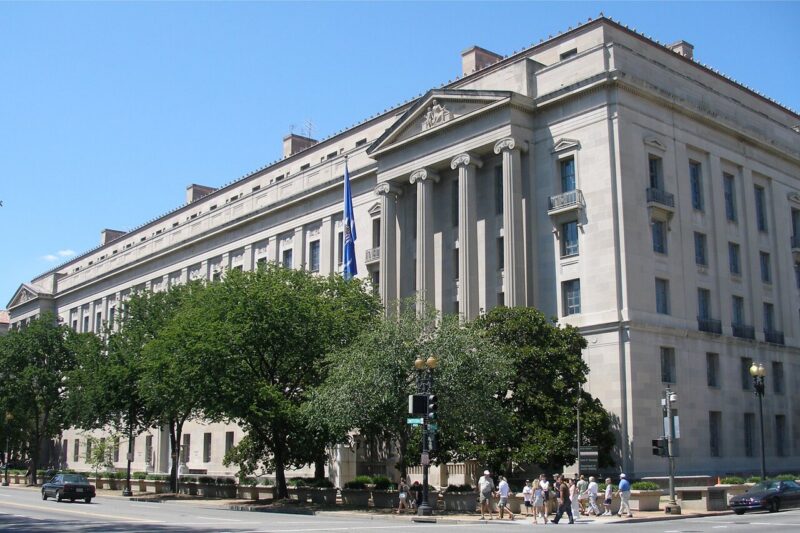
Wikimedia Commons
The Robert F. Kennedy Department of Justice Building in Washington, D.C., headquarters of the U.S. Department of Justice, in August 2006.
The Department of Justice indictment alleges that the SPLC misled donors and banks by secretly paying informants inside extremist organizations between 2014 and 2023. The SPLC argues those payments were standard confidential-informant practices used to monitor violent extremist threats and often shared with law enforcement.
This is not the first time a nationally prominent civil rights advocacy organization has been targeted when its core mission directly conflicts with the administration’s political base. Historical precedents involve the National Association for the Advancement of Colored People, which was aggressively targeted by southern state governments in the 1950s and 1960s. Alabama tried to force disclosure of the organization’s membership rolls in a campaign widely viewed as intended to suppress civil rights organizing. The Supreme Court pushed back in NAACP v. Alabama (1958), recognizing associational privacy protections.
During the Vietnam War, President Johnson threatened Jewish leaders that United Jewish Appeal dollars earmarked for Israel would face legal challenges if there wasn’t greater Jewish support for the war effort; he never followed through on that threat, though. The Nixon administration, however, is infamous for using the IRS, FBI and intelligence agencies against perceived political enemies, including anti-war organizations, activists, journalists and civil-rights leaders. This eventually contributed to the post-Watergate reforms limiting political abuse of federal power.
American Civil Liberties Union has often been attacked rhetorically by administrations of both parties, especially during wartime or national-security controversies, but it has not historically been the subject of a major federal criminal prosecution over its advocacy work. Planned Parenthood has also repeatedly faced congressional investigations, attempts to strip federal funding, state-level prosecutions, undercover sting operations and Medicaid exclusion attempts, but those were generally framed around abortion funding or medical compliance, not allegations of criminal fraud related to its advocacy.
There are precedents for governments using regulatory or investigatory powers against advocacy-focused nonprofits. What is less common is a criminal indictment against a major mainstream civil rights organization based on operational methods tied to its advocacy mission, accompanied by overt political rhetoric from top officials. Jewish advocacy organizations, including the Anti-Defamation League, the Religious Action Center, the Jewish Council for Public Affairs and the National Council of Jewish Women, might see the actions taken against SPLC as potentially challenging.
The SPLC case is potentially precedent-setting. Critics argue that if the government can characterize undercover monitoring involving engaging confidential informants as “fraud” or “material deception,” then many advocacy organizations across the political spectrum could theoretically become vulnerable. The concern is not limited to left-leaning groups; a broad precedent could affect gun-rights organizations, religious-liberty groups, immigration groups, anti-abortion organizations, environmental nonprofits, election-integrity organizations and watchdog groups.
At the same time, supporters of the prosecution argue that nonprofit status does not immunize organizations from fraud laws and that advocacy groups should face prosecution if donor deception or financial misconduct occurred. The administration’s position is that this is an ordinary fraud case, not political retaliation.
The real significance may ultimately depend on whether the courts dismiss the case, whether prosecutors can prove actual intent to defraud and whether similar theories are later employed against other advocacy organizations.
The SPLC case sits at the intersection of several major constitutional and historical fault lines in American law: First Amendment protections, executive power, selective prosecution, nonprofit regulation and the long American history of government treating ideological opponents as security threats. This case could influence how aggressively the government will investigate advocacy groups, whether nonprofit operational secrecy receives constitutional protection, how broadly fraud statutes can be applied and whether courts impose stronger limits on politically sensitive prosecutions.
Steven Windmueller is Emeritus Professor of Jewish Communal Studies at the Jack H. Skirball Campus of Hebrew Union College – Jewish Institute of Religion in Los Angeles.