Opinion
UNDER PRESSURE
Getting messy on purpose: How Jewish teen programming can serve as a respite from achievement culture




 Add EJP on Google
It’s a scene youth educators and engagement professionals have all experienced: you’ve created content that rivals a Super Bowl halftime show, planned every detail down to the color of napkins to serve with snacks and confirmed with the teens that they’ll attend. But when it’s time for the program itself, the teens just don’t show.
This can happen for several reasons; No program is immune to the competing priorities of a teenager today. While recruiting for teen programs often feels like swimming upstream, shifting program culture to make it both less burdensome and more meaningful can change not just who walks in the door, but whether they choose to stay. At the most recent Honeycomb Facilitator Training, we explored a key factor in program retention that often goes unrecognized: the pressures of achievement culture.
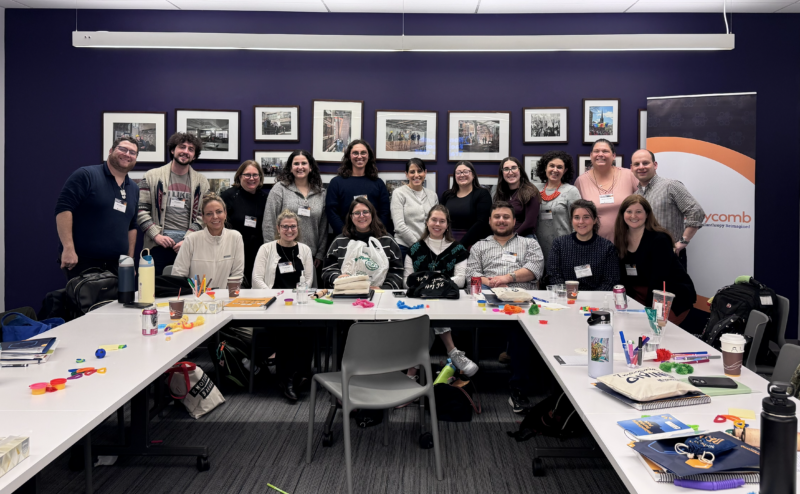
Courtesy/Jewish Funders Network
Participants at the 2025 Honeycomb Facilitator Training.
In honor of Mental Health Awareness Month, we want to raise awareness about how achievement culture can undermine Jewish teens’ wellbeing (and that of the adults who care for them), share some insights gleaned from the Honeycomb training and recommend some strategies to challenge and mitigate the pressures many teens are experiencing.
What is achievement culture?
To best understand achievement culture, it helps to start with a clear definition. As an adolescent development scholar who trains schools and youth-serving organizations on these issues (in addition to her work at the Jewish Funders Network), Beth defines achievement culture as a set of norms and expectations that convey that our human value is contingent on what we accomplish or achieve. This comes up often for teens, particularly those attending “high-achieving schools,” which tend to foster intense competition among students and define success in narrow ways such as admission to elite universities. Achievement culture can manifest in a number of ways, including what the Robert Wood Johnson Foundation has termed “excessive pressure to excel,” hyper-competition and envy among peers, perfectionism and contingent self-worth and low distress tolerance. Teens attending high-achieving schools report levels of anxiety, depression and alcohol or drug use and dependence that are two to three times higher than national averages, on par with levels associated with chronic stressors like poverty and racial bias.
Why is this an important issue for Jewish teen programming?
Honeycomb hosts an annual facilitator training to give new and veteran teen philanthropy professionals skills and resources to start or strengthen their programs. As program and education director, Laura frequently hears the scenario described above. Seasoned youth-serving professionals with the best-laid plans often struggle with recruitment and retention.
When teens are taught, either explicitly or implicitly, that narrowly-defined “success” should be their top priority, it can deprioritize experiences that could not only serve as a respite from achievement culture, but also provide important leadership skills, developmental support and Jewish identity building.
Strategies to combat achievement culture
Recognizing achievement culture as a likely culprit behind the recruitment issue, Honeycomb wanted to equip youth-serving professionals with tools to combat it. Beth introduced core concepts and research related to achievement culture and helped participants reflect on how it presents in their youth philanthropy programs. Based on her experience working with youth-facing professionals in high achieving schools and community organizations, and on Honeycomb’s decades of experience developing and supporting Jewish teen philanthropy programming, we offered several strategies to challenge achievement culture in Jewish spaces, which we want to share here with the broader field:
1.) Make the journey the outcome.
The impact of a grant cannot be guaranteed; well-reasoned funding strategies don’t always go as planned, and the world can change on a dime. This is something that philanthropists and grant makers understand deeply. It’s important that program leaders do not work towards a predetermined outcome of success, and that they embrace learning from failure as a vital (though admittedly disappointing) part of good philanthropic practice. From the scientific method to the revision process for literary and analytic writing, every academic discipline has a mechanism for leveraging flaws and failures to produce stronger work. Learning from failures and setbacks in philanthropy is just as vital.
2.) Avoid “sitcom problems.”
If only we lived in a world where life’s problems could be solved in a neat 30-minute episode! But complex, vexing issues – the kind that philanthropy seeks to improve – can’t possibly be remediated or resolved in a single grant cycle. Set expectations accordingly. Encourage teens to continue conversations across programming sessions. Be honest about how “success” is defined and don’t suggest that they’re going to solve real-world systemic issues in a short amount of time. Pirkei Avot teaches us, “It is not your responsibility to complete the work, nor are you free to desist from it.” Help teens understand that while they may never see the finished success of their work, they can still make a vital impact.
3.) Get comfortable with mistakes, setbacks and failures.
One part of Beth’s workshop that particularly resonated with the Honeycomb group was a real-life case of someone who embraced failure – wearing it not on her sleeve, but around her waist. When Caitlin Kirby, a doctoral student in Earth and Environmental Science at Michigan State University, defended her dissertation, she appeared before her faculty committee dressed in a homemade skirt crafted from rejection letters she’d received in the course of her doctoral work. When asked about this decision, Kirby explained that her faculty advisors had always modeled transparency about their own professional setbacks and disappointments, teaching Kirby that having publications or scholarship applications rejected is just part of the process of doing good science, not a blanket judgment on the scientist’s ideas or a sign that they should give up. In the Honeycomb training, Kirby’s story led participants to brainstorm ways they, too, could model refusing to treat failure as shameful in order to create more space and permission for others to do the same.
4.) Beware of framing self-care as the antidote to stress.
While self-care is important for wellness, achievement culture can hijack its impact. When teens already feel overwhelmed and primed to view falling short as a judgment on their character, prescribing good practices (e.g., mindfulness, sleep hygiene, exercise) can end up feeling like an additional burden or expectation, setting them up to feel like they are failing at yet another task. There is also an important distinction between self-soothing activities and the kind of self-care that addresses teens’ underlying sources of stress. Sometimes taking a break, eating comfort food, or bingeing a show can feel supportive and grounding, but those activities can also function as a form of avoidance and end up perpetuating anxiety. By ensuring program spaces that foster connections and affirm teens’ intrinsic value beyond their external accomplishments, teen philanthropy and other youth programs can provide a crucial respite from achievement culture in a way that no spa day could.
Based on their decades of experience supporting Jewish teen philanthropy programs and Jewish youth professionals, Honeycomb also recommends the following:
5.) Find ways to “double dip”
When teens see the value of a program experience intersecting with other aspects of their life, the draw to participate becomes greater. Honeycomb encourages youth philanthropy programs to approve counting program time towards schools’ community service requirements. When Jewish programming seamlessly interacts with the world teens are living in and the multiple demands on their time and attention, it lessens the feeling of doing “one more thing” in their already over-programmed lives.
6.) Name it to tame it
Leaders can add a layer of awareness by being transparent with teens, naming achievement pressure as a reason they want to be solicitous of teens’ time and availability. Let them know you understand something about the pressures they are facing and that your goal is for their teen philanthropy experience to be meaningful but not burdensome.
Beth ended her presentation with a slide that said, “Thanks for getting messy with me!” Likewise, we encourage youth professionals to model getting messy: embrace imperfection and awkwardness as inherently and unavoidably (and therefore acceptably) human, welcome the opportunity to learn and grow together, and to set the expectation that no one needs to arrive knowing all the answers.
Beth Cooper Benjamin is the director of programs and peer networks at the Jewish Funders Network and was the keynote speaker at the 2025 Honeycomb Facilitator Training.
Laura Hemlock-Schaeffer is the program and education director at Honeycomb, a project of the Jewish Funders Network.