Opinion
CALL TO ACTION
It is time to take it to the streets




 Add EJP on Google
Author’s Note: Just before this article went to press, I learned of the death of the longtime head of the Anti-Defamation League, Abe Foxman. He was a firebrand — an outspoken champion for the safety of the Jewish people, a warrior against hatred. I dedicate this to his memory.
santima.studio/Adobe Stock
Dec. 6, 1987. On the eve of the Washington summit between Soviet President Mikhail Gorbachev and President Ronald Reagan, 200,000-250,000 people flooded the National Mall in a display of solidarity for Soviet Jewry. It was the largest Jewish rally ever held in the United States. It put the issue of Soviet Jewry squarely in Gorbachev’s face.
The results were momentous. Not long after the summit, the gates opened, and approximately 1 million Soviet Jews immigrated to Israel. Another 500,000 came to America. Four years later, the Soviet Union itself disappeared.
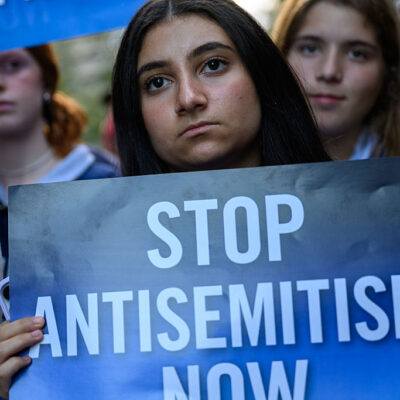
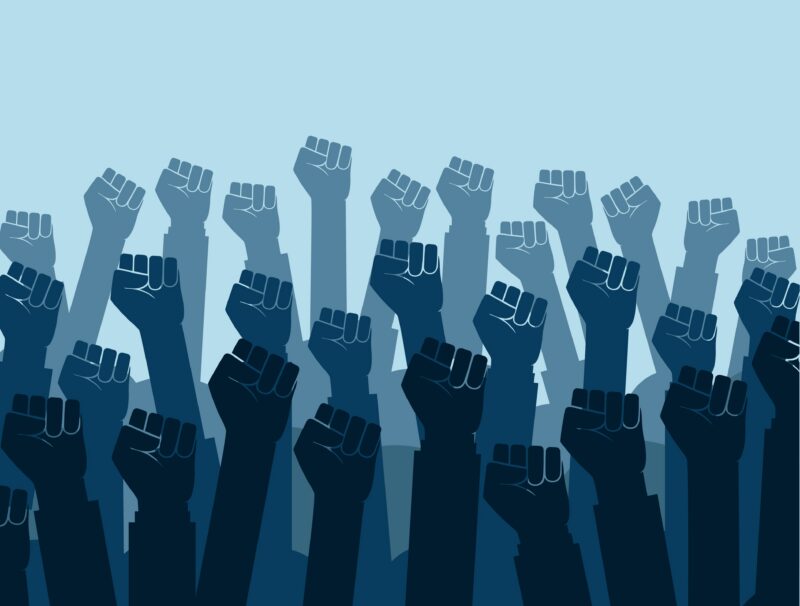
It is time for American Jews, and their allies, to gather again in Washington — to make noise and to make history. It is time for a massive rally to expose the issue of antisemitism in America, and to demand — not that antisemitism disappear, which is unlikely to happen, but that, as a nation, we publicly affirm that acting on those beliefs is un-American.
But that is only the beginning of what I am proposing.
Let me take you back further, to 1943. By then, the Nazi onslaught had already slaughtered a sizable percentage of European Jewry. The world was silent. Into that silence stepped a remarkable conspiracy of conscience.
Billy Rose — Broadway impresario, lyricist — and film director Ernst Lubitsch produced a dramatic pageant at Madison Square Garden. Ben Hecht wrote it. Kurt Weill composed the music. Moss Hart staged it. Two hundred rabbis and 200 cantors filled the stage with prayer.
And then came the stars: Edward G. Robinson, Paul Muni, John Garfield, Ralph Bellamy, Frank Sinatra and Burgess Meredith.
The pageant was called “We Will Never Die.”
It happened on March 9, 1943. Forty thousand people attended. The Hearst Corporation ran the advertisements — for free. Then the pageant went on the road: Philadelphia, Washington, Los Angeles. The Hollywood Bowl performance was broadcast nationally on NBC radio. Eleanor Roosevelt attended the Washington performance. So did senators, members of Congress and Supreme Court justices.
What made this work?
Three things: First, the venues were enormous. Second, the creators and performers were genuine cultural heavyweights. Third, and this is crucial: you did not have to be Jewish to participate. In fact, it helped if you weren’t. Look again at the cast: Bellamy, Sinatra, Meredith. None of them were Jewish. All of them were present.
Which brings me to the present moment.
American cultural figures need to lend their voices to one of the gravest moral crises of our era – the rise of antisemitism. Hollywood stars who happen to be Jewish — this is the moment for them to make their dramatic entrance. It should be, once again, at Madison Square Garden. And then, take it on the road – regionally, to Los Angeles, Chicago and Miami.
All broadcast live on television and the internet.
And then, we get those celebrities to appear on television spots, talking about how antisemitism is un-American and inhuman.
We will not stop with Jewish celebrities. Remember, “We Will Never Die” depended on non-Jews. We have allies. Let’s find them and let’s enlist them.
Here is what should humble us and embarrass us in equal measure:
In 1943, the American Jewish community was a fraction of its current size. It commanded a tiny fraction of its current wealth, influence and cultural power. Its internal structures were still in their infancy, if they existed at all.
And yet, a handful of writers, directors, composers and performers pulled off something extraordinary: multiple large-scale events, national broadcast reach and political attention.
That was then. Just think of what technology can offer us as a tool for today.
If Tucker Carlson and Nick Fuentes can mobilize their followers with a laptop and a microphone, then Jews and their allies — a conspiracy of decency — can surely do the same.
Moreover, we have legacy organizations – the entire alphabet soup of American Jewish defense agencies – with large budgets and even larger (virtual) Rolodexes.
One final note, and it is bittersweet.
Ben Hecht, for all his ferocious energy, came away from “We Will Never Die” despondent. He told Weill: “The pageant has accomplished nothing. Actually, all we have done is make a lot of Jews cry, which is not a unique accomplishment.”
He was too hard on himself. But his words contain a warning.
This time, we are not gathering to cry. We are gathering to shrei — to scream — in rage, in solidarity, in the refusal to be complicit in our own erasure and disappearance.
The streets are waiting.
Rabbi Jeffrey K. Salkin is an award-winning columnist, podcaster, author and the co-founder and co-director of Wisdom Without Walls, an online salon for Jewish ideas.