Opinion
LOUD AND PROUD
Making antisemitism irrelevant




 Add EJP on Google
I had the pleasure of spending the second week of June at the Zelikow School Leadership Conference in Los Angeles, connecting with peers from around the world as we continue developing our Jewish nonprofit leadership skills. During one session, facilitated by Jonathan Kaufman of Third Plateau, we were asked to imagine what would need to happen to achieve a future where, 10 years from now, an eJewishPhilanthropy headline could read: “Jewish joy is real and felt throughout the Jewish community.”
For the purposes of the exercise, “Jewish joy” was a sense of genuine belonging, meaningful relationships, curiosity and connection within Jewish life. When we began identifying the barriers that currently prevent Jewish joy from being ubiquitous, one assumption emerged almost immediately: We would need to eradicate antisemitism first. But I found myself wondering whether that assumption was true. Does antisemitism need to be eradicated for Jewish joy to flourish?
Courtesy/Zelikow School of Jewish Nonprofit Management
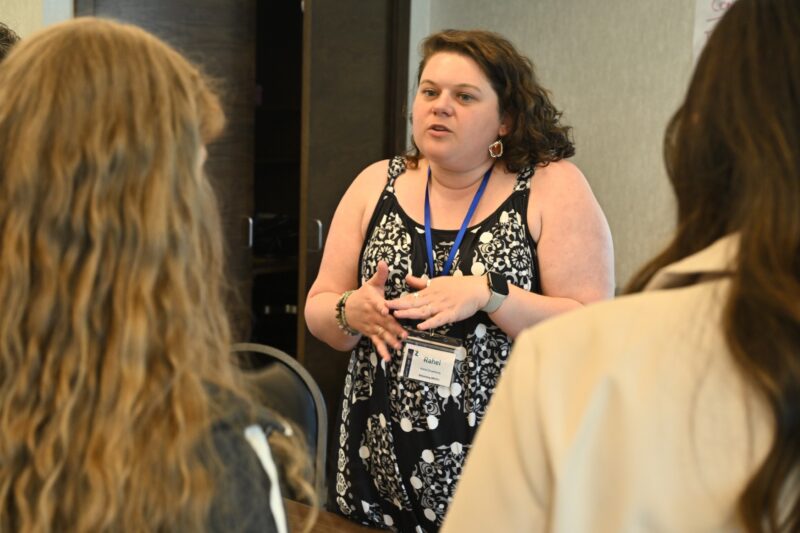
Rahel Gruenberg discusses how to make Jewish joy real during a session at the the Zelikow School of Jewish Nonprofit Management's annual June leadership conference in Los Angeles in 2026.
Don’t get me wrong. I understand that antisemitism is real. I had pennies thrown at me in middle school because I was Jewish. The JCC where I worked was vandalized with swastikas. I’ve participated in more active shooter drills, situational awareness trainings, de-escalation trainings, Stop the Bleed courses and CPR certifications than I care to count. I read the statistics from the Anti-Defamation League and Secure Community Network. I have spent 15 years working in the Jewish nonprofit field. I am not naïve about the threats we face.
Yet antisemitism doesn’t keep me up at night, nor is it the reason I wear a Jewish star, and it’s not what drew me to Jewish learning, Jewish community or Jewish leadership.
Judaism gave me rituals that connect me to the generations before me and the generations yet to come. It offered structure during both moments of loss, like when my dad died, and moments of joy, like when I married my wife. When I lived in Boston in my 20s, Judaism gave me a community — I celebrated Shabbat at the Moshe Kavod House and hosted 30-person Passover Seders with support from OneTable — and it gave me purpose. It is because Judaism so profoundly shaped my life that I have dedicated my career to making these opportunities accessible to others. It provides a framework for meaning-making and a deep sense of belonging. These are the reasons I stay.
Jewish history includes real persecution, violence and exclusion. We cannot and should not ignore those realities. But I often think about the feminist activist Gloria Steinem and her practice of “flipping” a situation to see whether our assumptions still hold when applied to another group.
If we think about other communities that have faced persecution, how have they responded?
As a queer woman writing during Pride Month, I cannot help but think about the LGBTQ+ community. The modern Pride Parade was born out of the Stonewall uprising, which was sparked by police violence and discrimination. LGBTQ+ people faced criminalization, exclusion, violence and eventually the devastation of the AIDS epidemic, yet the response was not to retreat from public identity. The response was, in many ways, the opposite. Pride became an act of resistance and resilience.
The goal was not to wait until homophobia disappeared before celebrating queer identity. The celebration itself became part of the resistance. Even while burying friends from violence and AIDS, queer people still gathered, danced, organized and insisted on visibility.
Every form of oppression is unique, and I am not suggesting direct equivalence between antisemitism and homophobia. But I do think there is something worth learning from how other communities relate to the hatred they face. How can Jews today embrace Jewish joy in the atmosphere of rising antisemitism?
I want to acknowledge that the Holocaust, the Oct. 7 attacks and generations of antisemitism have left real collective wounds. Trauma affects how individuals and communities perceive the world around them. Traumatized people often struggle to see resources, allies and possibilities around them. Increasingly, I hear statements such as, “No one supports us,” or “We are completely alone.”
Those feelings are real. At the same time, they may also reflect collective dysregulation and hypervigilance. Trauma can make danger appear everywhere, and support appear nowhere. Communities that remain perpetually activated cannot thrive. This is why resilience matters.
At the conference, we discussed the importance of grounding, connection and perspective as tools for resilience. We need to strengthen our connections to one another. We need to ground ourselves in relationships, rituals and purpose. We need to cultivate perspective. Jewish tradition has rich wisdom in all of these areas.
Which brings me back to the classroom exercise and my central question.
If we want eJewishPhilanthropy to report in 10 years — or sooner — that “Jewish joy is real and felt throughout the Jewish community,” perhaps the pathway is not: eliminate antisemitism ? achieve Jewish joy.
Perhaps the pathway is a combination of:
Addressing trauma.
Building resilience.
Strengthening connection.
Deepening belonging.
Celebrating Jewish life.
Cultivating Jewish pride.
And that will bring us to a place of ubiquitous practice of Jewish joy.
What if the goal is building Jewish life so rich, meaningful and compelling that antisemitism becomes less central to how we understand ourselves? Through that work, antisemitism becomes less central to Jewish identity; not irrelevant because it no longer exists, but irrelevant because it no longer determines our sense of self.
Rahel Gruenberg is the national recruitment and operations manager for ElevatEd and a graduate student at the Hebrew Union College-Jewish Institute of Religion. With more than a decade of experience in synagogue leadership, Jewish education and nonprofit management, Gruenberg is passionate about helping Jewish communities thrive.