Opinion
SEASON'S MEANINGS
Simchat Torah: A road map for Jewish joy


 Add EJP on Google
Simchat Torah is forever changed since Oct. 7, 2023.
This is the first year, since that terrible day, where we will be observing the holiday having all of our hostages returned to their families, and to the Jewish people. With that, Israel is still at war on multiple fronts, and there is widespread antisemitism across the globe. There are still so many of us who are grieving, and so many of us who are experiencing fear.
Avshalom Sassoni/Flash90
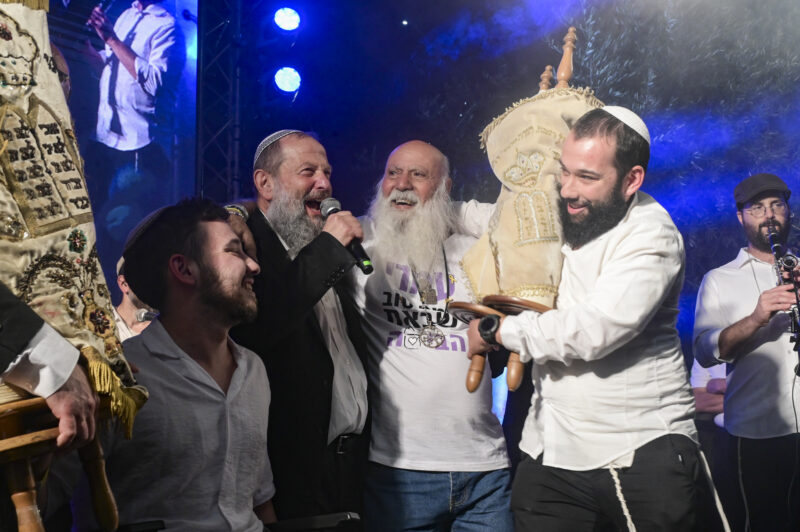
Dani Miran, center, the father of freed hostage Omri Miran, dances with two other men after the holiday of Simchat Torah at Hostages Square in Tel Aviv, on Oct. 14, 2025.
Rabbi Lord Jonathan Sacks, z”l, taught that Simchat Torah, the holiday marking the conclusion of the annual Torah reading cycle and the beginning of a new one, is proof that joy is inherent to Jewish peoplehood. He said that “Simchat Torah was born when Jews had lost everything else, but they never lost their capacity to rejoice. A people whose capacity for joy cannot be destroyed is itself indestructible.” This year, we too will celebrate the holiday even after having lost so very much, and we will need to find a way to reclaim the simcha, the joy, of Simchat Torah.
How do we do it? And what does Simchat Torah have to teach us about joy and about Torah?
One of the most fascinating and little-known facts about Simchat Torah is that it is a holiday that was created in the Diaspora by the Jewish community itself. Unlike the other holidays of the month of Tishrei, all listed in and commanded by the Torah — Rosh Hashannah, Yom Kippur, Sukkot and Shemini Atzeret — Simchat Torah arose out of yom tov sheni shel galuyot, the second day of a holiday festival observed only in the Diaspora. Simchat Torah, the ninth day of the holiday, was originally only relevant to those living outside the Land of Israel. In the Talmud, all we are taught about this ninth day is the prescribed Torah portion. We are charged to read V’zot Habracha, the final chapters of the Torah. From there, the Diaspora community in Babylonia, during the period of the Geonim, created a day that was about celebrating — not just celebrating the completion of the Torah reading but celebrating Torah itself. Restarting the Torah and marking the beginning as well as the ending. They filled the day with meaning, with rituals and most importantly with joy. So much so, that later in Jewish history, in Israel, Shemini Atzeret became overtaken with Simchat Torah, and they melded into one.
There is a critical lesson to learn from this history: that the Jewish people have tremendous power and authority in shaping their own holy time, and their own holy joy.
As Rabbi Yitz Greenberg writes in his essay “Simhat Torah: A Creation of the Jewish People”:
“The fact that the people created Simhat Torah also is testimony to the quality and inspiration of Jewry. The advance of the Torah is not just accomplished through divine revelation, or by the authority of learned scholars, but is driven by the collective wisdom and spirit of Jewry.”
We don’t need permission before we opt into the communal project. The holiday is not a top-down one commanded by the Torah, but rather a grassroots action where the people saw a lack – a day that didn’t have specific commandments or meaning – and rushed in to fill the day with depth. This is a powerful statement on the work of the klal – the collective of the Jewish community.
Not only this, but when we have a lack in our calendar, in our lives, in our world – we have the capacity to fill this lack with joy. The community could have made it a day of Torah study, or of acts of service, but the choice was to create a holiday that is about joy: dancing and singing and communal moments of togetherness. We are powerful, and through our power we can bring more joy to the world.
On Simchat Torah, we read one of the most famous lines in the Torah, the first verse we are charged to teach our children. Torah tziva lanu Moshe, morasha Kehillat Yaakov — Moses charged us with Torah, the heritage of the Congregation of Jacob. This fundamental statement teaches us that the Torah is the inheritance of every single Jew, and that each of us has a stake in its future. Famously taught in the name of the Ba’al Shem Tov, every Jew is themselves a letter in the Torah scroll.
Every single one of us inherits the Torah, but we are also each necessary for the Torah to be complete. Indeed, a Torah scroll that is missing even one letter, is invalid for use. If even one Jew is missing, our Torah, our community, and our joy is invalid.
The Sefat Emet, in his writings on Simchat Torah (5645/1884), builds on this verse and notices the words Kehilat Ya’akov – the community, or the gathering together of Ya’akov. He teaches that because each one of us has a portion of the Torah, the Torah herself is the mechanism through which the Jewish people are united. The Torah is what causes the kehillah, the togetherness. While we are in a time of great polarization today, actually, Torah study can be the very thing that brings us together. Through bringing our own individual voices, our own unique perspectives, our own letters, standing strong in our individuality, the Torah can become one whole.
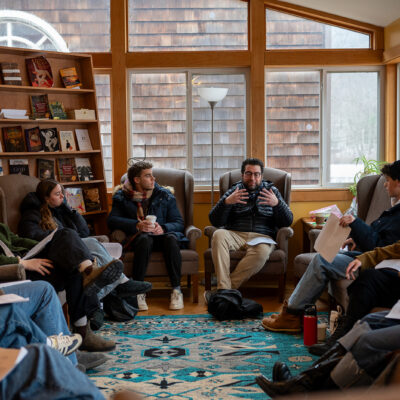
In education too, we must see Torah as a joint project, a relationship between teachers and students, and students and one another, where each member is valued and cherished, completing the whole. This summer, we at The Jewish Education Project launched the Deep Rich Jewish Content (DRJC) Summer Immersive. This three-day intensive brought together educators who teach in the part-time Jewish education space to learn about our DRJC toolkit and methodology, so they could bring richer, deeper Jewish content to their learners. But what we learned most was that Jewish educators need their own spaces to continue to learn and grow, and to feed their souls. They needed the joy of their own learning. Again and again, we heard, “I loved being able to spend my time over the summer learning before diving into work of my own.” We heard the joy in the responses – the joy of Torah study, and the gift of time and space.
We all need to come back to Bereishit each year, and we all need to come back to one another. We dance and sing and experience the joy of reclaiming Torah. Simchat Torah charges us to opt into the project of peoplehood, pick up our own rightful portion of Torah, and return to the Torah again and again. In joy, in love.
This year, as we enter Simchat Torah, let’s all make a choice. Pull someone new into the circle. Dedicate 10 minutes to a Torah conversation. Teach someone the verse in Deuteronomy 33:4 and what it means to you. Choose joy, choose Torah and allow Torah to be the mechanism through which we choose one another.
Rabba Yaffa Epstein is the senior scholar and educator-in-residence at The Jewish Education Project.