BIG TENT TEST
As Voice of the People recruits new members, first cohort wrestles with limits of civil debate — and initiative’s purpose
Members tell eJP that the organization, which was created to grapple with tough issues, has struggled to navigate difficult conversations
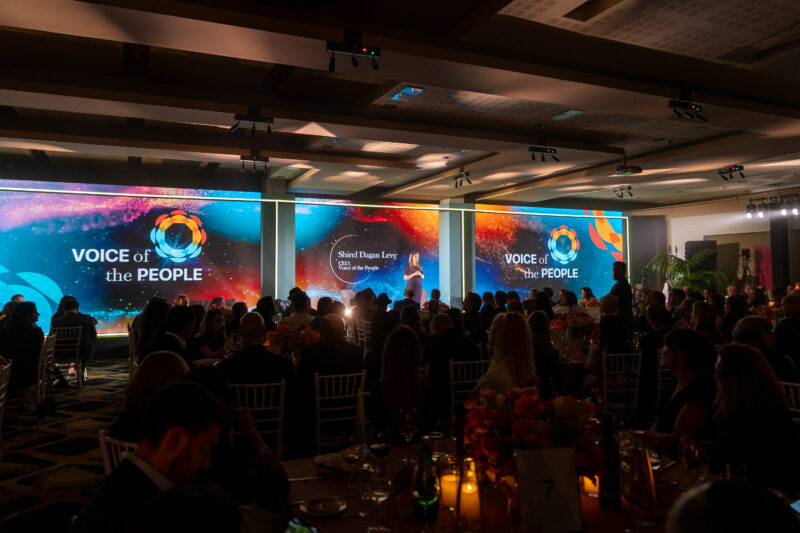
Dor Pazuelo
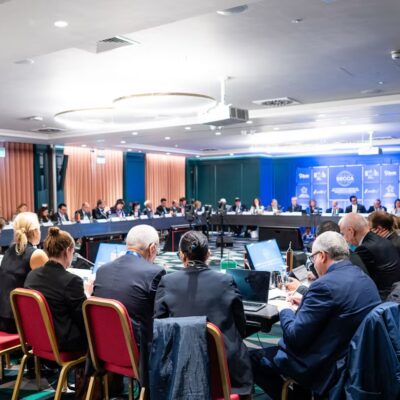
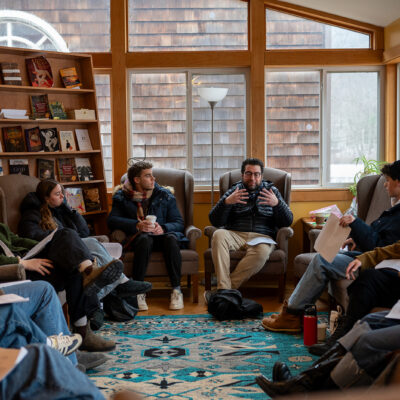
Members of the first cohort of Voice of the People meet in Haifa in March 2025.


 Add EJP on Google
Israeli President Isaac Herzog announced Voice of the People in early 2023, as Jews in Israel and around the world were in the grip of a fiery debate over the future of Israeli democracy. Using an algorithm that weighs community size, religious affiliation, gender, profession, age and background, the initiative was meant to create a council of 150 representatives from Israel and the Diaspora with a two-year term in which they could use their diverse backgrounds as a launchpad to respectfully and collaboratively discuss the issues facing the Jewish People and develop concrete plans to address them.
Delayed by the Oct. 7 terror attacks, the initiative launched in 2024. Members included nonprofit leaders and disability activists, doctors and actors, high-tech professionals and Jewish educators, philanthropists and rabbis of all denominations. Members were split into teams focused on five priorities: antisemitism, Israel-Diaspora ties, the relationship between Jews and non-Jews, identity and heritage, and polarization.
However, as the first cohort is beginning to wrap up and recruitment is underway for the next — with thousands of people already applying — several council members told eJewishPhilanthropy that the initiative has struggled to reach its lofty goals. Instead of a paragon of constructive, civil discourse by a diverse array of global Jewish leaders, several members said that the initiative has fallen prey to the very divisions roiling the Jewish world that led to its creation in the first place.
In interviews with six council members, several lauded the president’s initiative for putting together a truly diverse panel of Jewish figures from around the world and attributed the struggles to a fledgling, overly ambitious organization that had taken on more than it could handle. Current members also questioned the ultimate purpose of the initiative — was it to generate and implement new ideas or create an international network of Jewish leaders?
As the current cohort prepares to meet in a European capital later this month — the precise location has been withheld for security reasons — some members told eJP that they may not be attending in light of those questions and misgivings.
A spokesperson said that the organization remains devoted to its original mission. “Voice of the People was born from President Isaac Herzog’s vision as a global nonpartisan initiative for a stronger, more connected Jewish people,” the official said. “We bring together Jews from different countries, communities and backgrounds to build trusted relationships and turn shared concerns into collaborative action. The first Council brought together 150 leaders and generated approximately 20 initiatives, alongside connections and collaborations that extend beyond the program itself.” The spokesperson said members “are expected to engage in good faith, respect one another, uphold the Code of Conduct and recognize Israel’s right to exist as the state of the Jewish people,” adding, “These shared foundations make room for meaningful disagreement.”
Many of these arguments focused on disagreements over Israel’s conduct in its war with Hamas in Gaza following the Oct. 7 terror attacks and what constitutes legitimate criticism for a Zionist initiative and what is beyond the pale. Such disputes, over red lines and big tents, have intensified throughout the Jewish world over the past three years, particularly around the use of the term “genocide” to describe Israel’s campaign in Gaza — a legal charge that has been regularly employed by some international organizations and academics, but has not been proven in a court of law and has also been rejected by other international groups and experts.
A North American council member in the first cohort, who described themselves as “intensely Zionist,” said the idea for the project was strong, but the execution fell short.
In one case, the members said, speaking on condition of anonymity to openly discuss a sensitive issue, the leadership of Voice of the People responded to a participant who “crossed many lines” by shutting down the entire group and taking no action against the individual. The member also defended the initiative’s leaders, saying no one has figured out how to handle political clashes in such groups. “They aren’t unique,” the member said.
Voice of the People confirmed that some discussions were paused, but called it a deliberate intervention. “When discussions escalated and became harmful, we paused them and formed a team of Council members and professionals to review the situation and develop recommendations,” the spokesperson said, with the team expected to recommend “clearer boundaries, suitable forums for sensitive discussions, and clearer approaches to managing those discussions and enforcing the Code of Conduct,” a spokesperson for the initiative told eJP in a statement.
However, council members who spoke with eJP maintain that despite the Code of Conduct, there were no consequences for council members who engaged in such harassment and intimidation.
Voice of the People told eJP the second cohort’s major change is its timeline in light of its experiences with the first group. The second cohort will now run for 16 months, instead of two years, and will dedicate more time to getting members to build trust with one another before they develop projects.
The friction points to a deeper question, the member said. “The main underlying question is: Is Jewish unity already a chimera?” the member said. “Meaning, are we perhaps too far apart?”
The member traced the trouble to a more basic gap. “The pains are larger than how to handle the conflict,” the member said. “The real pain is, what do they really want to be?” The difficulty in handling conflict stems from that lack of definition, the member said.
Another Voice of the People council member, Roei Eisenberg, who is active in both the World Zionist Congress and as a lay leader in the federation system, described an organizational culture of shutting down tough conversations instead of helping participants navigate them productively. “Voice of the People exposed some nerves that are really painful in our community, and instead of leading, it shied away and tried to cover them up,” he told eJP, in his first time speaking publicly about his concerns since joining the initiative’s inaugural cohort in 2024. “And that’s not us. That’s not Judaism, and that’s not Israeli to me.”
Jenna Richman, a Los Angeles TV writer and producer, who was a council member on the first cohort, said that she faced harassment after referring to Israel’s conduct in Gaza as a “genocide” — a conclusion she said she reached based on her own research. “I am not anti-Zionist,” Richamn said, referring to herself as a proud Jew.
“There is a constant refrain that it’s fine to disagree or criticize Israel, but in practice, none of the ways anyone is doing it seems to be acceptable,” she said. Richman lauded Voice of the People for trying to solve that problem, but said that no breakthrough has emerged.
“The president wants a council that reflects diversity of thought on these issues within the Jewish community,” Richman said. “That desire is earnest, where I think the failure of leadership was that there was not an appropriate infrastructure to ensure constructive conversation.”
On a less fraught level, another first-cohort council member, who spoke on condition of anonymity, said recruits joined without knowing what the program would demand of them. For instance, no one mentioned during recruitment that members would compete in a pitch contest for their ideas, the member said. Members from across the council raised those concerns and asked Voice of the People to clarify the expectations before recruiting a second cohort, the member said.
A spokesperson for Voice of the People told eJP that the group has accepted this feedback from participants. “As Voice of the People is a new initiative completing its first cohort, we are drawing on members’ experiences to refine the program’s delivery and clarify expectations,” adding that for the next cohort this includes “more precise communication about the program’s stages and requirements, beginning during candidate selection.”
Interest in the program has only grown over the past two years. Voice of the People recently opened applications for its second cohort, and more than 4,000 people have already applied for 150 council seats, split evenly among Israel, North America and Jewish communities elsewhere. Voice of the People told eJP that Herzog remains closely involved and weighs in on members’ projects before they launch. Applicants must identify as Jewish and believe Israel is the nation-state of the Jewish people. The deadline is Oct. 12.
Asked who should apply, Dagan Levy, told eJP, “We look for leaders who bring distinct expertise, diverse perspectives and a genuine commitment to the Jewish people as a collective.”
The first cohort drew senior figures from business and private equity who likely would never have applied to a program like it before, many of them newly engaged after Oct. 7.
Mixing those newcomers with longtime communal leaders of varying observance and expertise is deliberate. Dagan Levy said she met each of the first 150 members before the program began and warned them they would often feel uncomfortable in the room.
“If we keep sitting with people who look like us and think like us … that’s not the way to change, and we have to stretch,” Dagan Levy said.
Voice of the People offers seed funding for initiatives born out of its convenings to council members, with an average funding of around $20,000. Beyond that, Dagan Levy expects members with strong ideas to raise their own money.
“If your idea is really good, the money will be there,” she said. “That’s part of your role as leaders: If you believe in the idea, you’re going into it.”
The initiative runs on a budget of roughly $5 million per year since its founding in 2023, with funding provided by the Azrieli Foundation, the Wilf Family Foundations and the Patrick and Lina Drahi Foundation. Its website describes it as “a collaborative effort” involving Israel’s president, the World Zionist Organization and the Jewish Agency for Israel. That budget does not include the travel and security costs for the Israeli president to attend gatherings outside of Israel.
The initiative employs 12 full-time staff members and 10 part-time facilitators. “The budget supports an intensive, sustained program for a carefully selected group of leaders from across the Jewish world, including work with content and methodology experts, in-person and virtual meetings, and in-depth program development, alongside staffing, technology and operations,” the organization said in a statement. “Annual expenditure varies with the program’s activities.”
Despite the surge of applicants, skepticism about the initiative’s goals and impact persists among participants and funders alike. Some funders who are not supporting Voice of the People praised the brand that the initiative has built globally in just a few years. Others questioned what it adds to the existing Jewish communal soup of gatherings and elite programs.
Funders — some who heard extensive details about the initiative secondhand at various philanthropic convenings — also have doubts of their own about Herzog’s Voice of the People. Several spoke to eJP on condition of anonymity.
A foundation professional with 30 years of experience argued for strengthening what already exists. “Instead of creating new organizations and initiatives, we need to look at what we already have in the Jewish world and see how we can work together, how to cooperate and how not to duplicate,” the professional said.
Dagan Levy said the initiative measures success over the long term: council members who act with curiosity and generosity in their communities, and a network ready to mobilize in a crisis and take initiative.
“It’s big, but we know it’s a marathon,” she said.
Related News
HIGHER EDUCATION
As Jewish donors reconsider academia, Jan Koum doubles down, endowing Israel studies at Stanford

MAJOR GIFTS
Center for Jewish History celebrates 25 years with a $25M matching grant
ADVANCING A VISION
N.Y. federation donates $1M toward building shared-society center named for peace activist killed on 10/7
PRESIDENTIAL REBUKE
Israel’s Herzog: Mamdani ‘makes no effort’ to hide disdain for Israel, Jews must fight back
CLOSING WORDS
In AZM address, Cosgrove links communal ‘orthodoxy’ on Israel to rising anti-Zionism among young Jews