Opinion
A LOUD SILENCE
My father’s other child must find its voice


 Add EJP on Google
This essay is adapted from remarks Elisha Wiesel delivered on September 30, 2026, at the United States Holocaust Memorial Museum in Washington, D.C., at an event honoring what would have been his father Elie Wiesel’s 98th birthday.
Wikimedia Commons
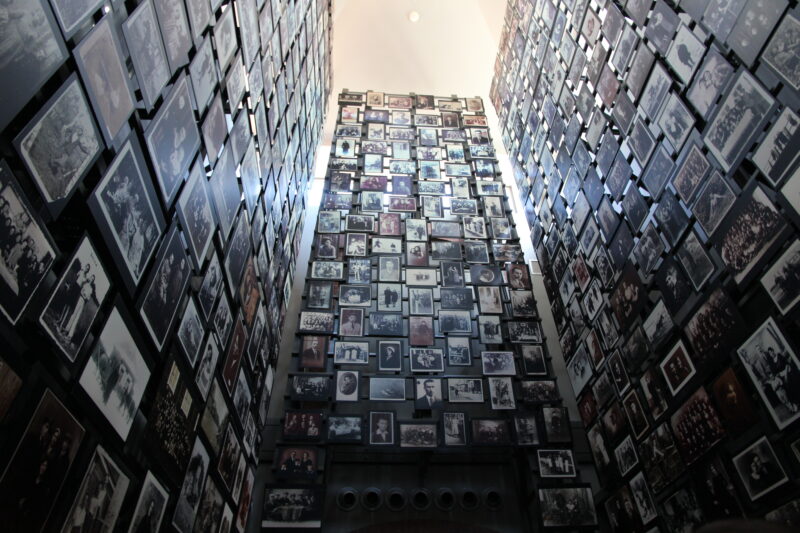
An exhibit at the U.S. Holocaust Memorial Museum in Washington, D.C.
I didn’t like being an only child. Even my half-sister, Jennifer, 12 years older, had left home by the time I was 6. I told my parents it wasn’t fair that I had no siblings or cousins my age. Then, in 1995, I traveled with my father to Sighet, the Romanian town where he was born, and I understood why.
I stood in the bedroom where his little sister, Tzipora, had slept next to him. She was murdered at Auschwitz. She should have grown up to be the aunt who spoiled me. I should have grown up playing with her children.
My father did ultimately have another child, but not one I’d anticipated.
In 1978, President Jimmy Carter asked my father to chair the commission that would decide how America should remember the Holocaust. My father insisted on a living museum, not an inert memorial. Fifteen years later, when I was 21, the United States Holocaust Memorial Museum opened on the National Mall. His words are carved at its entrance: “For the dead and the living, we must bear witness.” At the dedication, in the falling rain, he turned to President Bill Clinton and begged him to stop the bloodshed in Bosnia. That was my father’s vision for the museum: a place that remembers, then acts.
My father loved this country as the greatest force for good in human history. American soldiers liberated him at Buchenwald. A customs official forgave his lapsing visa and set him on the path to citizenship. He never forgot, either, and he never forgot that memory carries obligations. “We are responsible, not only for the memories of the dead,” he said at the dedication in 1993, “but also for what we are doing with those memories.”
The museum has lived up to that. In 2004, it declared a “genocide emergency” in Darfur. In 2015, it documented the Islamic State’s genocide against the Yazidis. It gave a home to the smuggled photographs of Syrians tortured to death in Bashar al-Assad’s prisons. In 2018, it concluded that the Burmese military had committed genocide against the Rohingya, more than three years before the U.S. government said so.
Because it is a federal institution, the museum faces constraints that a private citizen like me doesn’t. When the president says immigrants are eating pets, or that an entire group of immigrants is mostly criminal, it is easier for me to call that out. And when he acts against an Iranian regime that has repeatedly threatened to annihilate Israel, it is easier for me to thank him. My father knew how hard it is to speak truth inside the halls of power. Watch the footage of him urging President Ronald Reagan not to go to Bitburg. You’ll see him sweating.
But on one question, the museum has a unique responsibility that it has not yet met.
Since Oct. 7, 2023, the word “genocide” has been used as a weapon against Israel — on campuses, at the United Nations and by a sitting member of the museum’s own governing council, Sen. Bernie Sanders. The charge is false. Genocide, as defined by the 1948 convention that followed the Holocaust, requires intent to destroy a people as such. Israel has fought a war it did not start against an enemy that sees its own civilians as expendable and openly declares its intent to repeat the atrocities of Oct. 7. The suffering of Palestinian civilians in Gaza is real, and it should trouble everyone; but suffering in war, even terrible suffering, is not genocide. What Israel has done is not genocide but the prevention of genocide.
This is not a matter of semantics. The genocide charge turns the Jewish state into the new Nazis, and the Jewish People back into a threat to be removed from the family of nations. It inverts the Holocaust. Those who started the accusation knew exactly what they were doing. They knew that the uninformed would spread hate like wildfire.
Three weeks after Oct. 7, 2023, Stephen Smith, the longtime director of the USC Shoah Foundation, and I appealed to the Association of Holocaust Organizations, the national network of Holocaust museums and centers. We urged them to make clear what the language of genocide means and does not mean. Some listened. Many did not.
The museum’s leaders have spoken as individuals. Stuart Eizenstat, then chairman of its governing council, wrote last year that the terms genocide, Holocaust and Nazi are being weaponized to attack the legitimacy of the Jewish state. This July, the current chairman, Jeffrey Miller, invited New York Mayor Zohran Mamdani to visit the museum to learn what genocide actually looks like. I am grateful to them both.
The institution itself, however, has not spoken. It made its own findings for Darfur, the Yazidis and the Rohingya. It has the scholars, the credibility and the mandate to do the same here: to explain, with the rigor it brought to Burma, why the genocide label does not fit Gaza, and what the misuse of Holocaust language does to Jews around the world. It rushed to condemn a governor’s comparison between immigration enforcement and Anne Frank; it can surely address a false accusation of genocide against the Jewish state. Declining to join the accusation is not the same as dismantling it, and only the museum can do that.
My father believed profoundly in the power of words. They could, he said, at times attain the quality of deeds. If the museum speaks, others will follow, and in a way that no individual could make them.
I have not been as present at the museum as I should have been. I was in my twenties when it opened, busy building a career, and I don’t think I visited until after my father died. I regret that. But I have come to see the museum as my father’s other child. Like me, it carries his name into a world that often seems to have forgotten what he taught.
When I stood in the bedroom that my father and his little sister had shared, I understood who was missing. Yet my father left me a sibling with walls of stone and a heart of memory. I hope it finds its voice, for the dead and for the living.
Elisha Wiesel is the chairman of The Elie Wiesel Foundation. He is the son of Marion and Elie Wiesel.