Opinion
READER RESPONDS
The top rung: What trauma survivors can teach funders about relationships


 Add EJP on Google
In the quiet stretch between Sukkot and Simchat Torah, I read Amanda Cohen, Lauren Halperin, Alexandra Meyer and Noa Nir’s piece on the Jewish Federation Bay Area’s peer connector network (“When we make space for relational work, our community flourishes,” Sept. 30). They wrote that people need “people to go with.” I have been watching that happen in therapy rooms for more than 20 years, and it is never more evident than in war zones and at disaster sites.
I have worked in these settings in my capacity as a clinician: I have been deployed to Israel several times with an Israeli aid organization; and when fire tore through Chico and Paradise in Butte County, Calif., in 2018, I responded with IsraAid. In March 2020, I was standing beside my research poster at a clinical conference in San Francisco when the pandemic began closing the city around us.
Courtesy/S3C Foundation
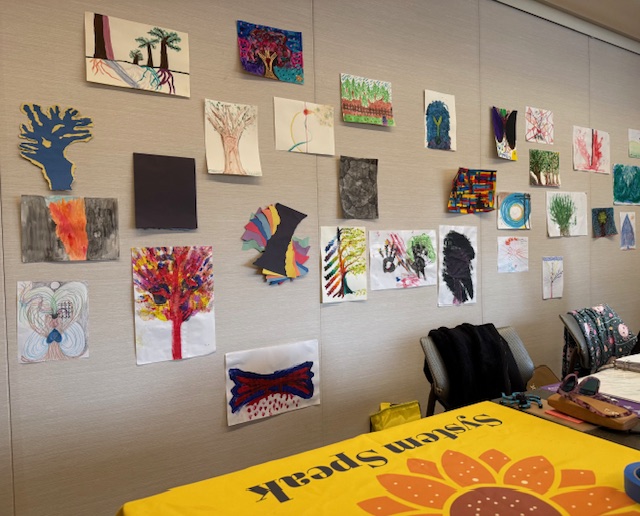
Artwork created by survivors of complex trauma at a System Speak Symposium in an undated photo.
In each of those places, the thing that carried people through the weeks was a person. It was the volunteer who remembered someone’s name. It was the neighbor who came back the next day, and the day after that. It was the one person who noticed someone had gone quiet and went to find them. Programs mattered, absolutely. But it was the relationships underneath them that held the weight, made them work, and brought them through such trauma alive. That is what happens when people go with.
The word that matters most in the authors’ sentence is “with,” and our tradition has been thinking about it for a long time.
Maimonides envisioned tzedakah as a ladder of eight rungs: near the bottom is the gift given grudgingly, and at the very top is the gift, loan or partnership that strengthens a person until they no longer need to ask (Mishneh Torah, Laws of Gifts to the Poor 10:7, 10:14). I read that ladder as a teaching about power. Every rung involves generosity; what changes as you climb, though, is who gets to stay in charge.
Below the ladder is entirely doing to people: deciding, directing and correcting from above. In a family, its extreme form has a name: coercive control. In our own story, it has another: Mitzrayim, the narrow place.
The lower rungs hold doing for people. Each rung is a real mitzvah, and each leaves the giver deciding. Doing for has its moment. After a fire, people need blankets before they need a planning meeting. The harm begins when the emergency arrangement becomes the permanent one. Then the person being helped is fed, housed, and served, and still has no say in the design. Over time, doing for becomes enabling on a personal scale and systemic oppression on a communal one, because it preserves the arrangement of power that created the need. Liberation cannot be handed down by those who hold power over others; it has to be made together. Hillel asked, “If I am not for myself, who will be for me? And if I am only for myself, what am I?” (Pirkei Avot 1:14).
The top rung is doing with people, and this is where healing lives. It asks what someone wants before offering what we have. It lets the person being served become a person who serves, which is what happened when 43% of the young adults the connectors met stepped up to build Jewish community for others.
Tikkun olam gives the same teaching a larger shape. In the Kabbalah of Isaac Luria and his students in sixteenth-century Safed, the vessels meant to hold the divine light shattered, and sparks of that light scattered through the world (Scholem, 1941/1995). Repair means gathering those sparks back up, and no one can do it alone, because each of us holds pieces that others need. In all my years as a trauma therapist, I have never found a better picture of recovery.
For survivors of complex trauma, this difference is everything. A person whose will was silenced cannot heal inside another structure that continues overriding it, however kind or well-intended. Recovery asks for a relationship where their choices count, where someone stays beside them, and where they are trusted to help shape the room. Liberation is something we can only do together.
These experience shaped the S3C Foundation, which I founded drawing on the Jewish call to repair the world alongside other healing traditions. We serve adults recovering from complex trauma and dissociation. We now run 17 peer groups. We offer scholarships to our quarterly symposia, distribute printed workbooks to survivors, and hold free seats for community members in every clinical training we teach. We have witnessed peers liberate themselves into housing, education, and healthier relationships. We have gone together to weddings and funerals, celebrated new jobs and new families, and walked alongside peers as they moved from inpatient care through outpatient treatment.
So when I read that Bay Area peer connectors met with more than 2,600 young Jewish adults over seven years, and that nearly 90% of those surveyed reported a sense of belonging, I recognized the work. I also recognized how rare it is for a funder to stay with it long enough to see it. That’s what I want to honor.
Trauma teaches us something about why relational engagement works, and why it takes so long. For many survivors, trust is the very thing that was injured. A person who has learned that closeness is dangerous will often stand at the edge of community for a long time before stepping in. They may never show up in an attendance count. They may come once, sit near the door, and leave early. Then, months later, they come back because someone remembered them.
The authors wrote that this work moves at the speed of trust. Healing from relational wounds only happens in relationship. It happens slowly, through repetition, through someone reaching out a second and third time. A community that funds that kind of patience is doing trauma recovery work, whether or not it uses the word.
This Simchat Torah also marks three years since Oct. 7, 2023. I, like many others, lost family and friends and colleagues that day, and the grief still feels raw. I carry their names into every circle I sit in and every dance we dance. Joy Sisisky, the federation’s president and CEO, wrote to the federation community this week about holding joy and sorrow together, mourning what we have lost while still dancing and still beginning the Torah again. As a Jewish clinician, I find this one of the wisest things our tradition asks of us. Grief in a community does not end on a schedule. What helps it move is a circle of people who keep reaching for one another’s hands, even when some of us can only manage one lap around the room this year.
I want to say thank you to the federation and its partners for investing in that circle. At S3C, we describe our community through the image of sunflowers, which turn toward one another for warmth when sunlight is scarce. Like the scattered sparks of tikkun olam, survivors repair what was broken together: centered in ourselves, empowered by resources, and connected to community. That middle piece is where funders come in. When a funder like the Federation funds organizations and then trusts them to build alongside the people they serve, that is doing with. Thank you for funding work that does not photograph well and cannot be rushed. Thank you for caring for people who are too often invisible. And thank you for publishing what you learned, so that small organizations like ours can point to it when we explain why relationship is the work.
Somewhere at the edge of every community is a person holding a spark that no one has asked about yet. They may not come this week, or this year. Our work is to keep the circle wide enough that when they are ready, there is room for them in the dance.
Emma Sunshaw is a psychotherapist in Washington State specializing in complex trauma and dissociation, a Fellow of the International Society for the Study of Trauma and Dissociation, and the executive director of the S3C Foundation (s3cfoundation.org). She hosts the System Speak podcast.