DOUBLE YOUR FUN
Grinspoon doubles down on camps with $50M matching grant
New larger initiative will succeed the foundation’s $25 million Forward Together program, helping camps upgrade infrastructure, build endowments and boost scholarships

Courtesy/JCamp 180
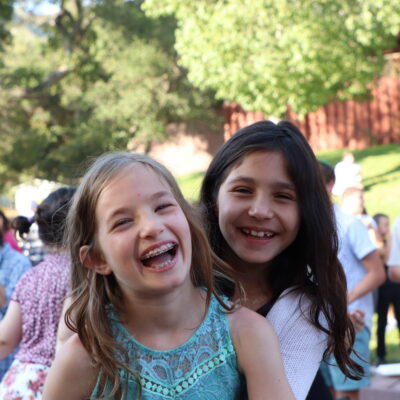
Campers at Camp Ramah in California




 Add EJP on Google
With Jewish camps struggling to break even amid rising costs, even as enrollment surges, The Harold Grinspoon Foundation is doubling down on its support for summer camps, prematurely ending its $25 million grant matching initiative and launching a new $50 million program. The funds are meant to help camps improve aging campgrounds, build endowments and bolster financial aid, the foundation announced this week.
HGF’s previous matching initiative, Forward Together, began in 2023 and was due to run through next year. That initiative was also intended to invest $25 million in more than 100 nonprofit Jewish overnight camps affiliated with JCamp 180. Instead, Forward Together will sunset a year early, with the beefed-up grants offered beginning this January instead.
“We were really excited about how the [Forward Together] match is performing and how the camps are succeeding at raising dollars and motivating philanthropists, and we wanted to do more, and we felt like there was a need,” Sarah Eisinger, director of JCamp 180, told eJewishPhilanthropy.
Through Forward Together, JCamp 180 donated one dollar for every three dollars raised by camps. The new grant will also offer grants with a 1:3 ratio but will double the amount offered annually, from $5 million to $10 million, with the goal of infusing $200 million into the field in total.
According to last year’s Foundation for Jewish Camp census, more children attend Jewish camps than ever before, with many supported by financial aid. At the same time as attendance has skyrocketed, so has the cost of running a camp, with the price of staffing, security, insurance and food skyrocketing. According to Eisinger, two-thirds of JCamp 180-affiliated camps operate within a 3% margin of the break-even point.
“There’s a sense of urgency around this because we know that operating expenses are growing and outpacing inflation at the camps,” Eisinger said. “We also know that the philanthropic community is with us. There are more dollars coming into camping, and we were really excited to be able to double down on our investment. And we know that the camps can meet this challenge.”
The Forward Together initiative saw HGF invest $5 million annually, with the goal of spurring camps to raise another $15 million, but affiliated camps have reported bringing in an excess of $120 million annually. The initiative connected with 10,000 funders, with many donors giving larger amounts than in past years, showing that camps were growing their major-gift programs.
The amount that can be allocated to each camp is decided by the camp’s size. Through Forward Together, grants ranged from $4,000 for the smallest camp to $100,000 to the largest.
JCamp 180 ensures camps meet fundraising goals by providing its network of 100 overnight and 40 day camps with management consulting services, training and professional development, Eisinger said. Eighty-eight camps used the Forward Together initiative to launch permanent endowments. Of the $50 million invested through the new grant, $10 million is expected to go toward endowments.
“In 50 to 100 years. I want to look back on this moment… and say that was a really smart moment,” Eisinger said. “In spite of all of these increasing needs, in spite of COVID, in spite of Oct. 7, people had the wherewithal to develop endowments so that we could secure Jewish camp for generations to come.”
Forward Together has provided Camp Ramah California with $83,500 annually for the past four years, half going towards general operating expenses and half for facility maintenance for “the least sexy things imaginable,” Rabbi Joe Menashe, executive director of Camp Ramah California, told eJP, including siding, leaky-floor repairs and air conditioners.
Half of the grants need to go towards capital improvements but the remainder is unrestricted. Menashe described the matching grant as the “wind at our sails” that provides camps with “an additional leg of stability and predictability, which enables us to then do all of the sacred work that all of the Jewish camps are doing in concert together,” he said. “There’s not a Jewish nonprofit camp in the country that doesn’t rely upon unrestricted dollars to make budget. Tuition alone is not enough for us to operate the camps professionally and responsibly, and so unrestricted dollars are a vital, absolutely necessary pillar of a business model of Jewish camping today.”
The investment “comes at a pivotal moment for Jewish overnight camping,” Rabbi Bill Kaplan, senior vice president of JCC Camps of North America, told eJP. “What makes this investment especially powerful is its potential to inspire an additional $150 million in philanthropy—bringing $200 million into the Jewish camp ecosystem over the next five years. That is transformational. It will strengthen facilities and endowments, help camps address growing needs such as scholarships and security, and ensure that more young people can experience the Jewish joy, belonging, friendships, and community that only camp can create.”The $50 million matching grant is a lot of money, Jamie Simon, the CEO of Foundation for Jewish Camp, told eJP, and more is needed, but the philanthropic world recognizes the need and is stepping up because donors realize that “it really does build Jewish identity and builds Jewish lives and a Jewish future.”
“I’m just so inspired by Harold,” Simon said. “Harold has spent a lifetime championing Jewish life, and Jewish camp is more joyful, more accessible and more durable because of him.”
Eisinger hopes the matching grant will stimulate others to give even more. “We want to make sure that as philanthropists, large and small, are thinking through where to put their dollars in order to secure the Jewish future, they are thinking about camp. This matching grant opportunity is also a call for philanthropists and donors to think about camp as one of the places where they really should be putting their dollars.”
Related News
PRESIDENTIAL REBUKE
Israel’s Herzog: Mamdani ‘makes no effort’ to hide disdain for Israel, Jews must fight back
ADVANCING A VISION
N.Y. federation donates $1M toward building shared-society center named for peace activist killed on 10/7

MAJOR GIFTS
Center for Jewish History celebrates 25 years with a $25M matching grant

EXIT INTERVIEW
Elizabeth Sokolsky, longtime EVP of Birthright Israel, to retire next year

MAGICAL EXPERIENCE
Shefa launches psychedelics retreat for Jewish professionals suffering burnout