CONSTRUCTION PROJECTS
On a kibbutz hit hard on Oct. 7, Jewish Agency lays the cornerstone for the first of 1,000 homes
The roughly NIS 1.5 billion initiative is backed by bank loans, government grants and communal investment as the Jewish Agency aims to help revitalize Israel's South
Lior Daskal/Jewish Agency
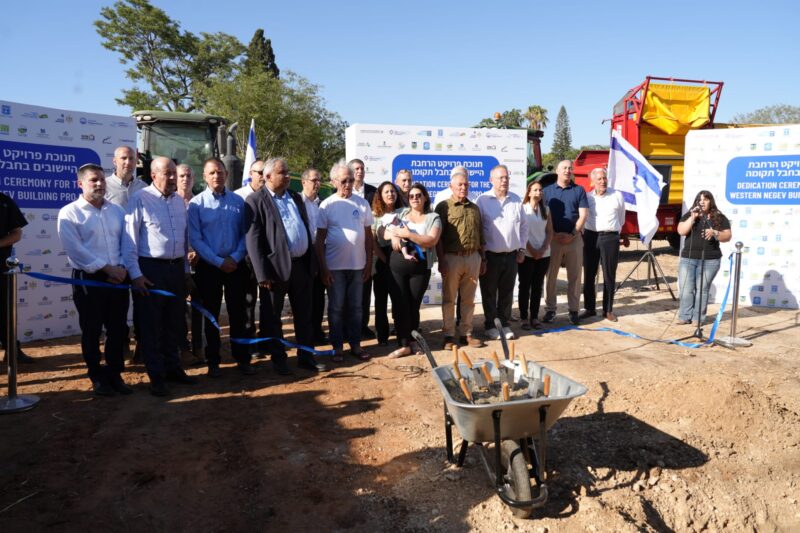
Members of the Jewish Agency's Board of Governors launch the Western Negev Building Project during a ceremony at Kibbutz Ein HaShlosha on June 29, 2026.




 Add EJP on Google
At Ein HaShlosha in southern Israel, on the same grounds where Hamas terrorists killed four members in the Oct. 7 terror attacks, hundreds of Jewish leaders from around the world — in Israel for the Jewish Agency for Israel’s (JAFI) three-day Board of Governors meeting — gathered on Monday to lay the cornerstone for up to 1,000 new housing units across the communities of the Western Negev.
The Western Negev Building Project, led by the Jewish Agency and with support from Israel’s Ministry of the Negev, Galilee and National Resilience, the Finance Ministry, the Tekuma Directorate and the Housing Ministry, has enrolled 14 communities so far, among them Ein HaShlosha, Kfar Aza, Nahal Oz, Nirim and Kissufim.
At Ein HaShlosha, 46 units are planned. Of the 1,000 units, about 100 are expected to be ready to receive families by the summer of 2027, the Jewish Agency said. The housing units are meant to add space for newcomers to the communities that were attacked on Oct. 7, 2023, and then evacuated. While many residents have opted to return, others have sought new homes elsewhere.
The project, which was first announced at least year’s Board of Governors meeting, also returns the Jewish Agency to one of its historic priorities — physically building communities in Israel — which it had somewhat moved away from as it focused more on educational and social programs.
The roughly NIS 1.5 billion ($500 million) in construction costs comes from three sources: about 10% in equity from the communities themselves, some 15% in government grants and the remaining 75% in bank loans taken on by the Jewish Agency.
Those loans are secured by a government guarantee and by the Jewish Agency’s own guarantee, which donations help backstop. Another $40 million in philanthropy bolsters the construction budget — about $25 million to support the Jewish Agency’s loan guarantee and roughly $15 million for community projects. These include cultural centers and shared workspaces, tailored to what each kibbutz or moshav needs to attract and integrate new residents.
“These three days are about Jewish leaders from all Jewish communities all over the world arriving to Israel, and that by itself is a statement in this horrific time,” Maj. Gen. (res.) Doron Almog, the Jewish Agency’s executive chairman, told eJP. “[These are] Jews arriving to Israel to show their unconditional solidarity and continue supporting the State of Israel.”
Almog tied this project to a wider effort to grow Israel’s population through aliyah. He pointed to roughly 6,000 new immigrants, olim, expected from the United States and France over the next two months and to incentives meant to draw doctors, scientists, engineers and lawyers to the South and the battered North. “We are speaking about 1 million olim in the coming years,” he said, describing the creation of an “olim village” where new arrivals would study and work in the hope that many stay indefinitely.
Representatives from the World Zionist Organization, along with a number of Israeli politicians and civil servants, attended the cornerstone laying ceremony in Ein Hashlosha alongside the the Jewish Agency and its Board of Governors.
This included Israeli Finance Minister Bezalel Smotrich, a controversial figure in Israeli politics, who only days before had made waves after he claimed credit for the return of the Israeli hostages — a remark that drew outrage from former captives and their families, who accused him of delaying and scuttling proposed hostage deals throughout the war.
When Smotrich spoke at the podium during the ceremony, he was heckled by Eyal Eshel, whose daughter Roni was an IDF field observer, known as a tatzpitanit, who was killed by Hamas terrorists at the Nahal Oz base on Oct. 7. “Get off the stage, you’re not worthy of being here,” Eshel shouted, telling the far-right minister that hostages had “returned in coffins because of you.”
Almog stepped in to embrace Eshel, telling eJP that he felt Eshel’s pain and drawing a parallel to his own brother, who was killed in the Yom Kippur War when Almog was 20 — a loss he too frames as a failure of the state. “The pain is also a power,” he said. “One of our challenges is to take this pain — it will continue with us until our last day — and channel this pain to hope.”
Smotrich’s presence caught some delegates off guard. Harry Levy and Shoshana Dweck, co-chairs of Arzenu Olami, the global Zionist arm of the Reform movement, said they learned only minutes before arriving that the finance minister would attend. “We were on a bus and taken by surprise just a few minutes before we got to the dedication ceremony that the minister of finance was going to be there,” Levy said. “We thought we were going to a dedication ceremony for the rebuilding of these kibbutzim and the region… Had we known he would be there, we would not have gone.” (Similar claims were also made regrading Smotrich’s participation in New York City’s Israel Day Parade last month, when he also arrived without prior announcement.)
Dweck said the Reform movement’s delegation chose not to protest. “We made the choice to not protest because the focus of our being there was on the people of the region, those who had suffered,” she said. “His being on the stage not only distracted from that message but also caused deep and abiding pain for the people who suffered so much.”
Despite rising polarization in Israel during a heated election year, Almog remains resolute and focused on the kind of society — and Jewish peoplehood — he said the rebuilding is meant to produce: one that strives for excellence and “never leaves the weakest behind. [And] I understand the frustration, I understand the opposition, I understand the pain,” he said, as he balances this cluster of emotions and grievances with his and JAFI ultimate goal: “building Israel and rebuilding Israel.”
“It’s not about me, it’s not about the prime minister — that’s above us,” he said. “It’s about the eternity of the Jewish people, our communities, our soil, our state.”
Related News
ADVANCING A VISION
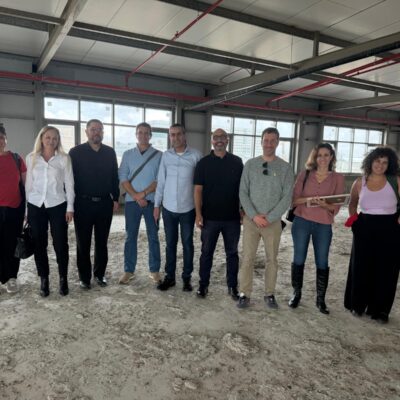
N.Y. federation donates $1M toward building shared-society center named for peace activist killed on 10/7
CLOSING WORDS
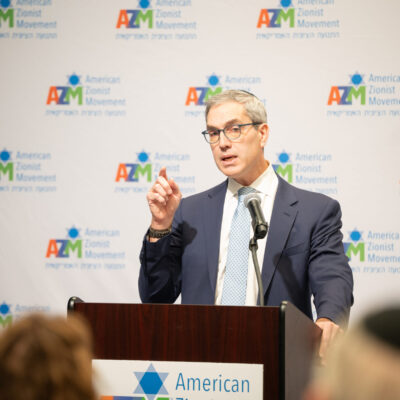
In AZM address, Cosgrove links communal ‘orthodoxy’ on Israel to rising anti-Zionism among young Jews
PRESIDENTIAL REBUKE
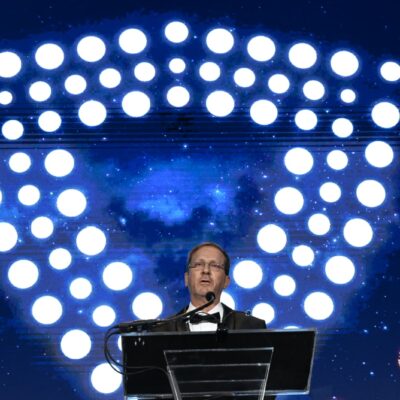
Israel’s Herzog: Mamdani ‘makes no effort’ to hide disdain for Israel, Jews must fight back
EXCLUSIVE
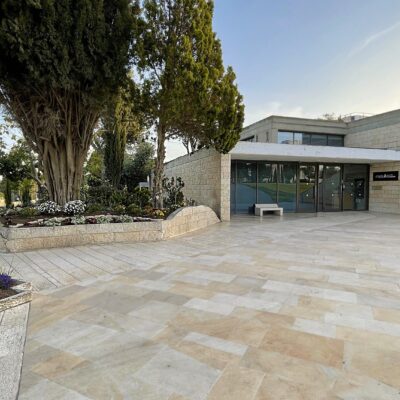
Detroit-based philanthropists Nancy, James Grosfeld donate $8M to renovate JDC’s Israel campus

MAGICAL EXPERIENCE
Shefa launches psychedelics retreat for Jewish professionals suffering burnout