ON THE SCENE
United against antisemitism despite divisions, U.K. Jews and supporters rally against recent attacks
Speakers, audience decry Labour government's failure to address recent spate of antisemitic violence in the country
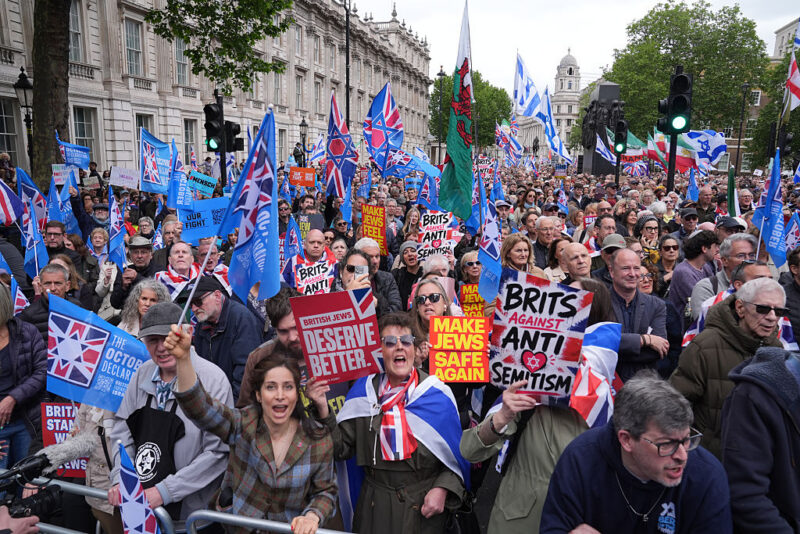
Lucy North/PA Images via Getty Images
People attend a 'face down' antisemitism rally in Whitehall, central London, following a series of antisemitic attacks in the country, on May 10, 2026.




 Add EJP on Google
LONDON — With attacks on Jews spiking in England, an estimated 10,000 people, Jews and non-Jews, thronged Whitehall — the main government corridor in central London — on Sunday to rally against antisemitism.
But although both the main Jewish newspapers, Jewish News and The Jewish Chronicle, published a joint editorial urging unity in the face of hate, there were ample signs of factionalism in parts of the crowd.
One thing the rally seemed to make clear, even if it had not been held immediately after local municipal elections, in which U.K. Prime Minister Keir Starmer’s party lost hundreds of seats: The mainstream Jewish community has lost faith in the Labour government and its ability to fight anti-Jewish hate crime.
Pat McFadden, secretary of state for work and pensions, could barely make himself heard above the booing as he addressed a sea of posters highlighting the absence of his party leader with the slogan, “Where’s Keir?” The opposition from the crowd came despite a supportive address by McFadden, in which he pledged that the government would do everything in its power to stamp out antisemitism in Britain.
Those clutching the posters were eager to denounce Starmer for his perceived failures — including “recognition of a Palestinian state while Hamas was still holding hostages” — and “three weeks before he turned up,” a reference to Starmer’s perceived belated visit to see the local community after the stabbings of two Jewish men last month in Golders Green, a heavily Jewish London suburb.
Another poster — reading “British Jews slaughtered on your watch, Starmer” — attracted police attention and the man holding it was encouraged to take it down. Some non-Jewish attendees displayed signs identifying themselves as “Mensches,” an apparent reference to their support for the Jewish community. Another poster read: “I am an autistic non-Jewish friend of Israel — ask me why.”
The opening address by British Chief Rabbi Sir Ephraim Mirvis set the tone of the rally, when he put the blame for many of the attacks on Iranian proxies and local criminals. Why, he asked, to loud cheers, had the Iranian ambassador not been expelled, and the notorious Islamic Revolutionary Guard Corps not been designated a terrorist organization?
Some of the loudest cheers for Mirvis’ comments came from a huge section of the crowd that included Iranian exiles, who are fiercely opposed to the current regime; they waved flags with images of the former Crown Prince, Reza Pahlavi. In recent months, this community has made common cause with British Jews, to the extent that each now often shows up at each other’s public events.
The rally appeared to serve as a boon for the Jewish community’s right-of-center faction. Gideon Falter, chair of the Campaign Against Antisemitism, which had originally been going to hold its own demonstration, made a barnstorming speech in which he coined a new term: “Britifada,” a portmanteau of “British” and “intifada,” which he applied to the near-daily attacks on the Jewish community. These ranged from the two deaths at Manchester’s Heaton Park Synagogue last Yom Kippur, to several arson attacks in London, the Golders Green stabbings — and most recently an attempt by an unknown driver to run over a group of children from a local Jewish school.
Two voices from the right were opposition leader Kemi Badenoch and Richard Tice, the deputy leader of the far-right Reform U.K. Party, which did well in the local elections. The participation of the Reform U.K. Party, which holds anti-immigrant policy positions, also divided the Jewish community, with thousands signing a petition to revoke the invitation.
Tice, who spoke in place of the Reform Party’s divisive leader, Nigel Farage, described as “an absolute shambolic disgrace” what he believed was the government’s failure in dealing with antisemitism, declaring,: “An attack on the Jewish community is an attack on British values,” a theme repeated by nearly every speaker.
Former Chancellor of the Exchequer Sajid Javid was not among the listed speakers but told eJewishPhilanthropy that he had felt it vital to attend the event. “We can all see that the British Jewish community is under attack,” he said, “and this is an opportunity for everyone to stop and stand in solidarity. It is a problem not just for Jews, but for Britain and our democracy. If we do not deal with it, we will all pay the price.”
Also attending was former Conservative Cabinet minister Michael Gove, who now edits the influential Spectator magazine and wrote a passionate denunciation of antisemitism last week.
Religious leaders from almost every faith in Britain issued an open letter condemning antisemitism on the eve of the rally. “The specter of Jewish people being stabbed at random in the street, killed defending their synagogues and Jewish infrastructure being firebombed feels like a nightmare from another time,” they wrote.
“This is not a problem for Jewish people to have to respond to. This is a problem for all of us to fix,” the letter reads. “This country belongs to you as much as any of us. You are as British as all of us who call this country home. And we will do everything we can to protect you and your community from the extremists who threaten you.”
Adrian Cohen, acting president of the Board of Deputies of British Jews, which co-convened the rally together with the Jewish Leadership Council, was one of a number of Jewish leaders who attended a Downing Street meeting called by Starmer last week.
In a swipe at Green Party leader Zack Polanski, who was pointedly not invited to attend the rally and recently questioned whether antisemitism is truly on the rise in the U.K., Cohen told the crowd that antisemitism was “not a perception. It is real.”
Cohen said that at Downing Street the community had asked for “three P’s: to protect, to prosecute and to partner,” adding that Jews did not want merely a “Jewish responsibility, but a national responsibility.”
As people gathered for the rally, several told eJP that they had sensed “evil expanding throughout the U.K.” One man, who did not want to give his name because he serves in the British Army, said he was Christian, but had many Jewish friends. “One of them gave me a Star of David to wear with my cross,” he said, “but I won’t wear it in public.” The man, who was over 6-feet tall with a muscular build, said he is concerned about the reaction that a Jewish symbol can receive.
Elsewhere in Whitehall, Britain’s best-known gay rights campaigner, Peter Tatchell, bore a sign reading, “I stand with the Jewish community/Fight antisemitism/Love will triumph over hate.” But Tatchell was escorted from the crowd by a phalanx of police after some angry Jewish activists — one wearing an IDF T-shirt — spotted that Tatchell was also wearing a badge supporting Palestine.
Tatchell said later that police had offered to allow him back in, but that he had thought he would become too much of a distraction.
Related News

ADVANCING A VISION
N.Y. federation donates $1M toward building shared-society center named for peace activist killed on 10/7
PRESIDENTIAL REBUKE
Israel’s Herzog: Mamdani ‘makes no effort’ to hide disdain for Israel, Jews must fight back

MAGICAL EXPERIENCE
Shefa launches psychedelics retreat for Jewish professionals suffering burnout

EXCLUSIVE
Detroit-based philanthropists Nancy, James Grosfeld donate $8M to renovate JDC’s Israel campus

MAJOR GIFTS
Center for Jewish History celebrates 25 years with a $25M matching grant