ON THE SCENE
WJC marks 90th anniversary in Geneva, still fighting the antisemitism that led to its founding
WJC President Ronald Lauder says Jewish groups still working to recover funds that Swiss banks refused to return to Jewish families after the Holocaust
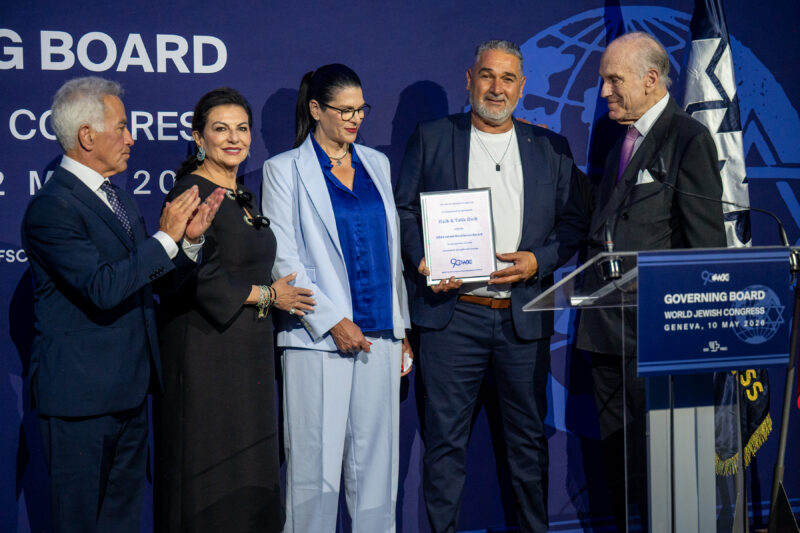
Shahar Azran/World Jewish Congress
Itzik and Talik Gvili (center) receive the World Jewish Congress' Israel Resilience Award from WJC President Ronald Lauder (right); WJC Israel President Sylvan Adams (left); and WJC Board Chair Chella Safra at the WJC Governing Board meeting's opening dinner in Geneva on May 10, 2026.




 Add EJP on Google
GENEVA — Ninety years after its founding in the city, World Jewish Congress Board Chair Chella Safra lamented on Sunday night the persisting need for the international organization, which was formed in response to rising antisemitism in Nazi Germany and throughout Europe.
“World Jewish Congress was established in this city in 1936 with the clear and urgent purpose to make our voice heard, to sound the alarm with a clear and urgent voice, to unite when the world seemed ready to turn its back on us,” Safra said, addressing a room packed with dozens of Jewish communal leaders and dignitaries from around the world.
“Geneva was the stage from which the Jewish people chose to unite and speak for themselves. And tonight, 90 years later, we are back for that same very purpose, unfortunately,” she said. “But the threats we face today do not come from any single movement, any single ideology or any single fear. They are global. Antisemitism has not disappeared; it has evolved. It spreads across continents, it mutates across political tendencies, and it seeps into our institutions and increasingly fills our streets.”
In addition to marking its 90th anniversary, the WJC Governing Board gathered in Geneva this week for a three-day meeting aimed primarily at coordinating the collective Jewish communal response to rising antisemitism across the globe. This includes a deliberate, concerted shift in focus to the threats posed by Islamist antisemitism, which increasingly accounts for the violent attacks on Jewish communities around the world, and accordingly away from those posed by far-right sources.
The gathering comes amid a rare public spat between Israel and the WJC, an organization with which it has close ties, regarding the organization’s decision to cosponsor a Jewish cultural event with the Spanish government, which has emerged as one of Europe’s staunchest critics of Israel. Israeli Ambassador to the U.S. Yechiel Leiter penned a letter, which was leaked to The Times of Israel, chastising the group for partnering with Spain, calling it “surprising and deeply disappointing.” WJC defended its cooperation with the Spanish government, saying that it is critical to maintain a relationship with local governments for the good of the country’s Jewish community.
Officials from both WJC and the Israeli Foreign Ministry delegation to the event described the interaction to eJewishPhilanthropy as confusing in light of their deep ties and the ample opportunities for private discussions about a disagreement, as opposed to a public condemnation.
Ralph Friedlander, WJC vice president and president of the Swiss Federation of Jewish Communities — the official host of the gathering — similarly noted the similarities between the period that led to WJC’s founding and today, though he highlighted two main differences.
“First, the existence of the State of Israel, and the fact that in most democracies today, Jewish people enjoy — not only on paper, but also in practice — the same rights as non-Jews,” he said.
“There are laws against discrimination, and in many countries political leaders and security authorities take the concerns of Jewish communities seriously, support them and do much to ensure their protection,” said Friedlander. “To know that we do not have to fight this centuries-old hatred alone means a great deal to us, because one thing is absolutely clear: Fighting antisemitism is not solely the responsibility of Jews, it is the responsibility of society as a whole.”
Attendees included heads of Jewish communities from around the world — from Armenia to Venezuela — as well as the antisemitism envoys and coordinators from a number of countries and international bodies. This includes Rabbi Yehuda Kaploun, the State Department’s special envoy to monitor and combat antisemitism; Katharina von Schnurbein, the European Commission’s coordinator for combating antisemitism and fostering Jewish life; and Arezoo Hersel-Rohila, the Israeli Foreign Ministry’s director of the Department for Combating Antisemitism and Holocaust Remembrance.
Guy Parmelin, the president of the Swiss Confederation, also addressed the group, highlighting the need for all of society to combat antisemitism, calling it “an attack on fundamental global values, on human dignity, freedom and respect.”
“Young people, in particular, need to understand that democracy, human rights and freedom cannot be taken for granted and must be defended at all times,” Parmelin said.
In brief remarks, philanthropist and WJC President Ronald Lauder recalled his work with the Volcker Commission in Switzerland in 1996, aiming to recover the money that European Jews had stored in Swiss banks and which they did not receive after the war. Lauder noted that 30 years later, that work continues. Earlier this year, the Senate pressed senior executives from the Swiss banking giant UBS to hand over documents related to Credit Suisse’s support for Nazi Germany during and after World War II.
“We got some back in the Volcker Commission,” Lauder said. “But there’s [another] commission now, and I spoke this evening with the president [Parmelin]. He understood exactly what I was saying. And I must say, I was very, very encouraged.”
The opening evening concluded with WJC presenting its inaugural “Israel Resilience Award” to Itzik and Talik Gvili, the parents of Ran Gvili, the Israel Police officer who was taken captive in the Oct. 7 attacks and whose remains were recovered in January — the last hostage to be returned to Israel.
“Tonight, we honor a family that came to embody the strength, heartbreak and resilience of the Israeli people after Oct. 7. Ran Gvili was among the first to head out that morning, and he was the very last to come home,” WJC Israel President Sylvan Adams said at the event. “To Itzik and Talik, I say tonight: No parent should ever have to experience what you have endured. But your dignity, your courage and your refusal to surrender hope inspire us. Ran’s memory is now forever a part of the story of Jewish courage and resilience during one of the hardest chapters in modern Jewish history.”
Related News
ADVANCING A VISION
N.Y. federation donates $1M toward building shared-society center named for peace activist killed on 10/7

EXCLUSIVE
Detroit-based philanthropists Nancy, James Grosfeld donate $8M to renovate JDC’s Israel campus
PRESIDENTIAL REBUKE
Israel’s Herzog: Mamdani ‘makes no effort’ to hide disdain for Israel, Jews must fight back
EXIT INTERVIEW
Elizabeth Sokolsky, longtime EVP of Birthright Israel, to retire next year
CLOSING WORDS
In AZM address, Cosgrove links communal ‘orthodoxy’ on Israel to rising anti-Zionism among young Jews