Forget wars — nonprofit OneDay is looking to prepare Israel for the real threat: earthquakes




 Add EJP on Google
Israelis are used to living through metaphorical earthquakes: Oct. 7, the fight over judicial reform and the future of the country’s democracy, the Six-Day War, events where the political and societal ground shifts.
Elad Blumenthal is warning about the real thing.
Next year marks the 100-year anniversary of the last major earthquake to strike the land of Israel. Experts predict the next major earthquake will likely be centered on the Dead Sea Fault and could severely damage more than 28,000 buildings, thus leaving tens of thousands trapped and inflicting catastrophic casualties. The damage radius could encompass the entire country, stretching from Kiryat Shmona to Eilat, and devastating the densely populated central hubs of Tel Aviv and Jerusalem.
“This is the greatest strategic threat to the State of Israel… We are living in an illusion that someone will come to help us,” Dr. Ariel Heimann warned the Knesset Internal Affairs and Environment Committee in 2022.
Blumental spends most of his days talking with volunteers, municipalities and funders about earthquakes. As he tries to educate and awaken others to Israel’s next approaching emergency, he is challenging different levers and players of Israeli society to transform its reactive culture into a proactive one. This is the difference between life and death and this time, Blumental told eJewishPhilanthropy last week, reacting after the fact will not be an option.
“After [the Oct. 7 terror attacks], we realized the cost of being unprepared,” said Blumental, the founder of the Israeli nonprofit OneDay. “What would people give to go back to Oct. 6 with the knowledge that we have now? I don’t know if we are in Oct. 2, Oct. 4, or Oct. 5 of the earthquake, but it is coming. And we have the knowledge. Now, it’s up to us to act.”
According to Blumental, OneDay is built on a high-impact social volunteering platform that spearheads roughly 500 community projects annually.
Facing a frightening countdown with an unknown deadline, OneDay is answering with action and mobilization to build a proactive national network of localized civilian search-and-rescue units. Rather than relying on a government and army response that lacks the capacity to handle the simultaneous collapse of thousands of buildings — 28,000 of which Blumental warns are unprepared to withstand a major earthquake — OneDay is taking action now. In close partnership with the Israel Defense Forces’ Home Front Command, they are equipping everyday citizens across 10 Israeli cities and growing with heavy-duty machinery and intensive training. This ensures that each city has a team ready to pull their own neighbors from the rubble the moment the dust settles.
As Israeli civil society and philanthropists around the world look back on almost three years of emergency giving and campaigns, OneDay isn’t waiting for the next emergency to act. “We know it’s coming. The data is clear. Maybe two years, maybe tomorrow, but it will come during our generation,” said Shahak Orlev, a 26-year-old student and volunteer leader with OneDay’s branch in the central Israeli Emek Hefer region.
With approximately 810,000 apartments built without modern earthquake resistance standards — many sitting on “soft soil” that amplifies seismic waves — the Home Front Command faces an impossible mission. Despite housing some of the best search and rescue experts globally, the Home Front Command does not have the manpower to address a nationwide structural collapse. At best, national rescue battalions could manage perhaps 50 to 150 destruction sites simultaneously.
Data presented to eJP by Ron Avni, one of Israel’s leading earthquake experts and former comptroller at Ben-Gurion University, paints a grim picture of this state negligence regarding civic infrastructure. Avni noted that government budgets are routinely stalled or diverted to other political priorities. According to a 2024 State Comptroller report, out of 1,600 schools requiring structural shielding since 2008, only 124 have been retrofitted. Even more alarming, the critical infrastructures of five out of seven major hospitals are currently unequipped to survive a destructive earthquake.
Avni said that despite multiple master plans and billions of shekels theoretically allocated for reinforcement over the two decades, only a fraction has materialized for actual shielding. “The government is abandoning its citizens in this area as well,” he said.
This leaves thousands of collapsed structures unattended during the critical first 72 “golden hours,” when survival is most likely, Blumental said.
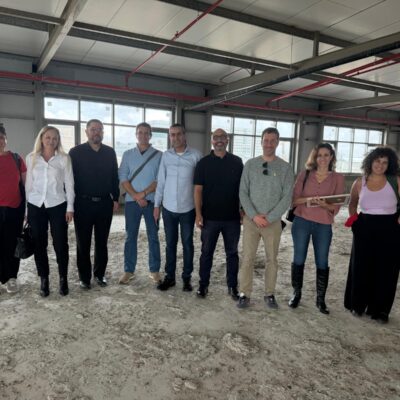
To fill this massive, fatal gap in civic infrastructure, OneDay relied on its foundation. “We didn’t build the earthquake project from scratch; we built it on top of our existing social capital,” Blumental said. “Our expertise lies in crowdsourcing and mobilizing. We took our massive database of motivated, young Israelis and corporates and our logistical ability to organize large-scale missions and layered on professional search-and-rescue training and IDF-synchronized protocols. OneDay partners closely with municipalities. Formalized by the IDF Home Front Command, the organization is currently operating fully equipped units in 10 cities.
For the volunteers on the ground, many of them students and young parents, this proactive stance is a powerful antidote to national anxiety.
“We know that Israel is really good at reacting, not anticipating. So it was really special to prepare for something before,” said Orlev. “We feel shame when we don’t take action… [We want] to learn, to help, to prepare; and with a lot of the feeling that Israel is not prepared, we want to minimize the suffering and casualties.”
For Blumental, this mindset shift is just as critical as the physical training. “This project represents a strategic shift in the Israeli mindset that we saw on Oct. 7 as well: from a ‘passive’ reliance on state authorities to ‘proactive’ civilian resilience,” he noted. “For years, the assumption was that ‘the army will come to save us.’ We are changing that narrative to ‘I am the responder for my neighbor.’ By training civilians to be ready to act in the first 72 hours, we are building a mindset of self-reliance and mutual responsibility. We aren’t just teaching people how to use a hydraulic jack; we are empowering an entire generation to take ownership of their community’s safety.”
Funding this proactive vision is an uphill battle in the competitive and exhausted post-Oct. 7 philanthropic landscape. The Jewish world stepped up to fund an astronomical emergency response over the past two and half years, and “emergency fatigue,” whether spoken or unspoken, is present throughout the boardrooms of federations and foundations across the Jewish world.
“I understand that philanthropists are tired and exhausted by the situation here,” Blumental said. “When I’m going to them with something like an earthquake, many people say it will not happen in our lifetime… It’s hard to convince them to support the next crisis while we are still in this crisis.”
Jewish Federation Los Angeles, a community intimately familiar with the devastation of natural disasters, stepped forward as a strategic partner in OneDay, investing nearly $500,000 to help establish OneDay’s national network. They were joined by other major federations, including the Jewish Federation of Greater Philadelphia and Boston’s Combined Jewish Philanthropies, who have also made significant gifts to support OneDay’s work.
“Our experience here in Los Angeles, especially through last year’s wildfires, has fundamentally shaped how we respond to emergencies,” said Rabbi Noah Farkas, CEO of the L.A. federation. “Speed matters, but precision matters just as much. The wildfire crisis pushed us to build relationships and infrastructure in advance, so that when an emergency strikes, we’re not starting from scratch.”
Farkas explained this wasn’t a donation to a future emergency; it was an immediate investment in civic infrastructure designed to yield a much higher return than reactive, post-disaster scrambling.
This is the paradigm shift required of the philanthropic sector: “By investing in proactive strategies to develop long-term infrastructure, capabilities, and interventions, we can minimize the amount of future emergency funding that will be necessary,” Farkas said.
No organization can prevent the ground from shaking beneath Israel as we approach the 100-year mark since the region’s last major earthquake. However, as OneDay’s volunteers strap on their helmets and train with hydraulic lifts, a young generation of hundreds of Israelis across 10 cities — and growing — is proving that the failures of the past can be applied to save lives in the future.
“When it happens, it will be too late to train rescuers to save people from within the ruins,” Blumental said. “It’s not emergency funding. When the emergency happens, it will be too late. We need to act now, because I will not need any funding after the earthquake. We need to build teams now to be prepared.”
Related News

MAJOR GIFTS
Center for Jewish History celebrates 25 years with a $25M matching grant

MAGICAL EXPERIENCE
Shefa launches psychedelics retreat for Jewish professionals suffering burnout
PRESIDENTIAL REBUKE
Israel’s Herzog: Mamdani ‘makes no effort’ to hide disdain for Israel, Jews must fight back

EXIT INTERVIEW
Elizabeth Sokolsky, longtime EVP of Birthright Israel, to retire next year
Detroit-based philanthropists Nancy, James Grosfeld donate $8M to renovate JDC’s Israel campus