Opinion
LEADERSHIP DEVELOPMENT
When crisis dims imagination: Three conditions Jewish leaders need now




 Add EJP on Google
When M2: The Institute for Experiential Jewish Education released findings from its Hope Study in the fall of 2025, the data gave shape and scale to what many leaders had been experiencing — internal communal conflict is eroding the outlook of professionals who sustain Jewish life. The underlying issues propelling conflict are well known: political upheaval and polarization, declining trust in institutions, divides around Israel, and rising antisemitism. The study provided a strong signal that the way communal professionals relate to the future must be central to leadership development in this moment.
At the Mandel Institute for Nonprofit Leadership, we’ve interpreted this signal as a call to expand leaders’ imaginative capacity: the ability to see the challenges of the present clearly, while generating and working toward compelling visions of a different future. Expanding that capacity requires a shift toward futures thinking, distributed leadership and an ecosystem mindset — and this insight is now shaping a significant redesign of our Executive Leadership Program.
Yariv Weinberg
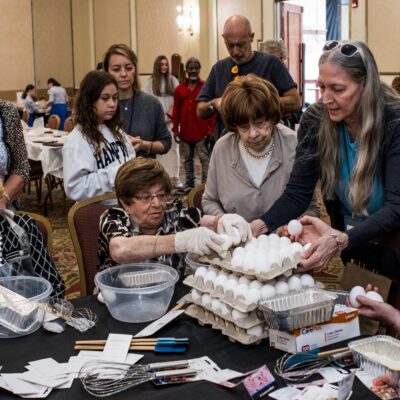
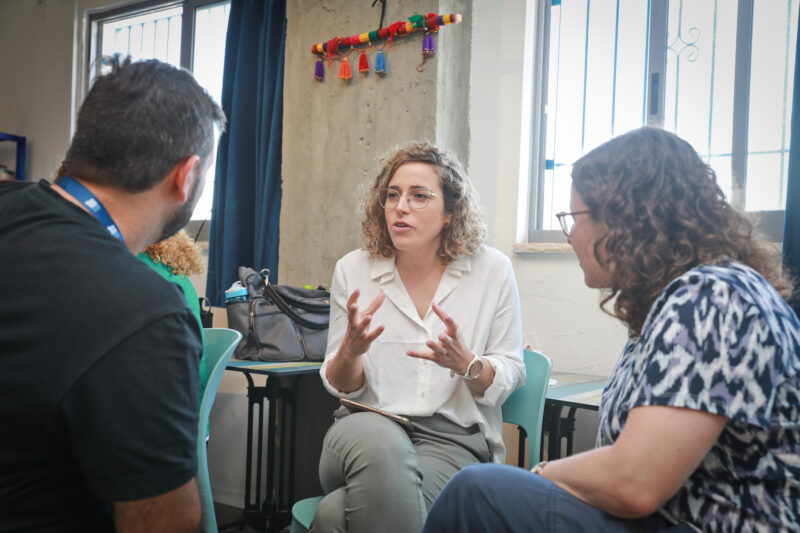
Participants at a Mandel Institute for Nonprofit Leadership gathering engage in conversation in an undated photo.
Futures thinking and inner development
There is a growing conversation in the Jewish and wider nonprofit sector about the importance of thinking more systematically about the future: anticipating disruption, navigating uncertainty and imagining new possibilities for Jewish and civic life. Yet leaders often experience a gap between this aspiration and their daily reality. When the present is demanding and overwhelming, thinking about the distant future can feel out of reach or even anxiety-producing.
It’s also difficult to do. Most of us think about the future in much shorter time horizons — the next program year, or a three-year strategic plan. What we produce through this kind of short-term planning is likely to replicate the ideas and outcomes we currently have on hand. Futures thinking offers a structured process to notice signals of the future in the present, explore multiple scenarios for a decade or more into the future and connect these scenarios with actions we can take today to work toward desired futures or prevent undesirable ones. This is a core capacity that leaders need to navigate a rapidly changing world and build more adaptive organizations.
Foresight tools alone are not enough. Leaders also need inner capacities to move through discomfort and fear so they can sustain their sense of agency over time. Imagining different futures requires a willingness to question deeply held assumptions about what’s happening now, what led us here and what is within our power to change. Helping leaders clarify their purposes, grow tolerance for ambiguity and relate to experimentation and failure as sources of learning can provide an essential scaffold for foresight work. We plan to test whether strengthening these inner capacities leads participants in our Executive Leadership Program to use futures thinking more consistently in their leadership to guide evolution in their organizations and communities.
‘Leaderful’ organizations
Since 2018, our program has been a pathway for exceptional mid-career Jewish nonprofit professionals pursuing executive leadership. We are incredibly proud of our graduates who have earned appointments as CEOs and executive directors across the Jewish nonprofit field. We have also learned from our faculty and graduates that the field needs more leaderful organizations — institutions where the capacity for vision and action is broadly shared rather than concentrated at the top.
The power of distributed leadership is emphasized in Leading Edge’s 2025 “State of Jewish Nonprofit Talent” report, which notes that the primary levers of organizational health and impact do not reside exclusively in CEOs. This has implications for futures thinking as well. Foresight exercises are most powerful when done with groups of people who bring diverse perspectives and are empowered to imagine and work toward a wide range of possibilities together.
We have long offered tools in our curriculum for activating distributed leadership. Now, we have broadened eligibility for the program beyond those on a direct path to the executive suite. Senior leaders who hold significant responsibility — whether they aspire to a CEO role — are well positioned to build leaderful cultures from where they sit. They mentor emerging talent and shape the environments in which others lead. This condition is essential because it expands the circle of leaders who are empowered to imagine, experiment and shape what comes next.
An ecosystem mindset in a fragmented field
Even leaders with strong inner capacities and supportive organizations can struggle to imagine the future if their field of vision is too narrow. Across Jewish life, institutions, media environments and social circles are growing more ideologically uniform and insular. These conditions not only exacerbate communal conflict but also deprive leaders of information, relationships and models that can stretch the boundaries of what they believe is possible.
An ecosystem mindset — which we define as the ability to understand how one’s organization sits within and is shaped by a broader network of institutions and communities — can bolster imagination in two ways. First, it widens leaders’ awareness of innovation and emerging practices that exist beyond the walls of their organizations. These developments can serve as signals of how communal life is evolving and spur leaders to experiment in their own contexts.
Second, an ecosystem mindset invites leaders to see themselves as part of a larger, shared Jewish project — not one that requires consensus or uniformity, but one that can hold many commitments and visions of the future without fracturing. When we see ourselves as part of a shared project, the way we think about the future shifts. It requires us to ask a different question: Where does someone who lives, practices and believes differently than I do fit into the future I am envisioning? This question loosens the grip of zero-sum thinking, opens the possibility that current conflicts can transform into cooperation and invites us to imagine a more expansive, inclusive set of possible futures.
Our cohorts form learning communities with leaders from different contexts, organizations, roles and lived experiences. Through our redesign, we have deepened our commitment to building multivalent cohorts and exposing fellows to leaders and sites of inquiry across the spectrum of Jewish life. Our hope is that these relationships and experiences will enable fellows to cultivate an ecosystem mindset and lead with a more capacious view of what Jewish life is and could become.
We are living through a period that is testing the imaginative capacity of Jewish communal leaders in profound ways. We need to cultivate leaders who think expansively about the future, organizations where the capacity for vision and action is broadly shared and an ecosystem approach that restores a sense of shared project in a fragmented field.
If imagination has dimmed under the weight of crisis and conflict, then leadership development must be one of the places where it is continuously rekindled. That conviction is shaping our work at the Mandel Institute and is an invitation we extend to leaders across Jewish life to cultivate a field that is more imaginative and futures-focused.
Eva Heinstein is the director of the Mandel Institute for Nonprofit Leadership and Karen Spira is the director of the institute’s Executive Leadership Program. The institute is an initiative of the Jack, Joseph and Morton Mandel Foundation.