Opinion
YOUR VOICE COUNTS
Why we have to show up and speak out




 Add EJP on Google
In Short
Participating in civic life is a responsibility — and opportunity — for all American Jews.
“The most important office, and the one which all of us can and should fill, is that of private citizen.”
I found myself thinking about this quote by Louis D. Brandeis two weeks ago as I walked into the Ohio Statehouse with colleagues, volunteers and partners from the Anti-Defamation League and Ohio Jewish Communities. I serve as the JCRC Director at the Jewish Federation of Greater Toledo. From both a personal and professional standpoint, showing up and speaking on behalf of the Jewish community is a responsibility. It is part of what it means to take civic life seriously.
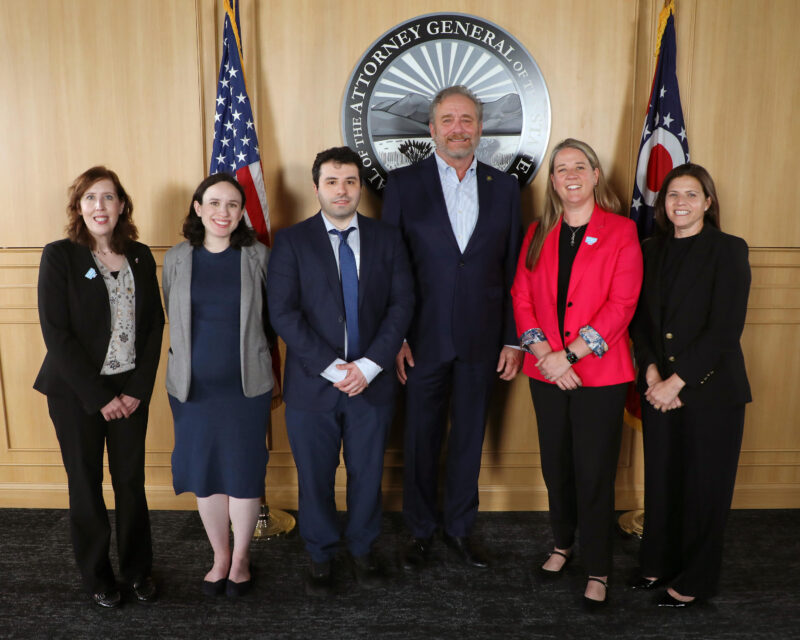
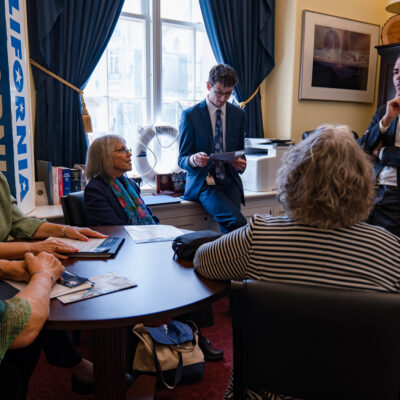
Courtesy/Office of the Attorney General of Ohio
The author (third from left) with colleagues from Jewish communal institutions at the Ohio Statehouse, April 2026.
Three years ago, I was living in Tel Aviv when the Oct. 7 attacks took place, one of the deadliest assaults on Jews in recent history. In the days that followed, before Israel responded militarily, I watched demonstrations in cities around the world where people openly celebrated the murder of Israeli civilians.
At the same time, antisemitic incidents rose sharply, including here in the United States. Synagogues and schools increased security. Jewish students reported harassment on college campuses. Many people began to feel a level of vulnerability that had not been present in years. These incidents came from different directions, including both far-right and far-left spaces.
That experience is part of what brought me to the Statehouse. Advocacy may not always feel urgent, but it is one of the most direct ways to participate in a democracy. Sitting across from legislative staff, sharing experiences and answering questions helps shape how policies are understood and written. It ensures that decisions are informed by the people they affect.
Right now, that matters for the Jewish community.
Jews make up a small percentage of the U.S. population, yet they are consistently among the most targeted groups in hate crimes. Recent reporting from the Anti-Defamation League shows a sharp rise in antisemitic incidents, including a significant number on college campuses. Behind those numbers are real experiences. Students who hesitate to express their identity. Families who think carefully about safety when attending synagogue.
In Toledo, the increase has been visible. Neo-Nazi flyers have been distributed. Protests have included groups that celebrated the October 7 attacks or spread false claims about Israel while denying the Jewish people’s connection to it. Community members have been harassed for displaying Jewish symbols or expressing any association with Israel. This is not limited to Toledo. Across Ohio, including in Cleveland, Columbus, Dayton and Cincinnati, there has been an uptick in reported antisemitic incidents, from harassment to intimidation. Much of this is tied to hostility toward Israel that spills over into targeting Jews more broadly.
This is why legislation that protects the ability of Jewish communities to live openly and without fear matters. Representative Josh Williams of Sylvania Township has been a strong advocate on these issues. Addressing antisemitism should not fall along partisan lines. It requires cooperation and clarity from both parties.
One of the bills we discussed was HB236, which would increase penalties for individuals who use masks to harass or intimidate others. There are legitimate reasons to wear a mask, including for health, and the bill does not change that. It focuses on situations where people conceal their identity while engaging in harassment. Laws like this have existed before, including in response to the rise of the Ku Klux Klan, and similar legislation has been passed in states like New York and Indiana. Today, we are again seeing individuals use masks while engaging in threatening behavior.
We also discussed HB306, which addresses targeted harassment through organized flyering. While it may sound minor, this tactic has been used in communities across Ohio, including in Toledo, to spread messages that single out Jews. On campuses and in neighborhoods, repeated campaigns can feel personal and intimidating.
Another issue raised was the need for a clear, codified definition of antisemitism in state law, as proposed in SB87. One of the challenges in addressing antisemitism today is inconsistency, especially when it intersects with conversations about Israel. A working definition gives educators, administrators and law enforcement a clearer framework for identifying and responding to incidents. It does not prevent legitimate debate or criticism. It helps ensure that when antisemitism occurs, it is recognized and addressed.
What stayed with me most from the day were the conversations. I heard about first-year college students arriving on campus and encountering swastikas within days. I spoke with advocates who are responding to incidents that have become more frequent in a short period of time.
This is happening in communities across Ohio, including our own.
Showing up matters. If we are not in the room, decisions are still made — just without us. I encourage you to reach out to your representatives and make your voice heard on these issues.
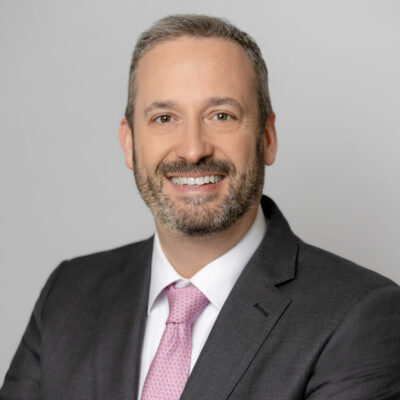
Roy Büchler is the director of the Jewish Community Relations Council at the Jewish Federation of Greater Toledo, where he leads community relations, Israel advocacy, government relations, educational outreach and responses to antisemitism. The views expressed are those of the author and do not necessarily reflect those of the Jewish Federation of Greater Toledo.