Opinion
Carrying the broken tablets: Jewish education in a fractured moment




 Add EJP on Google
The tensions surrounding Zionism today offer one of the clearest examples of what happens when complicated ideas are forced into binary categories — loyal or disloyal, pro- or anti-zionist, left or right. When students come to believe that every question about Israel must be sorted into categories of loyalty or betrayal, disagreement becomes a threat to belonging rather than a feature of serious Jewish life.
Educational settings are among the most important places to teach the next generation how to move beyond binaries and think more deeply. They allow us to help students stay in the conversation even when it’s challenging, and to cultivate a sense of belonging and commitment even when they don’t agree with one another.
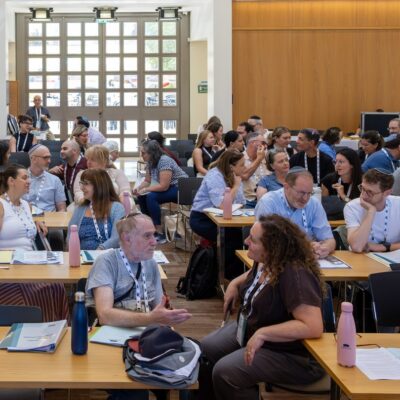
Courtesy/Shalom Hartman Institute of North America
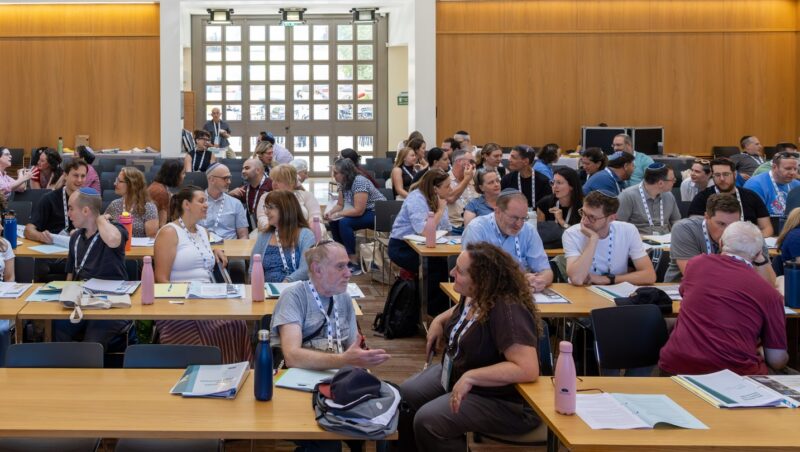
Participants in discussion at the Wellspring Summit for Educators in July 2026.
At the Hartman Summit for Educators last month, nearly 90 educators from day schools, Hillels, JCCs and congregational schools gathered to ask what this moment demands of Jewish education. Through our learning and conversations, five educational anchors became clear as essential tools for helping students move beyond binaries and remain in relationship amid complexity.
We must set boundaries based on our values
Every community exists within the confines of some definition, which inevitably involves drawing boundaries. The question is not whether boundaries should exist, but whether we can articulate the values behind the ones we choose to draw. Drawing the right boundaries requires introspection in a community as well as patience. It also means that different communities will have different boundaries. That is a feature, not a bug, of communal life.
Once we clearly communicated that the boundaries of the conversations for the Summit were anchored in the values of Liberal Zionism, it allowed our participants to ask the tough questions- about Israel’s legitimacy, Jewish power, democracy, anti-Zionism, loyalty, and critique. The boundaries gave us a shared language for entering discomfort together and created a productive space for disagreement.
An institution that can metaphorically display its “ten commandments” at the entrance is better equipped to do educational work and create a sense of belonging. Not because everyone who enters already agrees, but because everyone knows what kind of community they are entering. Clear commitments tell participants what the room stands for, what kinds of disagreement it can hold, and what forms of speech or behavior are unacceptable. When values are named at the entrance, boundaries become less arbitrary.
Criticism is part of what it means to belong
One common assumption we hear in our discourse is that criticism and loyalty are opposed. In many Jewish communal spaces, on campus, in classrooms, and online, criticism of Israel is read as opposition or disloyalty. This signals that loyalty requires silence or masking moral failures. At the same time, expressions of support of Israel are increasingly considered in some spaces as moral compromise. As a result, students come to feel that they must choose between their ethical convictions and their communal belonging.
At the Summit, educators reflected on how often students feel forced into a binary choice: critique or silence, loyalty or disloyalty. For some, the perceived social cost of being identified as Zionist or pro-Israel has become so high that it feels easier simply to walk away. But this is not the only option.
Jewish tradition offers us a different model: the concept of tochecha, or the obligation to rebuke. An integral part of tochecha is that the critique must come from a place of love and commitment, not from the standpoint of an outsider, but from that of someone who has skin in the game.
If we want our students to develop a lasting relationship with Israel and the Jewish people, we must help them understand that critique and commitment are not mutually exclusive. Educators need to help students distinguish between criticism that emerges from alienation and criticism that emerges from commitment. A Liberal Zionist framework can give students language for that distinction: commitment to Israel as the sovereign homeland of the Jewish people, to democracy and equality for all its citizens, and to Palestinian dignity and self-determination are some examples of this. Naming these commitments clearly creates the setting in which critique can happen. Students need to know that love of Israel can include accountability, and that loyalty can include protest.
Practically, this means students should not encounter Israel only through crisis or critique. They also need encounters with Jewish peoplehood, history, Israeli society, and Palestinian narratives throughout their educational experiences. This means investing in Israel trips and setting substantial time aside in the busy matrix of a school schedule for classes on these topics. Criticism cannot be the sum total of the relationship. It must sit within a broader understanding and responsibility for the Jewish future. It is our job as educators to make sure there is room for critique and that our students know they will still be valued members of the community even if — especially if — they voice their criticism because they care.
Teach learners how to engage competing narratives without it threatening their own identity
Some of the most powerful conversations of the summit emerged when participants encountered perspectives other than their own. Educators heard stories from across Israeli society, including Palestinian citizens and political activists on both ends of the spectrum. As one speaker mentioned, listening doesn’t mean we agree, but it does cultivate a more realistic understanding that allows us to engage with the disagreements more effectively.
This can mean helping our learners encounter Palestinian narratives within our educational settings: stories of displacement, occupation, fear, and national aspiration. Too often, students will first encounter these narratives later in life, framed as evidence that the story they were taught was partial or dishonest. If we introduce these complexities earlier, within a framework of Jewish belonging and commitment, students are less likely to experience them as a rupture. They will not be surprised and might be more confident in their own narrative because they have already learned that Jewish peoplehood, Zionism, and Israeli sovereignty can be taught honestly alongside Palestinian suffering and aspiration.
Educate towards constructive disagreement
Throughout the Summit, participants returned to the importance of mahloket, disagreement, as a feature of belonging to any community. It can be painful, threatening, and even destabilizing at times. And yet, if we want our students to belong to communities that are not carbon copies of themselves, we need to help them build that muscle in a constructive way.
Not only is machloket a core part of Jewish tradition, but constructive disagreement can be used as a tool to challenge binary thinking. Without that skill, students may come to believe that their only options are silence, opposition, or exit.
Practically, this means teaching students the art of disagreement. Students need opportunities to practice what it means to listen for the strongest version of another person’s claim, to distinguish between a person and their position, to ask clarifying questions before responding, and to name whether the disagreement is about facts or values.
In a classroom, this might mean pausing a heated conversation about Israelis and Palestinians before students respond. If one student is speaking from fear about Jewish safety and another from concern about Palestinian suffering, educators should ask each to name the value underneath their claim. That way, students begin to understand deeper questions: How do we keep Jews safe? What responsibilities come with Jewish power? How do we protect human dignity in moments of fear?
The goal of constructive disagreement is not to reach a resolution. As I said in the Summit’s closing session, the work is to offer frameworks and language for approaching difficult questions. That is what machloket can offer in this fractured moment: a way for students to be confident enough to disagree, listen, and remain committed to staying in the conversation.
Educate toward responsibility for the future
We are in the season between Tisha B’Av and Rosh Hashanah, between mourning what has been broken and preparing to begin again. On Tisha B’Av, we ask “Eicha?” — how? How did this happen? How did so much become fractured? But as we move toward the new year and return to the opening chapters of Genesis, we hear God’s question to Adam: “Ayeka?” Where are you? What are you responsible for now?
Jewish education has to hold both questions. Eicha asks students to face history honestly, to grieve what has been lost, and to understand how we arrived at this moment. But Ayeka asks them to move from analysis to agency. It reminds them that Jewish life is not only about interpreting brokenness. It is also about taking responsibility for what comes next.
Practically, this means asking students not only what they think, but what they owe. What do I owe the Jewish people? What do I owe those beyond my own community? What responsibilities come with sovereignty and power? What would it mean to critique from a posture of repair rather than abandonment? What future am I willing to help build?
This kind of responsibility is empowering. It helps students believe that their choices matter, even when they cannot fix everything. The goal is to raise students who can face brokenness honestly without being paralyzed by it, who can engage the moral consequences of Jewish power without walking away from Jewish commitment, and who can ask not only “How did this happen?” but “What does this moment require of me?”
That is the movement from brokenness to responsibility. It does not deny the fracture. It asks what we will carry forward.
In the Jerusalem Talmud (Masekhet Shekalim), Rabbi Yehudah ben Lakish teaches that the Israelites journeyed with two arks: one carrying the first set of broken tablets and the other containing the second set of whole tablets. Rather than hiding the broken tablets out of shame, they carried them openly at the front of their journey through the wilderness.
This image serves as a reminder that our fractures and imperfections do not need to be concealed. We can carry them honestly while moving forward. Jewish communities have never moved forward because we achieved perfect clarity or complete consensus. We moved forward because we learned how to carry what was broken alongside what was whole.
The challenge before us is not whether we can protect the next generation from complexity. We cannot. The question is whether we can give our students the tools, trust and a sense of belonging to engage with complexity without fear. Like the Israelites carrying both the broken and whole tablets through the wilderness, we must learn to move forward without demanding certainty. The future of Jewish education will not be secured by educators producing students who think exactly as they do. It will be secured by raising a generation confident enough to ask the difficult questions, committed enough to remain in relationship and courageous enough to help not only imagine but also build what comes next.
Rabbi Na’ama Levitz Applbaum is the director of educational leadership and engagement at the Shalom Hartman Institute of North America.