Opinion
REJECT FALSE BARGAINS
A third emancipation for American Jewry requires a Jewish civil rights movement




 Add EJP on Google
In Short
The Jewish community and its allies must build a movement organized across three mutually reinforcing domains: scholarship, litigation and public policy.
For centuries, Jewish life in the West has followed a recurring cycle: emancipation, retrenchment and renewal. Periods of opening in which Jews are granted rights and welcomed into public life, followed by periods of contraction in which those gains are limited, contested or quietly reversed. And then, often, periods of renewal — driven by law or political change, sometimes by war, or by the determined effort of those unwilling to accept exclusion as inevitable.
There have been two significant emancipations since the United States’ founding. The first emerged in the aftermath of the American Revolution, when Jews in American colonies could own property, engage in commerce, worship openly and participate in civic life. Jews were viewed as citizens in exchange for no longer being recognized as a distinct legal community with negotiated privilege and protection.
Dillon Meyer Media
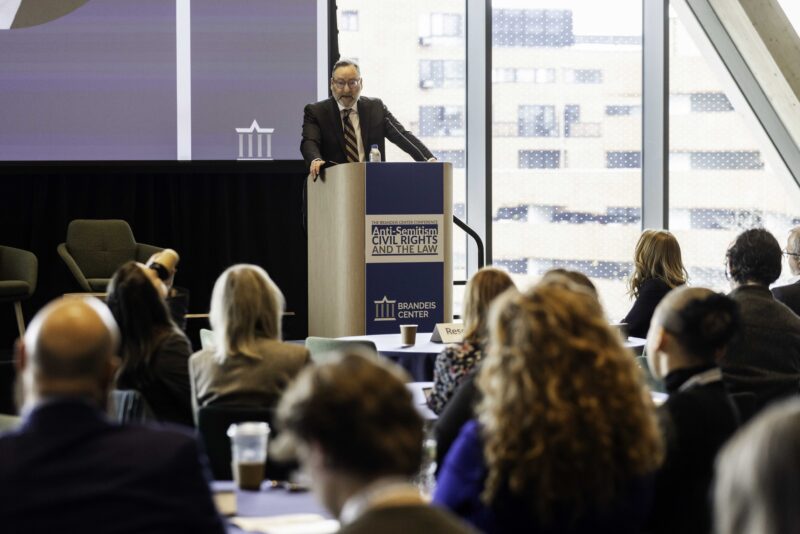
Kenneth L. Marcus speaking at the Brandeis Center Conference on Anti-Semitism, Civil Rights, and the Law in April 2026.
The second emancipation followed the Allied victory in the Second World War, when quotas weakened, anti-discrimination norms took hold and Jews entered public life in ways they never did before. During this time, Jews rejected the notion of racial distinctiveness and insisted on being treated as just another mainstream religion alongside Protestants and Catholics. In doing so, they took an implicit step away from Jewish peoplehood. In fact, Jews were now considered less as an ethnic minority and increasingly treated as a privileged and powerful white group undeserving of legal protection.
Each of these cycles centered on one recurring idea, pondered over hundreds of years: that Jewish belonging is conditional. That it may be granted, limited or withdrawn depending on compliance with prevailing norms. That emancipation is not simply a right, but a bargain that can be exchanged for political and legal assimilation.
Today, that bargain is reappearing in a modern form: Jews are increasingly told, implicitly or explicitly, that full acceptance requires distancing themselves from core aspects of their identity, including their connection to Israel and Jewish peoplehood. That is precisely why this moment carries both urgency as well as immense possibility and promise. A third emancipation would reject that false bargain once and for all: it would mean that Jews in America are protected not despite their full identity, but with their full identity intact.
Right now, we are in a period of retrenchment, evidenced by ongoing and seemingly constant antisemitic violence, exclusion, discrimination and terror. But this moment is not only defined by risk; it also presents a critical opportunity to shape what comes next. The law is here to protect us, and the foundations of a new Jewish civil rights movement are already being laid. After our antisemitism conference at Harvard last month, the Brandeis Center is helping launch that effort: a coordinated campaign to turn this moment of crisis into a moment of renewal. Law doesn’t create history, but it does determine whether history hardens into exclusion or is transformed into justice.
To bring about this third emancipation, the Jewish community and its allies must build a movement organized across three mutually reinforcing domains: scholarship, litigation and public policy. Each addresses a different point of failure; each is necessary and none is sufficient on its own. Together, they can create durable change.
First, scholarship means defining the harm. Without a stable and widely understood account of what constitutes antisemitism — how it operates, how it manifests in contemporary settings and where the line lies between protected expression and actionable discrimination – enforcement will remain inconsistent and contested. This is not merely academic. Civil rights law depends on shared definitions. It depends on the ability of administrators, regulators and courts to recognize when conduct crosses the line.
Where that understanding is unstable, the law becomes difficult to apply. For that reason, the work of definition — through legal scholarship, institutional guidance and frameworks such as the IHRA working definition — is foundational.
Second, litigation compels recognition and demands accountability. Strategic litigation does more than resolve individual disputes. It clarifies obligations, raises the cost of noncompliance, establishes precedents and forces institutions to confront patterns they might otherwise deny or defer. And, critically, it translates abstract principles into enforceable standards. Litigation drives change. With it, the law acquires force.
Third, public policy embeds those standards into practice. Even the clearest definitions and the strongest precedents are insufficient if they are not embedded in institutional practice. Public policy is the mechanism through which legal standards are operationalized: through federal guidance, regulatory enforcement, institutional rules and procedures and the conditions attached to public funding. It is what ensures that rights recognized in principle are realized in practice.
Taken together, these three domains form a single system. Scholarship defines the problem and identifies the standard. Litigation enforces the standard. Public policy embeds the solution. When they operate in isolation, progress is partial and unstable. When they operate together, they can reestablish the clarity, consistency and predictability on which civil rights law depends.
With this new legal movement, we can bring forth an ultimate emancipation in which Jews are not required to disavow peoplehood in order to belong. One in which Jews are not asked to distance themselves from Israel or any other core element of their identity in order to participate fully in public life. One in which identity can be expressed openly. One in which the rights of Jewish Americans are not subject to negotiation, exception, exclusion or erasure, but secured as a constitutional and legal right. The first two emancipations did not accomplish that, but this one can.
The Jewish community has experienced fear and devastation over the past few years. But out of crisis comes strength. This is a moment not only of response, but of renewal. And if we want to enter a new cycle of Jewish life, we must build the legal and academic infrastructure now to ensure that such a phase can exist. That means supporting scholarship, pursuing litigation, advancing policy and working together across institutions to ensure the law is applied clearly and consistently.
We are on the cusp of something historic, if done right. What it requires is a coordinated Jewish civil rights movement to get us there. If we meet this moment with clarity and collective effort, we can secure not only greater safety, but a future in which the next generation of Jews can live more openly, confidently and fully themselves.
Kenneth L. Marcus is the chairman and CEO of The Louis D. Brandeis Center for Human Rights Under Law and the former Assistant Secretary for Civil Rights at the United States Department of Education under two administrations.