Q&A
Inside the Cooperman Family Foundation’s $10 million gift to Birthright Israel
Jodi Cooperman, who oversees the family’s Jewish giving portfolio, hopes donation will inspire others to give, to ensure the longevity of the free Israel trips
Courtesy/Birthright Israel
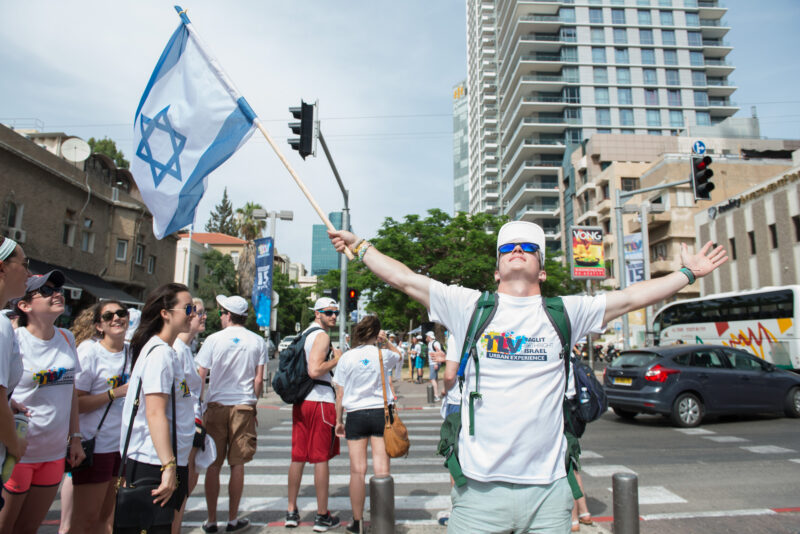
Birthright Israel participants are seen in Tel Aviv.




 Add EJP on Google
At a packed gala last night in Livingston, N.J., the Leon and Toby Cooperman Family Foundation announced a $10 million gift to the Birthright Israel Foundation.
The event, held at the Crystal Plaza, drew nearly 400 guests and raised an additional $2.7 million from Birthright donors and friends of the Cooperman family. Birthright Israel Foundation President and CEO Elias Saratovsky praised the Coopermans at the gala, saying the family represents the “very essence of what Birthright Israel stands for — continuity, connection, and the power of investing in future generations.”
The donation is emblematic of the Cooperman family’s philanthropic giving for Jewish and Israeli causes, with a focus on preserving the Jewish future and offering equal opportunity to all, according to Jodi Cooperman, the daughter-in-law of hedge fund manager Leon Cooperman, who manages the Israel and Jewish giving portfolio of the foundation.
Ahead of the gala, eJewishPhilanthropy spoke with Jodi Cooperman, who for years has also served as board president of the Interfaith Food Pantry of the Oranges in New Jersey, to discuss how her family is navigating the evolution of their giving across three generations.
During the conversation, Cooperman shared that her father-in-law, Leon, set a process in motion in 2024 that ultimately passed the baton to her. In doing so, he entrusted her and her two daughters, Courtney and Kyra, with the privilege and responsibility of managing the family’s multimillion-dollar giving to Jewish and Israeli causes. She discussed how she and her two daughters are navigating the complexities of multigenerational philanthropy and are doing so without full-time foundation staff in the U.S. or Israel.
This interview has been edited for length and clarity.
Jodi Cooperman: I’ve been involved in my in-laws’ foundation for 16 years. [And] in January 2024, with health challenges and running a business, my father-in-law turned to me and said, “I am turning over our Jewish philanthropy to Courtney and Kyra and you.” That came to us as a surprise, during a moment when everyone didn’t know what to do: how can we help? With Oct. 7, the world is turning on us. At a time when no one could figure out how to help, we were gifted this incredible responsibility to really make a change.
We wanted to figure out a way that we could be proactive. So we designed our pillars of what we wanted to focus on.
We got on a Zoom with family in San Francisco, Denver and New Jersey to put out all of the things we wanted to think about. At that moment in time, we could’ve decided that everything was going to Israel emergency funding because of the war. We were very clear that we need to focus on the Jewish future, and if we only focus on the emergencies, then the Jewish future won’t have all of the important organizations to sustain itself. [Though] we did support emergency funding through the [UJA-Federation of New York’s] Day After Fund.
To ensure we were building for the long term, we established core areas of focus. One primary pillar centers on helping Israel become the best version of herself by strengthening democracy, supporting education, and working with organizations that focus on a shared society. Another key focus is the broader Jewish future, directly investing in the institutions of daily Jewish life — such as synagogues, JCCs, PJ Library, and Hillels — alongside rich Israeli programming. We also chose to focus heavily on Birthright, specifically because of its unmatched capacity to reach the most lives. We view it as a critical starting point that has clearly helped this generation connect to Jewish life.
JH: Much of the recent donor narrative has been defensive, with funders withdrawing support from higher education institutions that no longer feel safe. Why is now the time to move from critiquing external institutions to doubling down on building the Jewish future from within?
JC: We have changed some of our focus away from American universities and places that do not have our backs, but we can only control what we can control. We need to focus on where we can have an impact, and by focusing on something like Birthright, we want to make sure that kids are not on a waitlist. We want to ensure that every kid who wants to go can go. All of the studies are showing that of the kids out there speaking out for Jewish students on campuses, the majority of them are the kids who went on Birthright trips.
We feel very strongly that treating the fight against antisemitism as its own stand-alone focus is not the best way to fight antisemitism. We have been saying it for two years, and Bret Stephens said it in his “State of the World Jewry” address. As a Jewish person, if your whole reason for being is to fight antisemitism, then you lose the meaning of what it means to be Jewish and what you are actually fighting for. When you feel secure in your Jewish identity and feel knowledgeable, it is a lot easier to speak up against antisemitism.
JH: With the current funding landscape for Jewish organizations shifting, why was this the right moment for your family to make a major, public commitment to Birthright?
JC: Now is the time as a family because of the way we are working together in this multigenerational work. I am working with my daughters, but really, I am focused on carrying out the legacy that my father-in-law has created with a strong Jewish commitment. And Birthright is something that we can all support. It is something we can support across all generations, and we want to make sure it is there in the future.
Historically, Birthright has relied on one major donor [Miriam Adelson], and when she pulled a lot of funding, it left Birthright needing to fundraise in a way they never had to before. Birthright needs to find a way to make sure that all Jewish people have a stake in it — to get more people involved as donors. I am hoping that by leading by example with a large gift, we can help other people step up to support Birthright at whatever their capacity is. For every kid who has gone on a Birthright trip, it would be great if they viewed it as a gift given to them, and they should help pay it forward for the next generation.
JH: In legacy families, the “generation gap” is often a deep challenge, especially on the Israel front. How does your family navigate different political or tactical perspectives, and how did Birthright become the ultimate shared lever for all three generations?
JC: We have deep respect for each other. We listen to each other, and the listening piece is really important. Our family has different political perspectives. The beautiful thing about working with my daughters is hearing from the next generation because they are living it. They are hearing from their peers, and they bring that perspective. And then my father-in-law has his perspective.
The ability to listen to what is important across generations is what matters. We are all in it together, but we have a lot of respect for the fact that my father-in-law worked so hard to make this money and [we] give it away. Respecting our differences and learning from each other is key. [For instance] the concept of a “shared society” was not something I was originally familiar with, and Courtney brought that to the table as we carefully learn more about the landscape.
JH: A gift of this scale requires immense confidence in the organization. What is it about Birthright’s current leadership and educational approach that made your family feel ready to partner with them?
JC: I feel like Birthright cuts across all Jewish and political beliefs, and it is something I believe everyone can get behind. They have 26 years of data that proves their success. My love for Birthright grew multifold because of listening to Zohar [Raviv, vice president of Educational Strategy]. Understanding his approach and educational philosophy gives me the most confidence in Birthright that I’ve ever had. It was very important to me that Courtney had the chance to meet Zohar recently to see how they develop their trips. If I hadn’t met Zohar and heard from him directly, I am not sure we would have encouraged this gift.
I [also] met with Elias [Saratovsky, president and CEO of Birthright Israel Foundation,] for the first time last winter. To have the CEO of Birthright be a participant from the very first year of the organization is incredibly meaningful. He gives me confidence that he is looking out for our Jewish future.
JH: Your father-in-law, Leon, has always pointed to “being a mensch” as his North Star — a value deeply reflected in programs like the Cooperman College Scholars in Newark, N.J. In 2026, what does being a mensch actually look like for a philanthropic family?
JC: Being a mensch also applies to how we work with organizations. I feel very strongly that I want to be supportive of organizations, and I don’t want them to spend all of their time making fancy PDFs for me. The conversations I have with people are what are truly meaningful to me. Building real relationships is very important. I just learned of a concept called “trust-based philanthropy” over lunch with a friend who runs a foundation, and it was great to find out that my style has a name; the way I go about doing this work, which feels very intuitive to me, actually has a framework.
We don’t have outside people vetting organizations; this is what the family does. My father-in-law wants the money to go directly to the organizations instead of paying for a large foundation staff.
[This motto was put into action when] my in-laws created the Cooperman College Scholars program, which is based out of Newark. It offers scholarships to about 80 kids a year. This is something they created on their own to help first-generation families.
[Leon’s] roots as the son of a plumber from the Bronx are always close to his heart, and his respect for the places that helped him become so successful is a core part of his menschy behavior. The program is now in its 12th year. For Leon, being a mensch means giving others the same opportunity to succeed that he had.
Related News
ADVANCING A VISION
N.Y. federation donates $1M toward building shared-society center named for peace activist killed on 10/7

EXIT INTERVIEW
Elizabeth Sokolsky, longtime EVP of Birthright Israel, to retire next year
CLOSING WORDS
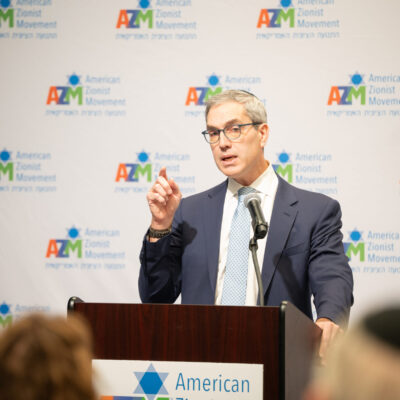
In AZM address, Cosgrove links communal ‘orthodoxy’ on Israel to rising anti-Zionism among young Jews

MAGICAL EXPERIENCE
Shefa launches psychedelics retreat for Jewish professionals suffering burnout

EXCLUSIVE
Detroit-based philanthropists Nancy, James Grosfeld donate $8M to renovate JDC’s Israel campus