GIVE PEACE A CHANCE
Tel Aviv peace summit offers alternative for Diaspora Jews looking to support Israel, but not its government
U.S.-based philanthropist who supported the It's Time coalition conference says this kind of program is the best way to engage young Diaspora Jews who are increasingly disconnected from Israel
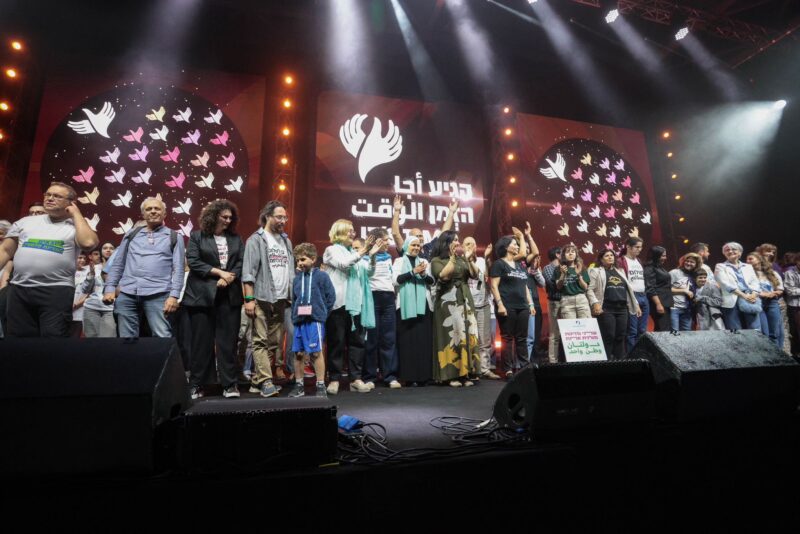
Ofer Amram/Sal productions
Participants stand onstage at the People's Peace Summit in Tel Aviv's Expo Center on April 30, 2026.




 Add EJP on Google
TEL AVIV — As the wars with Iran and Hezbollah still hang in the air amid fragile ceasefires, and with most of the country supporting a resumption of fighting on both fronts, the leaders of the It’s Time coalition pulled off an unexpected feat last week: hosting thousands of people at a sold-out peace summit, stressing the need to use diplomacy — not military might — to resolve conflicts.
Some 5,000 people filled the halls of Tel Aviv’s Expo Center at last Thursday’s third annual People’s Peace Summit, which was titled “It Must Be. It Can Be. It Will Be. Peace,” and thousands more joined via watch parties around the world.
As Jewish philanthropists and leaders struggle to engage the young American Jews who are increasingly losing their connection to Israel, the It’s Time coalition, a post-Oct. 7 network aimed at promoting peace and shared-society initiatives, is looking to offer a solution: fund the peace camp.
Sally Gottesman, a U.S.-based philanthropist who supports a host of progressive Jewish and Israeli causes, told eJewishPhilanthropy that she watched the summit live from her home in New York. Gottesman, one of the major backers of It’s Time, said that the summit served as important proof of concept and called on other Zionist Diaspora funders to get involved, warning that not doing so risked leaving a vacuum that would be filled by radical voices.
“The biggest problem the coalition has is [that] not enough people know about it. The other problem is that established Jewish institutions in the diaspora have not yet met the moment,” Gottesman said. “They’re shooting themselves in the foot by not wanting to talk about those things. That’s what young Jews want to talk about. So they’re either alienating people from being involved at all, or pushing them to the far left.”
With Israeli elections due by October, Offir Gutelzon, the founder of the U.S.-based protest movement UnXeptable, told eJP that this kind of peace summit, which runs counter to the prevailing political winds in Jerusalem, is critical for demonstrating to Diaspora Jews that Israel and its government are not the same thing.
“Right now, many younger observers look at Israel and see only [Prime Minister Benjamin] Netanyahu, [Finance Minister Bezalel] Smotrich, and [National Security Minister Itamar] Ben-Gvir,” said Gutelzon, whose organization was launched to oppose the government’s judicial overhaul plans. “We are not our government. Showing the world a massive, vibrant peace camp is the antidote to that despair. Peace and democracy are the two oars required to propel Israel forward toward the vision of its Declaration of Independence and its true purpose.”
The It’s Time coalition was established in the wake of the Oct. 7 terror attacks, with a founding mandate to end the war in Gaza — and make it the last. Beginning with 50 founding organizations, it has grown to over 80 groups spanning Jewish and Palestinian citizens of Israel alongside international partners.
The New Israel Fund, which Gottesman also supports, is a major backer of the coalition as well. Mickey Gitzin, acting CEO of NIF, told eJP that he was most excited about the global watch parties.
“The global Jewish community is seeking genuine partnership with Israelis. It is not finding that partnership through government or official channels, and so it must build those connections elsewhere, through initiatives like this,” Gitzin said. “The connection between Israelis and liberal Jewish communities is not just important — it is essential. It is, quite simply, like air to breathe.”
In addition to Gottesman and NIF, the summit’s principal funders included the European Union, the Robert Weil Family Foundation, a number of anonymous Israeli donors and other European institutional funders.
What those donors are funding was on full display last Thursday. The hall in Tel Aviv was packed with what one attendee described as “Beatles-mania energy.” “When the main event ended, the late-night halls were still full of high schoolers and pre-army program students who simply didn’t want to go home,” Tami Yakira, one of the event organizers, told eJP.
The conference, which was also spearheaded by columnist Mika Almog, highlighted the losses on both sides of the conflict, with one installation, “A Child is a Child,” displaying the names of every child killed in the war — in Gaza, in the West Bank, in Israel. Many of the speakers exemplified this as well, including Thair Abu Ras, a fellow at the Forum for Regional Thinking who lost approximately 40 family members in Gaza, and Mai Peri, whose grandfather Chaim Peri — an Israeli peace activist — was taken hostage in the Oct. 7 attacks and murdered in Hamas captivity.
Knesset members from progressive parties also attended the conference: Gilad Kariv and Naama Lazimi, from the Democrats Party, and Ahmad Tibi and Ayman Odeh, from the predominantly Arab Joint List. Yair Golan, leader of the Democrats Party, sent a filmed address. Canadian Ambassador to Israel Leslie Scanlon, EU Ambassador to Israel Michael Mann and Nicolas Kassianides, France’s consul general in Jerusalem, all attended as well.
“It was reaffirming to see the base that believes peace is still possible getting together,” Don Futterman, Israel director for the Moriah Fund, told eJP. “One message came through loud and clear: With this government, nothing will happen. Until we get a new government, there won’t be any change.”
Speaking on the sidelines of the gathering, Futterman also noted that there was still more work to be done in developing the pro-peace camp, reflecting on who was not in the room. “There’s a liberal religious community, a moderate religious community. There are liberal and moderate Mizrahi communities that were barely represented — and often are underrepresented in these forums,” he said.
For Diaspora Jews who believe that diplomacy is the best way to achieve peace for Israel, Gottesman argued that funding such efforts also contains a degree of self-interest, as global antisemitism has risen alongside Israel’s wars in Gaza, Lebanon and Iran.
“My Jewish safety is really dependent on Israel. If there were peace tomorrow, antisemitism would fall,” Gottesman said. “I’m worried about where It’s Time and these organizations are going to find their donors,” she said. “The right is moving to the right, and the left is moving to the left.”
Part of the challenge, she argued, is generational. Gottesman recalled a comment that was made during a recent gathering by a young woman: “In my grandparents’ generation, Israel was a miracle. In my parents’ generation, Israel was seeking peace. In my generation, Israel’s an oppressor,” she said. “I don’t think the next generation sees this as a very hopeful use of their funds or their time,” she said.
For Sandra Weil, of the Robert Weil Family Foundation, a supporter since It’s Time’s first summit, the coalition is as much about the work to be done in Israel as it is about a partnership with world Jewry. “The first [summit], it was so close to Oct. 7. It was just a call to meet — and cry,” she told eJP. “The more we’re still in the same mess, the more important the work becomes. More and more organizations turn to them [It’s Time]. Even politicians are realizing that this is an important voice.”
Related News
ADVANCING A VISION
N.Y. federation donates $1M toward building shared-society center named for peace activist killed on 10/7
PRESIDENTIAL REBUKE
Israel’s Herzog: Mamdani ‘makes no effort’ to hide disdain for Israel, Jews must fight back
CLOSING WORDS
In AZM address, Cosgrove links communal ‘orthodoxy’ on Israel to rising anti-Zionism among young Jews
EXIT INTERVIEW
Elizabeth Sokolsky, longtime EVP of Birthright Israel, to retire next year
EXCLUSIVE
Detroit-based philanthropists Nancy, James Grosfeld donate $8M to renovate JDC’s Israel campus