Q&A
Chancellor-elect Rabbi Mike Uram envisions ‘new chapter’ for JTS, Conservative Judaism
Incoming head of the Conservative seminary downplays students who opposed Israeli president’s presence at commencement, noting far greater support for it
Screenshot/Jewish Theological Seminary
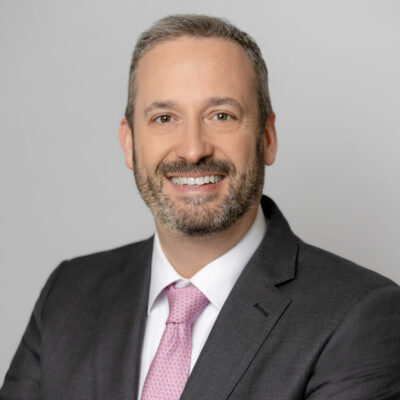
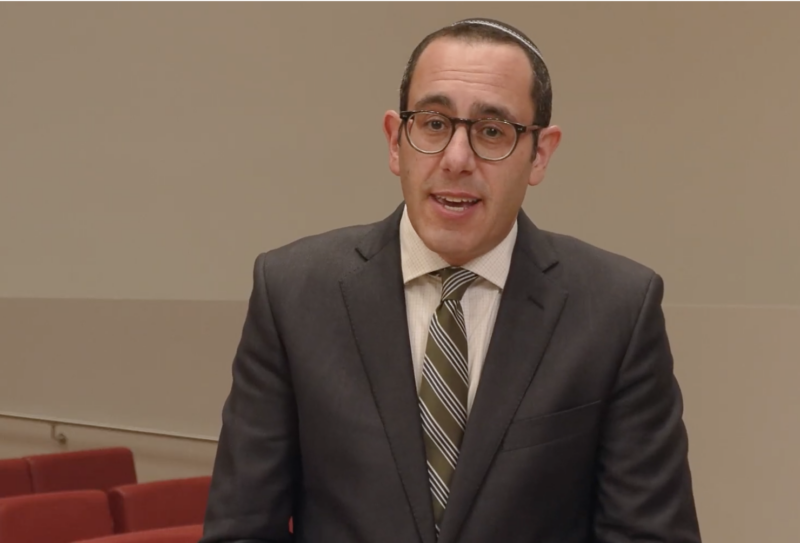
Rabbi Mike Uram, chancellor-elect of the Jewish Theological Seminary, in an introduction video after the announcement of his new role.




 Add EJP on Google
Amid intensifying, multidirectional polarization of the American Jewish community, Jewish Theological Seminary Chancellor-elect Rabbi Mike Uram is putting forth his own optimistic vision for Conservative Judaism: “the muscular middle,” a movement that can offer a middle ground for all types of Jews.
Still, he admits to taking the helm of JTS — the Conservative movement’s flagship rabbinical school in New York City — during a challenging era for all denominations, marked by historic levels of antisemitism, divisions over Israel among students and declining institutional affiliation among young Jews.
A 2005 JTS graduate, Uram will succeed Chancellor Shuly Rubin Schwartz, joining the institution after serving as the chief Jewish learning officer for the Jewish Federations of North America. He held several prior positions in Jewish organizations, including leading the University of Pennsylvania Hillel as executive director and campus rabbi for over 16 years.
Uram, who assumes the role on July 1, sat down with eJewishPhilanthropy to discuss his strategy for cultivating the next generation of American Jewish leaders at a fraught time.
HC: Recent data shows that while enrollment declines seen in the past couple decades at major Conservative and Reform seminaries have stabilized, the institutions still have not returned to previous growth levels. How do you plan to strengthen the pipeline of future rabbis at JTS? Are there any insights that can be drawn from Orthodox rabbinical schools, which are experiencing the most robust and consistent overall growth in enrollment?
Rabbi Mike Uram: I’m happy to share that JTS’ numbers for rabbinical school are high. There’s an incoming class of approximately 25 students, which is bigger than when I was a JTS student. I graduated with a class of 17.
In terms of how I imagine being able to help JTS go from good to better, I have a strong background in how to use relationship-based engagement to transform outcomes of Jewish organizations. There’s an opportunity to both cast a wide net to recruit outstanding candidates for rabbinical school but I also would imagine trying to integrate JTS into the larger Jewish ecosystem in different ways and start to focus on centers where there is a high density of outstanding Jewish leaders.
For example, the [Conservative movement’s] Ramah camp system, or Jewish camps in general, the counselors there are already people who are indicating their passion for Jewish life and Jewish leadership. Camp is an amazing training ground, where you have to be able to innovate on the spot.
[I want to] focus on the best and brightest of the camping movement [and] focus on campuses where there are great Jewish communities, and not just partnering with Hillel or Chabad but looking into student government or musical theatre — places with outstanding personalities.
[Orthodox rabbinical schools] are separate. The way Orthodox smicha works is different. There may be people studying at Yeshiva University who add on a little extra studies [to get ordained], but then many of those people go on to work in the nonprofit world or any number of other things. So the number of people in the Orthodox world who are getting smicha doesn’t represent professional rabbis who are going to work as rabbis.
HC: How do you see the rise of post-denominational Judaism among younger Jews shaping the future of institutions like JTS, which is rooted in the Conservative movement?
MU: We’re living in this very strange, lonely moment. According to [social psychologist] Jonathan Haidt, 85% of Americans are in the [political] middle, but roughly 7.5% on the extreme margins are the ones who get to dictate the political discourse on any given issue. Every complicated issue is presented as a simple binary where you’re either pro or anti.
According to Haidt, that leads to a situation where three-quarters of Americans feel hopeless, disconnected and unrepresented in political debates. So I think we are reaching a point where so many of us are starving for something more nuanced, instructive and to stop arguing with the extremes and have a pragmatic conversation. I call that the muscular middle.
Aside from denominationalism, JTS is an amazing learning environment for any Jew who would want to pursue Jewish study or rabbinical and cantorial ordination, because JTS represents that muscular middle in a profound way. It is serious, traditional Jewish learning, but it is open and accessible to everybody, and that is a very rare combination.
The challenge you raise is a serious one, but JTS is well-positioned to be a training ground for future Jewish leaders regardless of denominationalism.
HC: The choice of Israeli President Isaac Herzog as commencement speaker later this month has divided the JTS student body, with a petition accusing him of inciting violence in Gaza and prompting calls for his disinvitation. How as chancellor would you address this polarization? Will you engage in dialogue with students opposing the administration’s position, and what is your message to them? Does backlash like this ever warrant reconsidering the speaker’s invitation?
MU: I am very proud that JTS invited President Herzog to be part of commencement. At the end of the day, JTS has shown its commitment to the State of Israel and the Jewish people.
While there may be headlines about deep division, of all enrolled students this is a small handful of students [pushing back]. Just like every Jewish family and every political issue under the sun, there are people who are going to speak out against something.
Choosing the president of Israel as commencement speaker is a very powerful statement, and it’s a powerful statement that JTS held strong against the small number of students speaking out against it.
HC: Your background is different from your predecessors in that, instead of holding a doctorate, you have experience with leading Jewish organizations and within higher education, including Jewish Federations of North America and Hillel. How will that be an asset to JTS, especially in this time of rising antisemitism, both generally and on college campuses? How will you contribute to new student programming and philanthropic initiatives?
MU: One thing I learned [from my time] on campus is that there is a fierce devotion to not letting anti-Israel [activity] or antisemitism derail our mission or strategy. This is a constant challenge because there are real problems in America today with anti-Zionism and antisemitism. And, [combating those should not be the only focus] in building a bright Jewish future. Jewish success is not defeating antisemitism, Jewish success is building a thriving Jewish future for everybody who wants to be connected to it. We have to be able to do two things at the same time.
One of the questions I will continually pose is not ‘how do we fix problems that exist [now] or in the past,’ not ‘how do we go back to a time that was long ago,’ but ‘how do we [get] the Jewish future that we want in North America? What will that look like in 50 or 100 years? What’s the learning? What’s the roles that ritual and Torah play? Most importantly, how do you connect Jews to this technology of Jewish learning?’
A common strategy is to come up with an idea and market it broadly, hoping to create attendance. But a core area of my speciality is how to use relationships and social networks to activate people as Jews. That’s a huge part of what my outside experience will bring to JTS.
[From Hillel], I was trained in the art of higher education fundraising, which is very powerful. Having someone who has that broad set of connections can [be helpful in] connecting JTS to the larger Jewish ecosystem.
Because I’m a JTS graduate — and I think back about my time at JTS as maybe the most powerful leadership development experience I’ve had in my life — I hope JTS is getting a chancellor who is both deeply committed to the history of it, but also someone who sees opportunities that someone who has only existed in the denominations or in academia might not see. In some ways, JTS is the best kept secret in the Jewish community. As an outsider before I started talking to the search committee, I was not aware of how large the numbers were of students coming into the rabbinical and cantorial schools.
I was also astounded [to learn] JTS is in a very strong financial position. There are programs recently launched, such as one in creative writing chaired by Israeli author Etgar Keret. These are things not necessarily getting out there into the world. So I’m excited to be a messenger of all the great work [of] people like [Chancellor Schwartz], and for us to go from strength to strength.
HC: As chancellor, how do you think about setting boundaries around Israel and Zionism discourse at JTS — are there red lines, and if so, how are they defined?
MU: There are a lot of people defining what anti-Zionism means today. But at its core, anti-Zionism means you are advocating against the existence of a Jewish state in the land of Israel. That is not a normative position to have and that is not something an organization committed to Israel should be part of normalizing.
But in the many years I have worked on campus and at Hillel, I often try to avoid red lines. I think when a leader has to say ‘I’m your boss, you have to do this’ or ‘this is the policy,’ it usually means the leaders are in a weak position. The better way to solve those issues is by building a culture that is productive and attracts the right kind of debate.
My goal as chancellor is to build a culture based on core values and beliefs of the organization and the movement to which it’s connected, and let that be the guiding principle.
Rabbinical training is about training people to be the most sophisticated, passionate and well-rounded Jewish leaders they can be. Anybody who is serious about serving the American Jewish community has to be serious about Israel and deeply engaged in all things Israel. JTS is dripping with Zionism — there are Israeli flags at the entrance of the building and in the synagogue. One hundred percent of rabbinical students who were asked to study in Israel did, there was no ideological opposition. Counter to some headlines, this is something JTS is already doing well.
HC: When, if ever, is it appropriate for a rabbi to take an explicit partisan stance from the pulpit?
MU: Each rabbi has to understand that as they go. Generally speaking, the majority of rabbis in synagogues are in a place where people want a break from politics. In synagogue, they want to understand how to navigate the most painful issues impacting us in the 21st century [such as] loneliness and polarization.
There are particular rabbis and congregations where it makes sense for rabbis to take [a political stance]. [But] if you have a congregation that has a broad spectrum of political orientations, for a rabbi to speak out against half that congregation is not good for Judaism, the congregation or the rabbi. There are congregations that have more homogenous political orientations [and] there are rabbis who see their role of bringing Torah to the world in different ways. Some of those people want to be deeply focused on emotional wellbeing, some on Jewish literature and some on taking a political stance.
The job of an organization like JTS is to train people to have an incredibly broad and deep understanding of Judaism and who North American Jews are, so that ultimately they can find their voice in their career.
HC: Anything else you would like eJP readers to know?
MU: It seems we’re in an age of upheaval. A lot of norms a lot of us relied on — shared values and general behavior — are being turned inside out by politics, technology and a rise in antisemitism. There’s a moment now in the 21st century where Jewish wisdom, ritual, values and community is not just something to preserve but it is actually a set of tools to make sense of our life. A powerful message of what Judaism could be in the world is not how many people do it, how many people are paying [synagogue] memberships, but how is the practice of being part of these communities, engaging in deep conversations, helping people live the best versions of their lives possible and contribute to a better, more productive world?
As my career enters a new chapter and as JTS enters a new chapter, I’m excited about bringing the depth of Torah learning that exists in the most premier and preeminent Jewish academic space in North America and translating that to huge numbers of Jews who are all struggling with how to make sense of life today in these confusing and turbulent times.
Related News
ADVANCING A VISION
N.Y. federation donates $1M toward building shared-society center named for peace activist killed on 10/7
PRESIDENTIAL REBUKE
Israel’s Herzog: Mamdani ‘makes no effort’ to hide disdain for Israel, Jews must fight back
CLOSING WORDS
In AZM address, Cosgrove links communal ‘orthodoxy’ on Israel to rising anti-Zionism among young Jews
EXIT INTERVIEW
Elizabeth Sokolsky, longtime EVP of Birthright Israel, to retire next year
EXCLUSIVE
Detroit-based philanthropists Nancy, James Grosfeld donate $8M to renovate JDC’s Israel campus