Opinion
BARUCH DAYAN EMET
Abe Foxman: One of the last great architects of postwar American Jewish public life




 Add EJP on Google
The passing of Abraham “Abe” Foxman marks the loss of one of the last great architects of postwar American Jewish public life.
For nearly half a century, Abe stood at the center of the Jewish community’s struggle against antisemitism, extremism and ignorance. Long before antisemitism once again became a daily feature of American public life, he understood something many preferred not to confront: hatred adapts. It changes language, symbols and political homes. It reinvents itself for each generation. And it survives whenever decent people convince themselves the danger has passed.
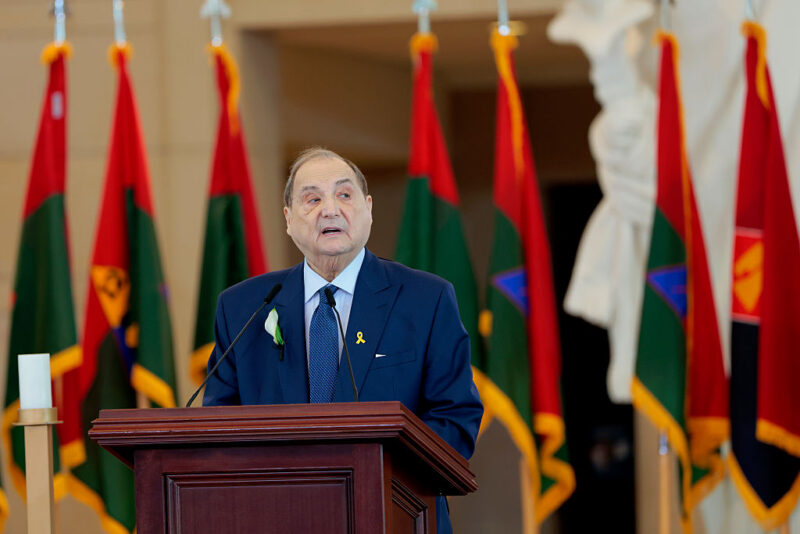
Anna Moneymaker/Getty Images
Abraham Foxman, Holocaust survivor and former national director of the Anti-Defamation League, delivers remarks during the U.S. Holocaust Memorial Museum's Annual Days of Remembrance ceremony at the U.S. Capitol in Washington on April 23, 2025.
Abe knew better because his life began under the shadow of the Shoah.
Born in 1940 in what is now Belarus, he survived the Holocaust after being hidden as a small child by his Polish Catholic nanny while his parents fought to keep him alive. That experience did not leave him cynical. It left him watchful. It gave him an instinctive understanding that Jewish security is never guaranteed, and that defending it requires both initiative from the Jewish community itself and alliances with people of goodwill, much like the woman who saved his life.
That sensibility shaped Abe Foxman’s approach to Jewish leadership for the rest of his life. He remained vigilant, unapologetically Jewish and deeply committed to building institutions strong enough to defend the Jewish people.
As national director of the Anti-Defamation League from 1987 to 2015, Abe Foxman transformed the ADL from an important Jewish defense organization into a global institutional force capable of shaping public debate, advising presidents and prime ministers, tracking extremist movements, building interfaith coalitions and responding in real time to the evolving forms of antisemitism and extremism. He understood that antisemitism could not be confronted narrowly or defensively. It demanded moral seriousness, political sophistication, institutional strength and public courage.
He also stood among the strongest defenders of the U.S.-Israel relationship and of the State of Israel of his era.
Years before the current climate, Abe recognized that anti-Zionism and antisemitism increasingly bled into one another in mainstream conversation. He rejected the fashionable expectation that Jewish leaders should treat hostility toward Israel as somehow detached from hostility toward Jews themselves. He defended Israel unapologetically in diplomatic meetings, on television, on university campuses and within the Jewish community itself, even when doing so invited criticism from both the left and the right.
I knew Abe Foxman for roughly a quarter of a century. Throughout that time, he was extraordinarily generous as a mentor and advisor to me, including during my years at the Conference of Presidents. He combined toughness and warmth in a way few leaders can. He expected seriousness. He spoke with moral clarity. He pushed younger Jewish leaders to think bigger about our responsibility to the Jewish people and the broader democratic society in which we live. He also challenged me, usually in private, though occasionally in the public pages of newspapers. Abe Foxman knew exactly when to make a point, and exactly how to make it land.
Abe’s worldview was never reducible to partisanship.
In an age of ideological sorting, he confronted antisemitism whether it emerged from the far right, the far left, religious extremism, elite circles, popular culture, or established institutions. He could meet with presidents, popes, Gulf officials, civil rights leaders, evangelical pastors, labor activists and foreign diplomats, and still criticize them publicly when necessary.
That independence frustrated people across the political spectrum. It also gave him unusual credibility and moral authority.
Abe belonged to a cohort of Jewish leaders shaped by the immediate memory of catastrophe. He could be combative, suspicious and relentless. But those qualities emerged not from theory, but from lived experience. He knew that Jews entered the modern age through emancipation and integration, but also through pogroms, exclusion and extermination. He never accepted the comforting fiction that history had resolved itself permanently.
In retrospect, his vigilance appears less excessive than prophetic.
The resurgence of antisemitism across political and ideological lines in recent years did not surprise him. The normalization of anti-Jewish conspiracies, the rehabilitation of old hatreds through new language and the growing pressure placed on Jews to justify their communal anxieties before expressing them publicly all reflected dangers he spent decades warning about.
Abe never treated antisemitism as an abstract academic subject. For him, the fight was personal, rooted in his own survival and in the knowledge that civilized societies can deteriorate faster than comfortable people wish to believe.
For all his toughness, Abe still believed people and societies could change, and that alliances across democratic societies mattered. That conviction guided much of his interfaith and civic work throughout his career.
That generation of leadership is fading.
The men and women who built the postwar American Jewish institutional order carried with them living memories of statelessness, displacement and genocide. Their instincts were shaped by trauma, but also by gratitude: gratitude toward the United States, toward liberal democracy and toward the extraordinary reconstruction of Jewish life after 1945.
Many younger American Jews came of age assuming acceptance was permanent, that antisemitism belonged chiefly to history books and that organized communal vigilance was no longer necessary. The past decade shattered those assumptions.
In that sense, Abe’s life reads less like a relic of another era and more like a warning about how fragile Jewish security and democratic norms can become.
He understood that memory does not sustain itself. It requires institutions, leadership, alliances, arguments and voices willing to sound alarms before others are prepared to listen.
Foxman belonged to a cohort that understood, in its bones, that Jewish continuity and communal safety can never be taken for granted. Abe carried that responsibility for decades. He understood that strong Jewish life depends on vigilance, leadership, trusted allies and the courage to speak clearly when others remain silent.
The American Jewish community and the broader fight against antisemitism are stronger because of his life and leadership.
May his memory be a blessing.
William Daroff is CEO of the Conference of Presidents of Major American Jewish Organizations. The views expressed herein do not necessarily reflect the positions of all member organizations.